Red Sonja is a fantasy film where the setting and the aesthetic reign supreme, a world of booming orchestral music and striking
production design that the rest of the movie never manages to match. The most interesting thing to examine in this Red Sonja review, is how much influence and power the women hold within this world, considerably more than in any other Richard Fleischer picture we have covered. That gives the film an identity its screenplay never figures out how to develop. The dialogue and the acting are severely lacking from

the opening scenes onward, and the gap between how striking this world looks and how little the film has to say becomes its defining problem. Both the acting and effects feel curiously dated for a movie released so close to its genre’s peak. Red Sonja is watchable and frequently striking as a throwback film and never actually boring, but the film is ultimately a film whose ambitions live almost entirely inside its art department.
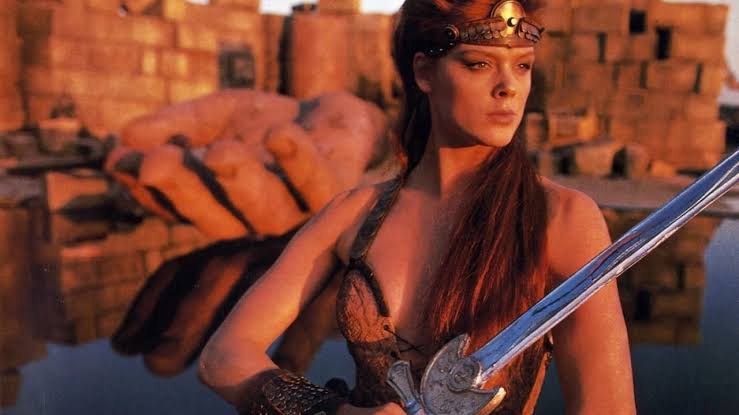
We are introduced early to Gedren, the female tyrant driving the story, whom the film positions as the engine of its world rather than merely an obstacle waiting at the end of a quest. Sonja emerges as the avenging force the title promises, while Kalidor, played by Arnold Schwarzenegger, serves as her valiant traveling companion rather than the lead the marketing implied he would be. Along the way, Sonja encounters Prince Tarn, a young royal displaced by Gedren’s conquest, whose arrival helps assemble the ragtag group that carries much of the film’s second half. That ensemble becomes one of the screenplay’s smartest decisions, giving the adventure a shape and rhythm it badly needs once the revenge premise is established. The problem is that none of these characters has enough interiority to give the journey much emotional weight. The plot keeps moving, but their motives rarely deepen beyond the demands of the quest.
The world-building is unquestionably the film’s strongest asset, a fantasy landscape with genuine scale and a visual confidence that holds up considerably better than the script. The score booms throughout, doing an enormous amount of work to sell stakes the story has not earned and carrying sequences that the staging and performances leave half-finished. Fleischer’s instincts for composition remain evident, and individual frames seem to belong to a far better movie than the one surrounding them. The effects show the film’s age most clearly, with creature work and optical sequences that feel dated even by the standards of 1985. The aesthetic ends up doing nearly all the heavy lifting, which explains why Red Sonja looks so good in stills yet plays so flat in motion.
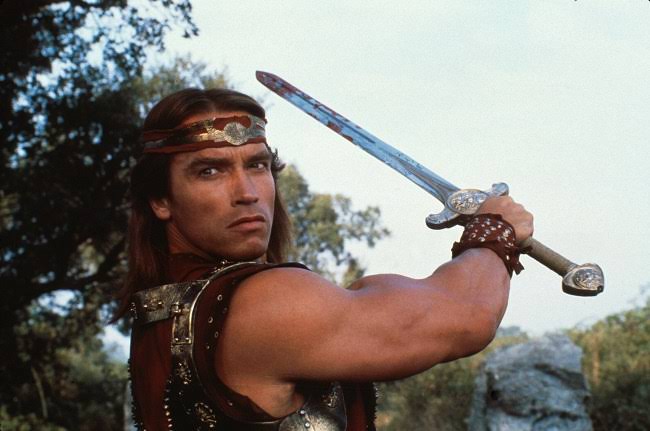
The dialogue is the weakest element in the picture, flat and declarative in a way that leaves even capable performers with little to play. Brigitte Nielsen’s Sonja has real physical presence and the screen command the role demands, but the script rarely gives her a line worthy of either. Schwarzenegger delivers a variation on the persona he had already established in the Conan films, and keeping Kalidor subordinate to Sonja is the right structural decision, even if the film sometimes seems reluctant to follow through. The performances surrounding Prince Tarn and the ragtag group are uneven enough to tip into camp, which offers some enjoyment but often feels at odds with the intended stakes. The writing compounds nearly every performance problem, leaving the cast to supply personality and conviction where the screenplay provides neither.
Red Sonja was created by Roy Thomas and Barry Windsor-Smith for Marvel in 1973, but the film plays far more like a Conan the Barbarian spinoff than a comic adaptation, borrowing its setting, format, and tone wholesale from that franchise. That makes this the completion of Fleischer’s unofficial Barbarian trilogy, following his work on the Conan films, and it is best understood as the third entry in that run rather than as a property with an identity of its own. Brigitte Nielsen essentially won the lottery with the role, landing it after being spotted on the cover of a magazine and changing her name from Gitte to the more internationally usable Brigitte along the way. The film was a gigantic box-office disappointment, drawing praise almost exclusively for its look and genuine hostility for nearly everything else, with Roger Ebert among its loudest critics. It is now regarded as the nadir of mid-’80s fantasy cinema, never achieving the cult status or artistic accomplishment required to stand alongside the films that inspired it, and interest in a remake has steadily soured in the decades since.
Red Sonja is a film with a genuinely good world and almost nothing to put inside it, which is one of the most common failures in fantasy filmmaking and one of the hardest to forgive. Its treatment of women as the actual holders of power in this world is ahead of where the genre stood in 1985 and deserves considerably more credit than the film’s reputation has allowed it. Fleischer’s craft keeps the whole thing afloat visually, but no amount of composition or orchestration can carry dialogue this thin across ninety minutes. There is enough here to recommend it to anyone working their way through ’80s fantasy cinema, provided they go in knowing that the aesthetic is the entire draw. Earning a 55/100 from the TwilightRoom, Red Sonja is a beautifully mounted fantasy picture undone by its writing, a film that looks like the genre’s peak and plays like its floor.
TwilightRoom Score: 55.5/100