The Social Reckoning is a considerably better film than early reactions from its first screenings suggested it would be, but I still came out of it unconvinced Aaron Sorkin
was actually the right man to tell this particular story. There are a slew of genuine positives to cover in The Social Reckoning, and the largest of them by a wide margin is Mikey Madison, who delivers one of the best performances of the year so far as Frances Haugen, a turn so controlled and so removed from her previous major roles that it demonstrates a level of range that solidifies her as one of the best actresses in

Hollywood. The story itself, built around the Facebook Files, is a necessary and timely one, and the film does a good enough job telling it that this lands as a positive entry into today’s climate, regardless of how the execution around it falters. Technically is where this film falls apart. It’s quite a mess, with very little nuance in how it handles its own material, and the time jumps and constant flashes of the part-and-chapter system feel closer to a high school Google Slides presentation than a structural choice made by a working filmmaker, resulting in one of the worst-blocked films of the year. Our Social Reckoning review finds a film far more solid than many other outlets suggest, but one that also struggles in many of the technical areas where its predecessor, The Social Network, excelled. And while the recasting and new additions are brilliant across the board, the switch in directors is a noticeable and unavoidable downgrade.
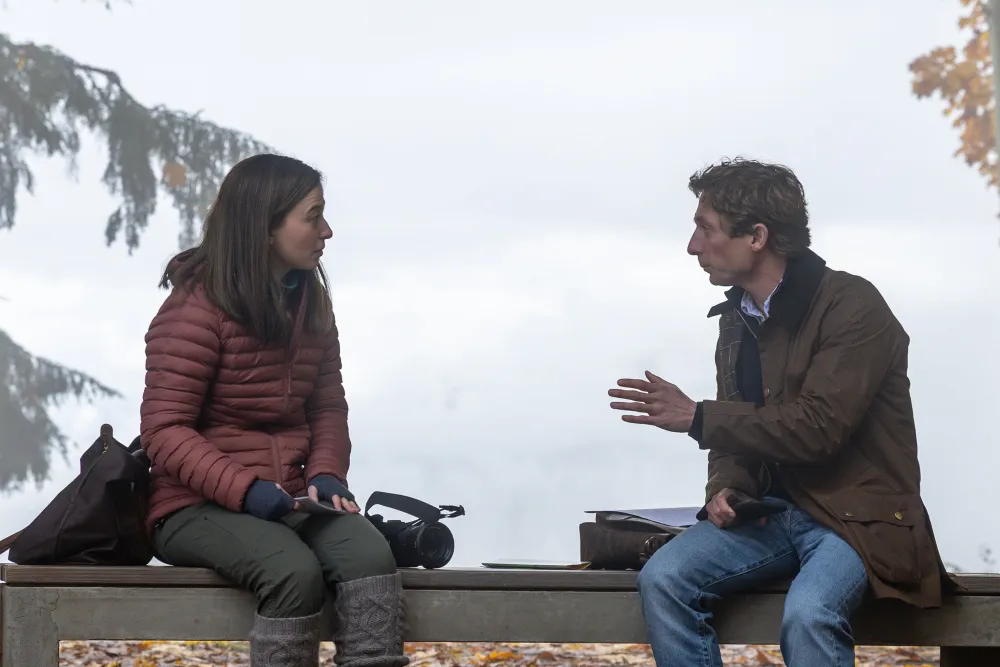
The film picks up at the end of the 2010s and builds itself around the Wall Street Journal exposé known as The Facebook Files, with Mikey Madison’s Frances Haugen as the whistleblower and Jeremy Allen White’s Jeff Horwitz as the reporter she brings her material to, which gives the film a clean two-person spine that it never quite trusts enough to lean on. Structurally, the bulk of the movie is staged as a series of clandestine meetings between Frances and Horwitz, cut against scenes inside Facebook’s executive suite, and the tension in the better stretches is generated almost entirely by how much each of those two people is willing to risk on the other. Jeremy Strong’s Mark Zuckerberg anchors the corporate half, and the film positions him less as a conventional villain than as a man who has built an apparatus so enormous that he no longer needs to personally decide anything for the damage to continue accumulating, which is the most interesting idea it has and the one it commits to least. What it does get right is the sense of scale, the understanding that this story is not about one disgruntled employee but about internal research that an entire company read, understood, and chose to bury, and that element is what justifies the film’s existence. Where it gets shakier is in dramatizing that scale, because a story built on documents and internal findings demands a filmmaker willing to locate visual tension inside paperwork, and this film repeatedly settles for people explaining the stakes to each other instead of finding a way to show them.
Madison is outstanding in a way that recalibrates what you thought she was capable of, carrying the entire moral weight of the film on a performance assembled out of restraint and accumulated exhaustion rather than the big declarative speeches Sorkin would ordinarily hand a character in this position. Jeremy Strong’s Zuckerberg is interesting, a performance operating in a strange, uncanny register that lands brilliantly in some scenes and reads closer to impression than character in others, and how much you take from it depends heavily on how far you want the film to go in indicting him. The recasting across the board is the single most successful decision made here, with every returning role refilled convincingly and every new addition slotting cleanly into a world that could very easily have felt like a thin imitation of a film released sixteen years ago. The dialogue work between Mark, Charlie, Frances, and Nick is where this film is unquestionably at its strongest, four performers locking into Sorkin’s rhythm with enough confidence that those exchanges genuinely play at the level of the original, and almost everything surrounding them feels a bit trivial by comparison. The ensemble is good enough that it ends up exposing the problem, because when the performances are this strong and the film still doesn’t fully land, the failure has to be located somewhere behind the camera rather than in front of it.

The switch from David Fincher to Sorkin himself in the director’s chair is the defining decision of this film and the one that costs it the most, because the original’s precision came from a filmmaker whose entire sensibility was built on withholding, and Sorkin’s instinct runs in the opposite direction in nearly every respect. Jeff Cronenweth returning as cinematographer gives the film a visual continuity with The Social Network that the direction cannot match, which produces the strange effect of a movie that looks like it belongs in this lineage while being staged and paced like something considerably less assured. The constant part cards and the chaptered timeline are the clearest symptom of that, a device deployed so frequently and with so little creative thought behind it that it stops reading as structure and starts reading as an apology, filling in context the filmmaking should have been capable of carrying on its own. The time jumps compound the problem, breaking momentum at precisely the points where the film has finally built some, and the cumulative effect is a movie that keeps interrupting itself to confirm that you have understood what you just watched. None of this scaffolding was necessary either, because the material is strong enough and the performances are good enough that a more patient hand would have arrived at the same destination without any of it, and that is exactly where the gap between this film and its predecessor originates.
The final act is extremely strong and is the point where the film finally stops explaining itself and starts trusting its own weight, delivering the stretch that most justifies the entire project and most clearly reveals what Sorkin was reaching for across the ninety minutes preceding it. It is also hard not to stay locked in once the film reaches that point, which is a very good thing and the clearest available evidence that the problems here are structural rather than failures of material or performance. The messaging is absurdly powerful and, more importantly, real, grounded in documents and findings that actually exist rather than in dramatic invention, and the film’s refusal to soften any of it on the way out is genuinely admirable. This is how you make an audience think, and the closing stretch achieves the thing most films in this genre only gesture toward, leaving you turning over your own relationship to the platform in question rather than simply nodding along to a thesis you were handed. If the whole film operated at the level of its last thirty minutes, the conversation around it would look entirely different, and the distance between that final act and the two that precede it is the most accurate measure of what went wrong here.
Overall, The Social Reckoning is a film worth seeing that could also have been considerably better, and both of those things can be true without one cancelling the other out. Madison’s performance alone makes it essential viewing for the year, and I would be surprised if it isn’t still in the conversation for a couple of nominations when awards season sorts itself out in a few months. The film’s existence as a cultural object matters as well, because a mainstream studio release that puts The Facebook Files in front of a general audience has a value clearly independent of how elegantly it was assembled. However, the comparison to The Social Network is unavoidable and frankly should be made, and the film loses that comparison in almost every category that isn’t casting. The director change, rather than the writing, is where that gap originates. The Social Reckoning is a necessary story told by a filmmaker who could write it better than he could shoot it, carried most of the way by one of the best performances of the year, earning a 78/100 in our TwilightRoom review.
TwilightRoom Score: 78.8/100