This week’s Throwback Thursday has us checking out the newly released 4k limited edition version of Kill Bill: The Whole Bloody Affair, Tarantino’s revenge epic
presented the way he always intended it, a four-hour saga that exudes utter coolness from its opening frames all the way through its final confrontation. Uma Thurman’s turn as the first true action queen mixed with Tarantino’s filmmaking is beautiful, unique, gory, and genuinely awesome, a combination that few films before or since have managed to replicate without taking clear inspiration. Watching both halves as one continuous piece reveals
just how differently the two parts function, with the first half’s pure kinetic revenge fun giving way to a slower, more dialogue-driven second half that tests your patience before rewarding it. The film is at its absolute best when it lets the Bride loose in all-out brawls against other female fighters, sequences littered throughout both halves with fantastic, brutal action that still holds up as some of the most inventive ever staged. Kill Bill: The Whole Bloody Affair is a genuine event of a film, one whose highest highs sit among the coolest and most technically inventive action filmmaking ever put to screen.
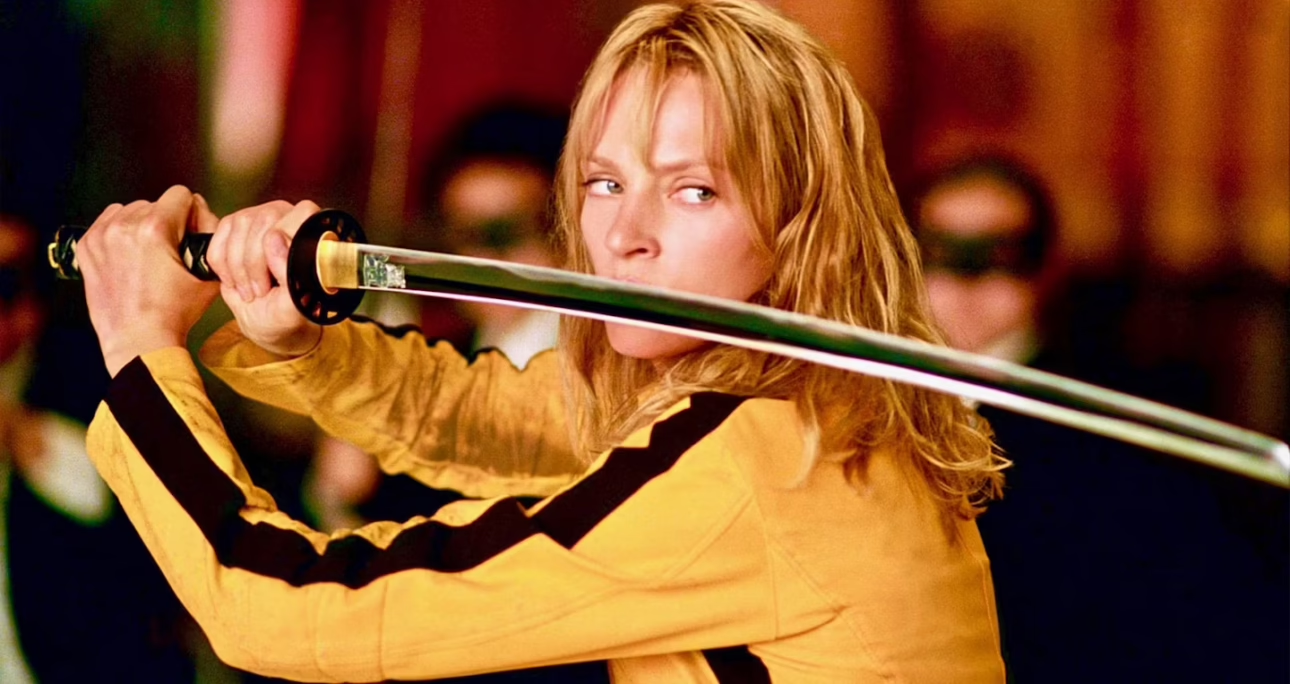
The Bride wakes up from a coma with a hit list and sets out to kill everyone who wronged her on her wedding night and stole her unborn child, a premise as simple as it is endlessly generative for the filmmaking Tarantino builds on top of it. He uses animation to tell backstory here, a choice that kicked off a long line of projects since citing Kill Bill as direct inspiration for doing the very same thing, and he has more fun with sound effects and editing here than almost anywhere else in his entire catalog, playing with the soundboard like an absolute maniac in a way that gives the whole first half its distinct texture. The sword battles land as a combination of beautiful modern action and old wuxia tradition while still feeling entirely unique in their own right, refusing to be a straight homage to either lineage. The dojo sequence, with the Bride in her yellow tracksuit and blood spurting toward the ceiling, is legendary on every front, fantastic action fun that has become the film’s most recognizable stretch for very good reason. The Bride wins that epic battle and moves on to her intended target in the gorgeous snowy outdoor setting just beyond the dojo, yet another legendary film setting, before winning again and threatening the entire chain of names on her list all the way to the top as the first part comes to a close.
The second half opens with a black-and-white flashback to the fateful wedding where everything went so wrong for the Bride, a blunt, direct retelling that reframes everything the first half raced through at full speed. From there, the film jumps to a much more Western setting as the revenge hunt continues, a genre switch that simply doesn’t succeed as well as the first half’s settings did, and it becomes clear pretty quickly that the second part is where the initial revenge fun is done and the Bride must now train to become a better fighter, a necessary story development that nonetheless hurts the film’s pacing considerably. The one-inch punch escape is genuinely fun to watch, but far too much time is spent on it relative to how little it actually advances the film forward. The moment she breaks out of the coffin, though, the film picks up considerably, and Chapter Nine stands as one of the best stretches in the entire runtime. The second half’s much heavier reliance on dialogue and reflection ultimately adds genuine context to the early revenge arc and its action, even if that shift comes at the direct cost of momentum.
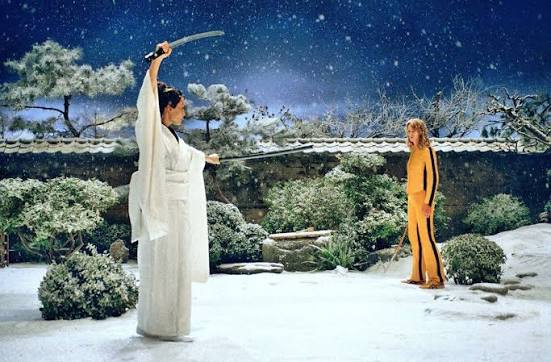
The film is at its absolute best when the Bride has all-out fights against other women, sequences littered throughout both halves with fantastic, brutal, uncompromising action that still holds up decades later. Tarantino’s sound design and editing choices remain the film’s most consistently inventive technical elements, particularly across the first half where he’s clearly having the most fun behind the board. The combination of practical setting work, from the dojo to the snowy garden to the Western stretches of the back half, gives the film an enormous visual variety few four-hour films could ever sustain without wearing out their welcome. The Whole Bloody Affair removes the cliffhanger ending from Volume 1 and the recap opener of Volume 2, bringing the pair together as a single cohesive storyline the way Tarantino always wrote it, and that seemingly small structural change makes a real difference in how the whole thing plays. Watching it this way clarifies exactly how the film’s two halves were always meant to speak to each other, with the slower back half functioning as reflection on everything the first half tore through.
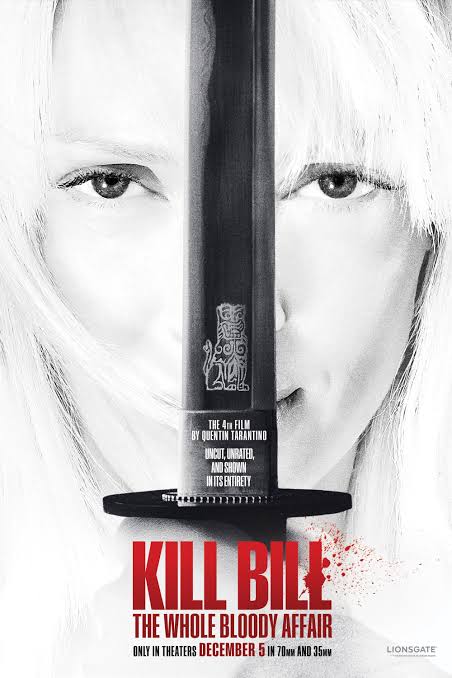
Kill Bill was originally conceived and filmed as a single feature, but was split into two installments during editing to accommodate its epic four-hour-plus runtime, with the parts released six months apart in October 2003 and April 2004. The two volumes were a major box office success, grossing more than $330 million worldwide, and Tarantino has always counted the duology as a single entry within his self-imposed ten-film rule. The Whole Bloody Affair premiered at the Cannes Film Festival in 2004 out of competition, then wasn’t seen again until a 2011 screening at Tarantino’s own New Beverly Cinema in Los Angeles, after which it was vaulted for well over a decade. It became something of a white whale for Tarantino fans across those years, resurfacing only briefly at his Vista Theater in Los Angeles in the summer of 2025, where the theater projected his personal Cannes print, French subtitles and all. Lionsgate finally gave the cut its first ever nationwide theatrical release on December 5, 2025, complete with 70mm and 35mm presentations and a new seven-minute anime sequence never seen before, with Tarantino noting he wrote and directed it as one movie and was glad to finally give fans the chance to see it that way.
Kill Bill: The Whole Bloody Affair finally delivers Tarantino’s revenge saga as the single, unbroken epic it was always written and shot to be and it lives up to every sentiment that has been made about it. The first half remains the stringer stretched by a comfortable margin, powered by legendary set pieces like the dojo fight and a filmmaker having the time of his life with sound and editing. The second half’s slower, more reflective approach hurts the pacing considerably, but it adds real context to the early revenge arc, and Chapter Nine onward is among the best material in the entire film in its execution. The Bride stands as one of the great action protagonists ever put to screen, and Uma Thurman’s performance remains the beating heart holding four hours of gore and style together, into one of the most influential films of Tarantino’s career. The Whole Bloody Affair is a genuine gift to Tarantino fans and a reminder of just how much coolness one filmmaker can pack into a single, blood-soaked epic, earning a 92/100 from TwilightRoom.
TwilightRoom Score: 92.9/100