The first Throwback Thursday review of April comes from a screening I attended at the Western Spirit Museum: one of the greatest Westerns of all time, a film that almost immediately separates itself from the genre’s traditional style through its quiet, realistic tone, slow pacing, and a broken-down visual aesthetic, the 1971 Robert Altman classic McCabe and Mrs. Miller.
It’s not a film that focuses on heroism or clear moral lines, nor does it build to a traditional High Noon–style, clock-strikes showdown, the film leans into the broken- down realism of the West, its ambiguity, and a much larger landscape-grounded depiction of the desperation of frontier life.

Robert Altman constructs a world that feels lived-in and unpolished with his Nashville-esque, overlapping-conversation style, prioritizing atmosphere and character over convention and narrative structure, something he does so well throughout his filmography and so eloquently in this setting. McCabe & Mrs. Miller is a quietly devastating and visually masterful revisionist Western that, through its gorgeous cinematography, intelligent performances, and unconventional Altman storytelling, establishes itself as one of the great films in the genre.
John McCabe arrives in a remote mining town hoping to build a business through gambling and alcohol, preying on the desperate for enjoyment workers and positioning himself as somewhat of an opportunistic but uncertain figure that never truly identifies himself. Similarly and slightly later into the film, as McCabe is building his future, Constance Miller enters the town with a more calculated and business-minded approach, choosing prostitution as a structured and profitable route, creating a partnership with McCabe to build a brothel for the town and a successful business. Their partnership shapes a fake-it-until-you-make-it version of McCabe, creating a complex relationship with Miller that comes to define the broken-down style of the film, establishing both economic success and the foundations for the narrative, but also a looming antagonist end that shows just how brutal the time period is.
The two begin the film as just transactional partners and in many ways remain that way for the entirety of the film, but their relationship slowly builds to something much more emotionally complex, and unexplainable. Their connection avoids traditional romance, instead presenting something so much quieter and restrained, ultimately something more realistic, culminating in a final scene between the two in the bedroom that connects them together in a way, that for the first time is not monetary, but honest. It’s a shift that is essential to the film’s emotional weight, as the moment becomes the catalyst for the final act of snowy gunfight that has made the film one of the most famous of all time.
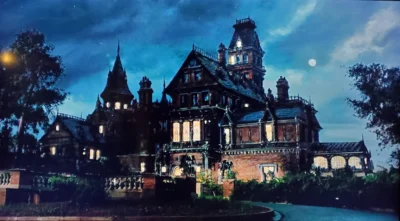
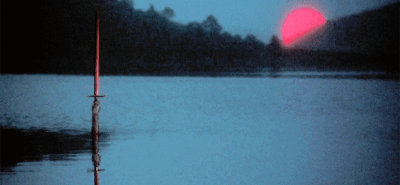
The relationship between Altman’s two characters, while the namesake for his film is so clearly not the only importance of his composition. Altman’ s use of cinematography has always been so real and thoughtful from the Long Goodbye to MASH and Nashville, its brilliance in a realistic bottle and his Western gem is perhaps his best work ever. He creates this version of the American West that feels so separate from Hollywood’s polished imagery, scenes in the pouring rain and snow, shots that dwell longer on the barren lands, and buildings breaking down left and right, not fixed between shots, nothing is ever perfect and that’s what makes it perfect. Natural elements like snow, rain, and mud are used to build this grounded and immersive atmosphere that is shockingly quiet and slow but so intriguing to the eyes of anyone interested in the American past. His visuals alone feel like a defining piece of Western cinema, emphasizing realism, making these characters almost tools to show this passed time.
Alongside this stunning cinematography comes Leonard Cohen’s wise music playing a crucial role in shaping the film’s tone, both with its audio and acting as a smarter, more reflective version of a narrator to the story. The songs provide emotional depth and perspective to the plot, alongside the setting, making Cohen’s integration of music the perfect enhancer for the melancholy and introspective qualities of the Western.
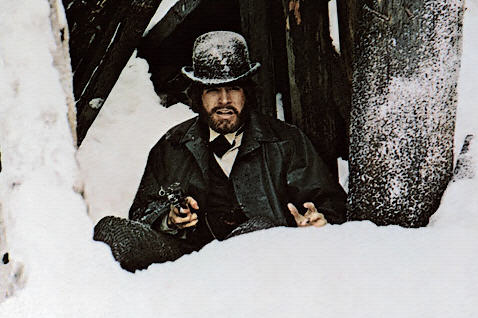
Warren Beatty as McCabe is so reserved by clearly hiding this emotional tension and brilliant in this film, and Julie Christie (Mrs. Miller) delivers an equally great performance that match both each other, and the film’s naturalistic style. The acting from each character outside of its two main roles, whether its an antagonist, passerby, or female worker are so well placed into the film that everything fits the realism vibe, while truly defining the film’s intrigue towards the end of its runtime. The simplicity of every one of their deliveries makes the emotional moments built-up so slowly feel so much more authentic and grounded. The actors perfectly play the behind-the-main-dialogue, conversational style of Altman’s films so well in McCabe and Mrs. Miller using the overlapping dialogue and layered conversation to create an even more in-depth sense of realism and lived-in space for the town. The technique makes the world feel alive in a way that was coined by the director and hardly ever replicated. With multiple interactions happening at once, rather than a single focused narrative thread, it reinforces the idea that the story is simply part of a larger functioning environment of a picked-out mining town from a piece of history.
The film’s first half requires an audience that’s attentive and prepared for its rhythms, making it more likely to be a second or third Altman recommendation from the TwilightRoom. The slow pacing requires patience, but is essential to building atmosphere and the stakes to deliver one of the most spectacular endings in film. The final 40 minutes deliver a perfectly-executed payoff, with tension building into an iconic snow-covered climax that separates it from the rest of its genre, set up by its slow beginning. The closing sequence, particularly the snow chase, stands as one of the most effective and memorable endings for not only its narrative plot and faux-death shootout, but also for the filmmaker’s choice to stage it in pounding snow and fully use the harsh, physical environment of the set. It’s an ending that contrasts the chaos of violence brought into the town by the group of antagonists with the quiet continuation of life in the town, working together to put out a church fire, reinforcing the film’s themes of isolation and insignificance, even in the face of danger. The emotions; and visual impact of the ending solidified the film’s lasting power.
McCabe & Mrs. Miller is a wonderfully depressing and atmospheric, cinematic masterpiece that fully rewards the patience it demands from its audience. Through Robert Altman’s direction, the film separates itself from traditional Westerns, leaning into realism, tone, and subtle character work rather than spectacle or heroism. Its slow pacing may not connect with everyone, but with full attention, it reveals itself as a deeply immersive and carefully constructed experience. By the time the final act unfolds, the film cements its place not just as a great Western, but as one of the best the genre has ever produced, earning it a 94/100 from the TwilightRoom.
TwilightRoom Score: 94.7/100