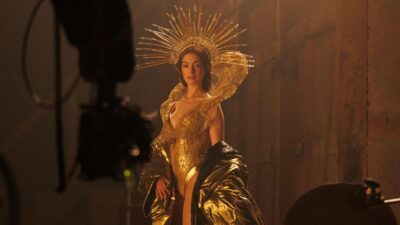
This week’s Throwback Thursday review comes from a recent 4K release from Arrow Video of the dark fantasy camp classic from 1981, Excalibur.
Excalibur presents itself as a sweeping retelling of the King Arthur legend, embracing a dark, medieval fantasy tone that has become that of a trend on social media, immediately separating itself from more polished and modern adaptations that aren’t as fitting. John Boorman, the director, leans heavily into the myth from 1451 here, using symbolism, and operatic storytelling to craft a film that feels

larger than life, and gorgeous, even when some of its execution falters. The film truly has endured the test of the last 45 years as this camp classic, not because of its performances or writing, but because of its commitment to its eerie atmosphere and legend. Excalibur is an ambitious and visually-striking telling of Arthurian legend that thrives on its mythic storytelling and dark fantasy aesthetic, but is held back from being a masterpiece by its uneven performances and often clunky dialogue, resulting in a flawed yet enduring throwback classic.
The film ambitiously covers Arthur’s entire journey, from his origin of birth through Merlin’s deal with Uther, to his rise as king pulling Excalibur from the stone, and ultimately his downfall at the hands of his sorceress sister and their malevolent son. Key moments such as his duel with Lancelot, the formation of the Round Table, and the tragic, almost Shakespearean love triangle with Guinevere provide some of the film’s most faithful adaptations of the nearly 600‑year‑old Arthurian tales. The wide scope of the film gives it an epic, fairy‑tale adventure vibe while maintaining a darker, more adult tone, forcing it to move quickly through major narrative beats yet preserving the same eerie energy throughout. Additionally the film pulls heavily from its source material, which to me is a positive, presenting a largely faithful adaptation of the Arthurian legend that is tremendously entertaining. However, this faithfulness comes at a slight cost of added depth or reinterpretation. Boorman really plays it safe with his storytelling and character development, not making any real changes to the narrative to update the old story. Maybe that’s a good thing that made the film better, but It just feels like a safe swing that prevented the film from achieving higher heights. The film really plays more like a visualized myth of the story packed into a brisk two‑and‑a‑half‑hour runtime than a fully developed narrative, which again works for tone and vibe but limits any real new impact to audiences that are familiar with the legend.
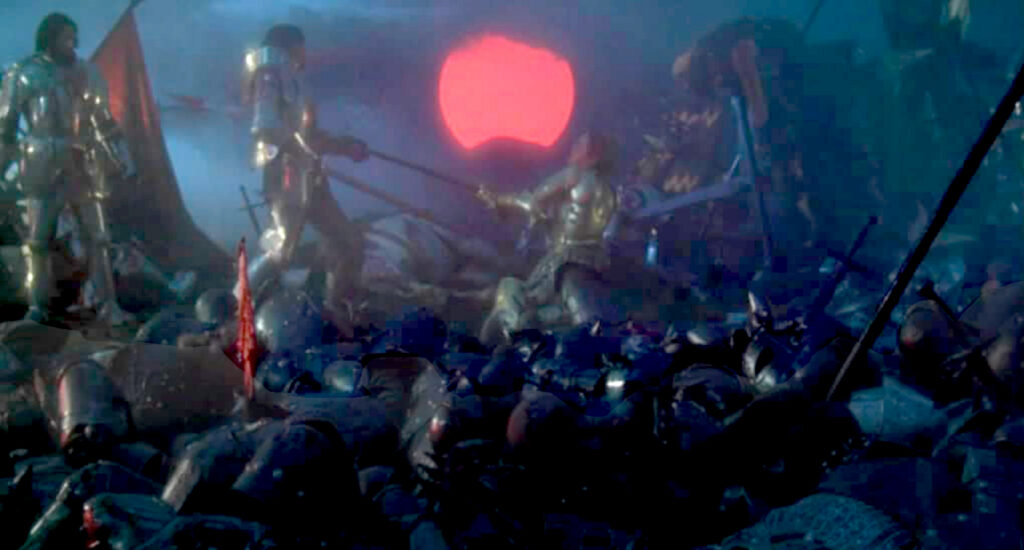
The best attribute of the film is clearly in the dark fantasy aesthetic with old castles, a red sun, and the dragon’s breath mist, it’s an iconic element that captures the medieval world in a much more adult way that feels perfectly grim and mythical. Cinematography, armor design, and major set pieces all contribute to this visually immersive experience that constantly is seen referenced and reinterpreted in films to this day, and is one of the most memorable vibes of all time. The final battle in particular, Arthur versus his son/nephew Mordred in the red sun setting, is gorgeous, starting out as one of the most striking sequences in the film.
Inversely, the clear most inconsistent and aged portion of the film across its runtime is the many common and dull acting performances that come off stiff and lacking in emotion that can pull the audience straight out of the film. Dialogue and writing often feels admittedly lazy for a review that rates the film so high from us, it feels awkwardly or overly theatrical, on this border of whether the film is enjoyably campy or poorly-aged campy. While the performances and dialogue do add to the film’s cult identity and love, it also really hinders the ability for the film to deliver to audiences that aren’t quite down for the aesthetic or legend it is portraying, it cuts the audiences that love the film a bit.
Arthur’s journey in the film from boy to king alongside the wizard Merlin is compelling conceptually, the entire way, particularly his struggle to earn legitimacy as a strong and independent king and lead figure. The relationship between Lancelot and Guinevere introduces an emotional conflict that pushes Arthur to a breaking point, as he gradually loses his love for his wife, his greatest champion, and his closest friends. The triangle lacks the depth needed to fully resonate and raise the stakes, but Lancelot’s return and the addition of Perceval help complete Arthur’s arc and ultimately bring the audience back around. One of the standout performances that is extremely up and down in delivery is Merlin. Central to the story as a character that is all- knowing, but also refuses to reveal information, may be a conscious decision, but one that really took me, as a viewer, out of the story.
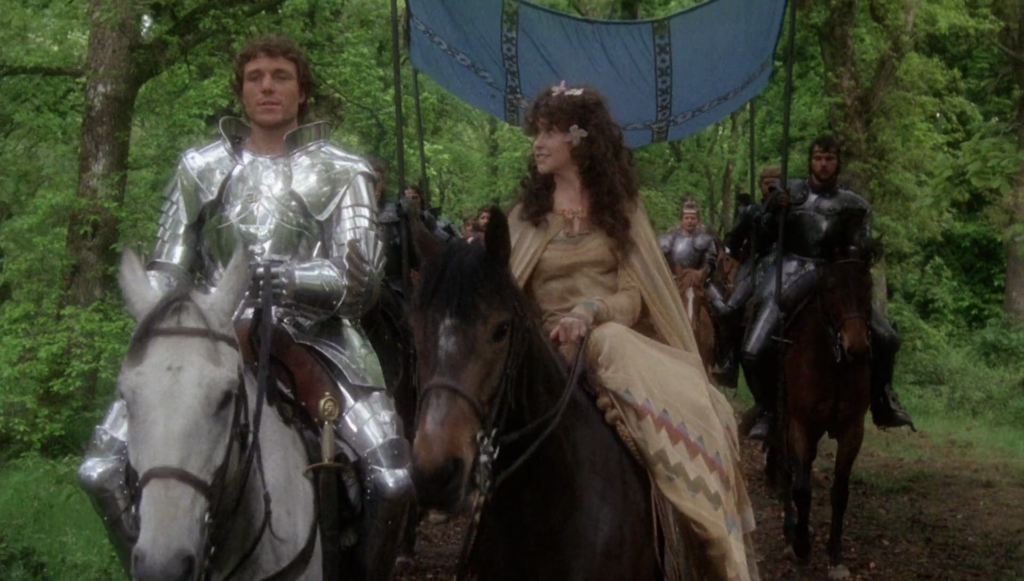
Overall, despite these inconsistencies, we at the TwilightRoom value a story that can fully-commit to its tone, and Excalibur does just that, blending serious adult mythological storytelling, with moments that come across as campy. The duality defines its identity, making it both immersive and unintentionally humorous at times, it’s a product of its era, embracing a style that feels distinctly ’80s while remaining rooted in ancient myth. Excalibur continues to remain influential in shaping the dark fantasy genre beyond its original time frame, paving the way for future medieval epics. Its visual style and commitment to myth have allowed it to stand the test of time, flaws and all. A film that demands to be experienced on its own terms, within its built world, rather than judged strictly by modern standards of criticism, so that’s how we’ll rate it.
Excalibur succeeds in creating a rich, immersive mythological world that perfectly fits the dark, eerie fantasy vibe I know and love, anchored by striking visuals and legendary sword‑wielding source material. Its weaknesses in performance and dialogue prevent it from true greatness in the film world, but do little to diminish its lasting impact on culture. Ultimately, Boorman’s epic stands as a flawed, yet iconic fantasy epic, one that continues to resonate as a defining throwback in the genre earning it an 84/100 from the TwilightRoom.
Twilight Room Score: 84.1/100