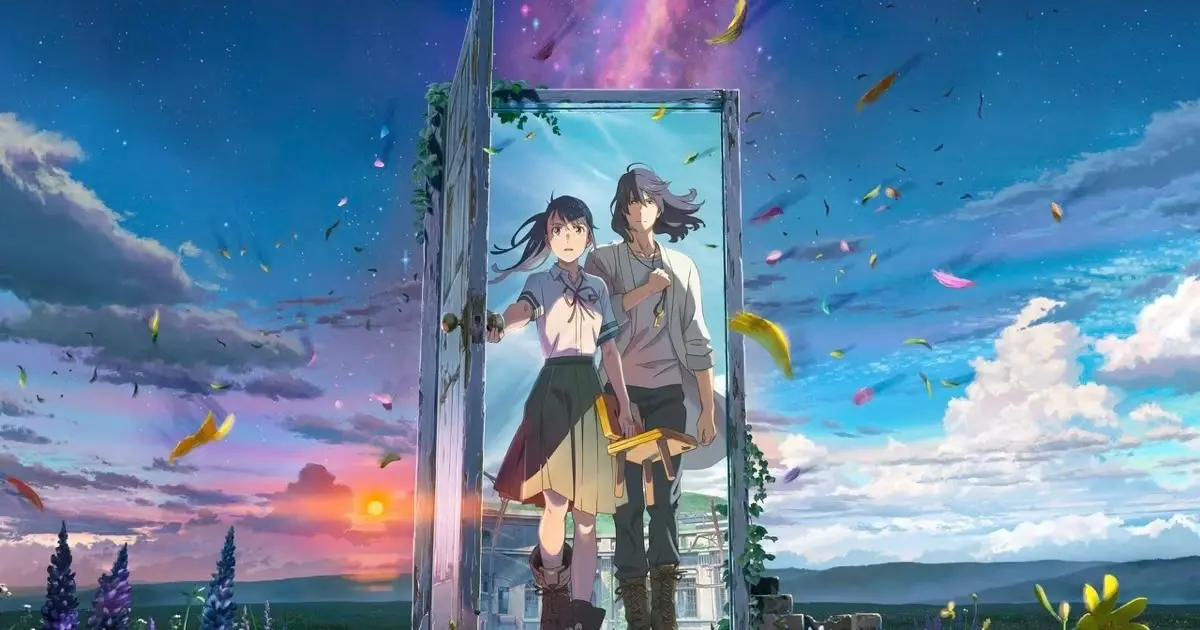
This week’s Throwback Thursday revisits Mikoto Shinkai’s Suzume (2022), the film that most completely earns the emotional swings he has been building toward for a decade.
It is the one entry in his disaster trilogy that falls in love with its own story rather than simply constructing it around a premise. The animation, as expected, is beautiful from the very first frame, using greens, blues, and starlight to assemble one of the most distinctive color and animation identities anime has produced in recent decades, rivaling that of the Ghibli films. What separates Suzume from its predecessors, Your Name and Weathering with You, is how completely
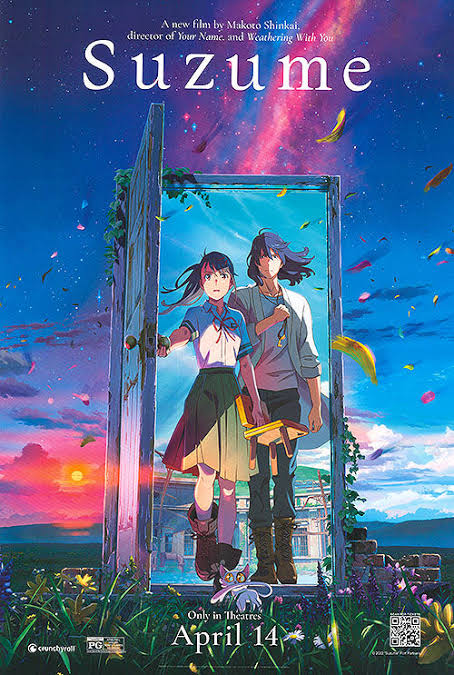
it commits to the bond at its center along with its adventure, finding real emotion in the journey and in the strangest possible setup, and never once treating that strangeness as a joke. The film is wonderful at combining an illuminating score, gorgeous galaxy-esque visuals, and emotion-packed dialogue to make the audience feel something, and it is just as impactful and monumental on a rewatch as it was the first time. Suzume is Makoto Shinkai at his most confident, taking a premise of beauty that should collapse under its own adventure and yet delivering one of the most elegant films of the decade.
The opening of Suzume is so casual it barely registers as a beginning, with Suzume giving directions to a young man named Souta Munakata she passes on the road before curiosity pulls her into a set of ruins in the forest and toward a lone open doorway. That setup is Shinkai at his most patient, letting the ordinary sit there long enough to matter before anything supernatural arrives to disrupt it. Then a mysterious cat turns Souta into a talking chair, a decision so bizarre that it should break the film entirely and instead becomes the exact thing that makes it work. Souta, now a three-legged chair, and Suzume set off chasing the cat across Japan, closing doors to stop a giant worm that only the two of them can see from unleashing catastrophe, and bonding steadily along the way. It’s a premise that no other filmmaker working today would commit to this completely, and the refusal to ever wink at it is why the emotion underneath holds.
The color work is Suzume’s signature and the thing that will keep it in conversation decades from now, with the greens of the countryside, the blues of water and sky, and the starlight of the Ever-After producing images instantly identifiable as nothing but Shinkai. The score is illuminating in the truest sense of that word, lifting sequences that would be merely gorgeous into something closer to overwhelming, and it never once overplays a moment that was already working. The galaxy-esque visuals during the door sequences are the clear peak, rendering a space that feels suspended outside of time without ever losing the human scale of two small figures standing inside it. The dialogue is emotion-packed without tipping into the overwriting that has occasionally undercut Shinkai’s work, and here it does real labor in making an audience feel rather than simply understand. Every element is calibrated to land as hard on a second viewing as on the first, which is the surest evidence of how carefully the whole thing was built.
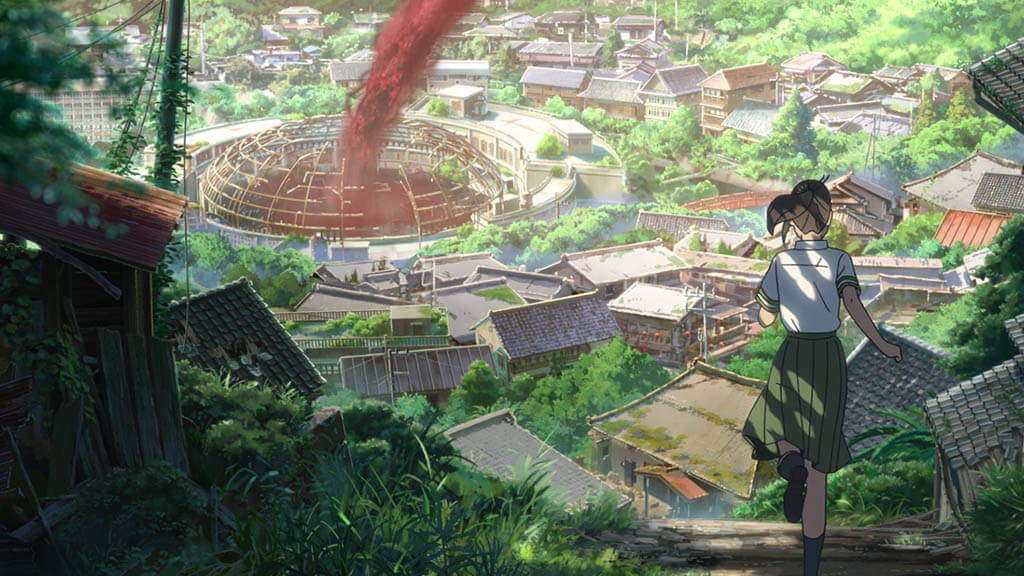
The turn that reframes everything arrives when Souta becomes the new keystone sealing the worm, and the film reveals that Suzume has been connected to all of this since she was a child. Her decision to save him transforms the road movie into something far more personal and far more urgent, shifting the film’s center of gravity entirely onto her. As Suzume travels toward the final door, Shinkai builds his climax around her rather than around the disaster itself, which is precisely the instinct he had been circling in his previous two films without ever fully committing to. The result wins the audience’s heart with a romantic story while simultaneously bringing Suzume’s own life full circle in a graceful way. That double movement, closing a love story and a childhood wound in the same breath, is the most sophisticated thing Shinkai has ever constructed, and it earns both its tears and its catharsis without reaching for either.
Suzume is the third entry in what has been labeled the Shinkai disaster trilogy alongside Your Name and Weathering With You, all three sharing a preoccupation with natural disaster, grief, and the fragility of ordinary life. Shinkai has admitted the films process collective national anxiety about catastrophe through the lens of young love and adventure, and Suzume is by far the most in love with that idea of the three. Your Name made him internationally known and generated enormous expectations for this film, which he deliberately steered in a different direction by refusing to simply produce a copy of what had already worked. It became the first Japanese animated film placed in competition at the Berlin International Film Festival since Spirited Away in 2002, which says everything about the weight attached to its release. The film grossed $315 million worldwide, making it the fourth highest grossing anime film of all time at its release, and picked up a Golden Globe nomination that year.
Suzume is Makoto Shinkai’s most complete work, a film that takes a genuinely ridiculous premise and builds something deeply moving out of it without ever apologizing for the strangeness. The color identity, the score, and the galaxy-esque door sequences give it a visual signature that nothing else this decade has matched outside of Ghibli. The bond between Suzume and Souta is the engine of everything, and the keystone reveal paired with her own childhood connection recontextualizes the entire journey in a single stroke. Bringing her life full circle alongside the romance remains the most elegant structure Shinkai has ever assembled, and it holds up completely on a rewatch. It solidified him as the only director who could rival Miyazaki in consistent identity and style while producing entirely independent stories, confirming him as one of the best working anime directors, earning a 88/100 from the TwilightRoom.
TwilightRoom Score: 88.8/100