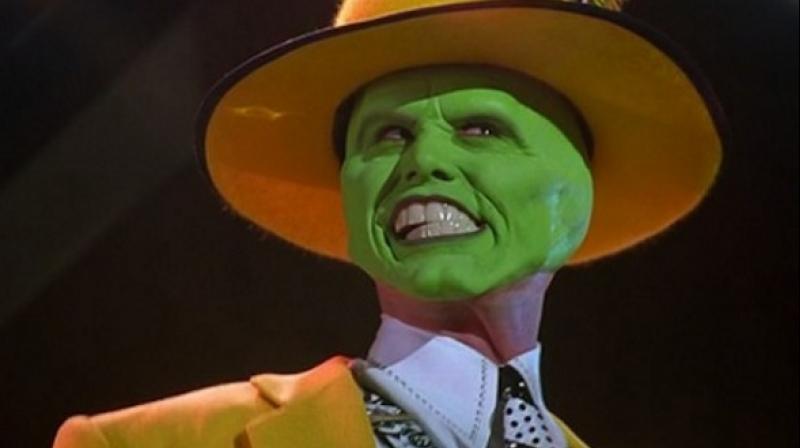
The Mask is Jim Carrey at the absolute peak of his career, arriving at the precise moment where audiences began to realize he could really act while also accepting that he might
be the funniest actor of the entire decade, and there is something remarkable about a film that serves as evidence for both claims at once. I came back to it for a Throwback Thursday but also because I recently picked up the 4K Arrow Video release, and those two reasons ended up compounding on each other in a way I didn’t expect, because watching a film you already know well in a presentation that fundamentally changes how it looks provides an enormous amount of context for why
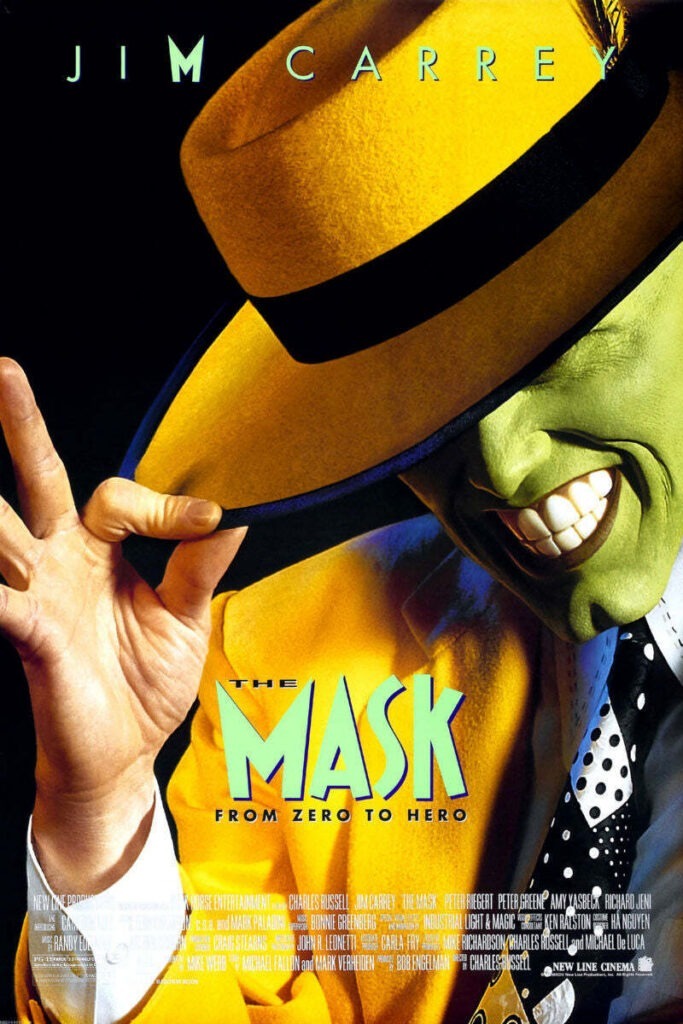
it worked so well in the first place. The first thing that becomes obvious is how strong the nostalgia here still is, with a 1994 film that remains endlessly quotable and genuinely hilarious rather than merely fondly remembered, which is the exact line that separates a film people have warm feelings about from a film that actually earns its standing as a classic of the 90s. The second is that this has one of the most uniquely chaotic and creative color schemes ever put on screen, a palette that was always doing far more work than it got credit for and that the 4K transfer finally delivers at the intensity it was built for, turning what used to read as dated 90s excess into something closer to a deliberate and fully realized visual identity. I will forever love Jim Carrey, and watching this again only reinforced that The Mask will always stand as one of his greatest comedic performances, a film that belongs permanently in the canon of 90s comedy no matter how the critical conversation around him shifts from one decade to the next.
Stanley Ipkiss is a bank teller with no leverage over anything in his own life, a man so thoroughly overlooked that the film’s opening stretch plays almost as a catalogue of small humiliations, culminating in his being turned away at the door of the Coco Bongo while the city’s more glamorous residents stream past him without a second look. The mask he eventually pulls out of the river isn’t really a superhero origin so much as a permission slip, transforming him into a stylized, green-faced spirit figure and doing less to grant Stanley powers than to strip away every social restraint he has ever operated under. What makes the premise work far better than it has any right to is that the transformed figure is the direct opposite of Ipkiss in every measurable way, which turns the whole film into a genuine identity crisis rather than a simple fantasy about becoming cooler overnight. Stanley spends the middle section trying to navigate the cartoon logic of his own transformation, repeatedly discovering that the mask solves his immediate problems while generating considerably larger ones he has no capacity to handle the moment he takes it off. The back half puts him at the mercy of genuinely bad people and eventually lands him in a jail cell once the mask has been taken from him, which is the point where the film quietly admits that the power was never actually his to control.
This is the most complete delivery of the specific thing Carrey does better than anyone, a performance built entirely around the erasure of physical limits, where every joke lands because his body genuinely appears to be operating outside the rules the rest of the frame is following. The dual-role structure also gives him something real to act against, and the Ipkiss half is far more carefully modulated than it tends to get credit for, a small and defeated man whose smallness is precisely what makes the explosion of the other half register as release rather than noise. The film also features a romantic setup that recurs across nearly all of Carrey’s comedies from this era: the love interest who turns out to be compromised, and the second woman essentially taken from the antagonist, a structural habit that by this point functions almost as a signature of his 90s output. Cameron Diaz’s Tina Carlyle supplies the film’s other spark, and the chemistry between the two of them is loose and genuinely playful in a way studio comedies of this scale rarely manage, particularly between a comic lead working at full volume and a straight presence who has to absorb all of it.
Watching it now, the performance reads as both a peak and a trap, the purest version of what Carrey was capable of in this register and the exact thing he would spend the following decade deliberately working against.
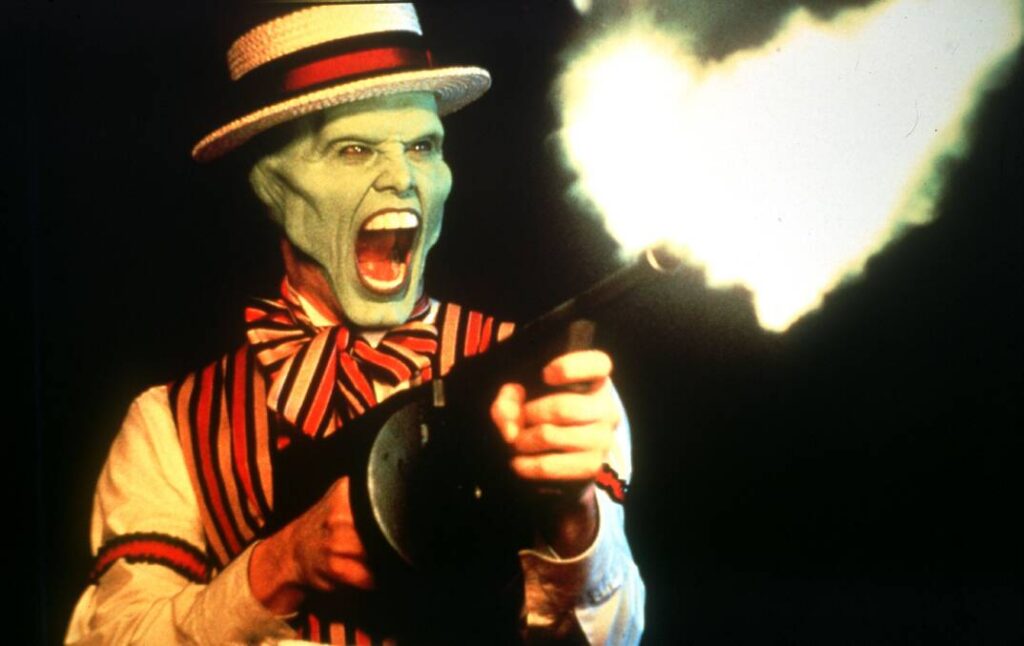
The visual effects were split between Industrial Light & Magic and Dream Quest Images under an unusually specific brief, translating rubber-hose 1940s cartoon animation into live action rather than assembling the usual catalogue of early-90s digital spectacle. That distinction is why the stretched face, the 360-degree head spin, and the impossible objects produced from the mask’s pockets still land, because all of them exist to enhance and physicalize something Carrey was already doing rather than to manufacture something his performance couldn’t support on its own. The color design is the element the Arrow 4K release most dramatically rehabilitates, a palette that commits to garishness as an actual aesthetic principle and uses the mask’s green as the anchor the rest of the frame gets organized around. Carrey’s daily makeup application ran four hours and was designed by Greg Cannom, a multiple Academy Award winner, and the practical craft in that prosthetic is a large part of why the character reads as a physical presence in the room instead of a digital overlay dropped on top of the shot. Several effects sequences were cut during production once the budget proved insufficient, which means the finished film is technically a reduced version of what was planned, and the fact that it still plays as maximalist says a great deal about how much of the energy was coming from the performance rather than the money.
The film is loosely adapted from the Dark Horse Comics series of the same name, which was considerably darker and more violent than anything that reached the screen, built around a genuinely murderous protagonist whose Mask-fueled rampages left real casualties behind them. The decision to shift the tone from horror-comedy to pure slapstick cartoon was driven by the casting of Carrey, with director Chuck Russell and screenwriter Mike Werb essentially rebuilding the concept around Tex Avery-style animated comedy once he came aboard, which stands as one of the clearest cases on record of a single performer dictating a film’s genre. Tina Carlyle was Cameron Diaz’s first film role, landed with no professional acting experience whatsoever after she attended the audition on her modeling agency’s advice and sat through roughly a dozen callbacks, and the fact that two future superstars broke out in the same production remains one of the more remarkable casting coincidences in modern Hollywood. Made for $23 million against a worldwide gross of $351 million, it was the most commercially successful of Carrey’s three 1994 releases, picked up an Academy Award nomination for Best Visual Effects that it lost to Forrest Gump, and helped earn Carrey both a Golden Globe nomination and a Razzie nomination for Worst New Star in the same season, a contradiction that captures exactly how divided critical opinion was about what he was doing while audiences voted unanimously with their wallets. The film is also credited with feeding the 1990s swing revival, as the Coco Bongo sequences and the big band soundtrack introduced an entire younger audience to the genre, and the movement that followed in the mid-to-late 90s, the Cherry Poppin’ Daddies and the Brian Setzer Orchestra included, draws a traceable line straight back to the film’s stylistic choices.
The Mask has long since settled into its place as the definitive showcase for Carrey’s particular gift, the purest possible delivery vehicle for a comic personality constructed entirely around the removal of physical limits. It is also the film that most completely translated the anarchic energy of golden age animation into live action, and its influence on the following decade of superhero comedy and live-action cartoon filmmaking is direct and easy to trace. Its most durable contribution may be the proof that digital effects could be deployed in service of a comic performance rather than pure spectacle, a template that has been imitated constantly in the more than thirty years since and matched almost never. The 4K presentation is the right way to revisit it now, not because the film ever needed rescuing but because the color work was always the most underappreciated thing about it, and this is the first time it has been possible to see it the way it was meant to be seen. Earning an 87/100 in our TwilightRoom review, The Mask remains a cornerstone of 90s comedy and home to one of the greatest comedic performances of Jim Carrey’s career, a film whose nostalgia is fully earned.
TwilightRoom Score: 87.0/100