
Digger is the rare film that refuses to leave your head without ever letting you articulate why, lingering for two hours like a word on
the tip of your tongue you cannot name but can never forget, and even after writing this Digger review, we have not settled whether that effect is torture or brilliance. Alejandro G. Iñárritu has made an enormous, unmistakable choice here, committing Tom Cruise and his entire film to an absurdist satire register that very few filmmakers at his level would be willing to risk after so much success in their careers. The execution of this giant swing is where the film falters though, because
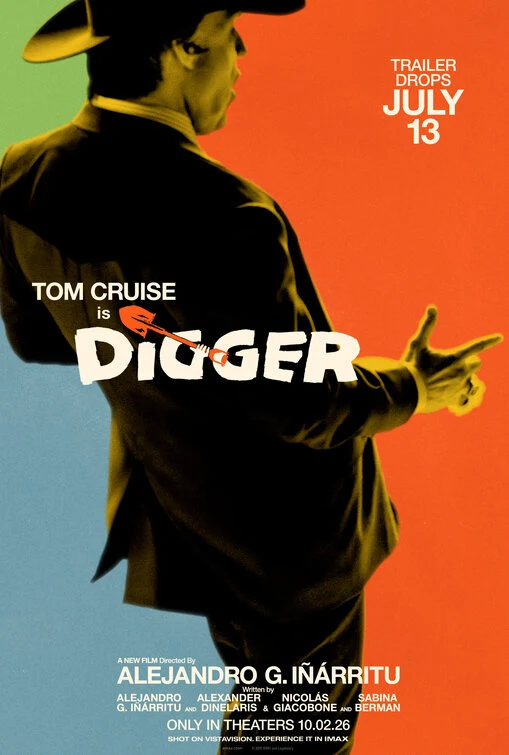
Iñárritu seems unable to trust his audience to arrive anywhere on their own and insists on explaining the film through constant monologues as the plot moves along a bumpy road. Technically, the film is undeniable, one of the director’s most impressive pieces of filmmaking, as the editing, camera work and angles, as well as the choreography in larger scenes all demonstrate year-leading brilliance. Here is a director completely in command of the medium he is telling his story within. This is a hard film to pinpoint, and our Digger review lands uncomfortably in the middle, a film too intelligent to dismiss, but perhaps also too intelligent for its own good, more pleased with itself than its audience is, with a Tom Cruise performance that promises much more than it delivers.
The premise here is vicious enough to carry a great film, and for stretches it very nearly does. Tom Cruise plays Digger Rockwell, an oil magnate racing to install himself in history as the man who saved humanity from a catastrophe he personally set in motion, and Iñárritu wraps that around a story nested inside a satirical stage play, Fossil Fools, that keeps pulling the ground out from under you without ever fully clarifying which layer you’re meant to believe. Riz Ahmed’s scientist, John Goodman’s president, and Sandra Hüller’s half-sister each embody a different variety of complicity, and the movie is at its most alive when it simply lets them exist in the same room as Digger rather than stopping to explain what each of them represents. That restraint is exactly what the script keeps refusing to maintain, interrupting its own momentum to deliver another speech instead of trusting the situation to generate pressure on its own. Somewhere inside all of this is a genuinely cutting film about a man convinced that his solution counts as an apology, and the screenplay buries it under commentary it never needed to write.
Whatever its problems, Digger is a technical achievement, and the single coolest thing it does is move between its nested universes mid-scene. Every one of those transitions arrives without warning and leaves you curious about which reality you’re going to emerge into on the other side, a trick few films this year have tried at this scale. Iñárritu’s handling of the shift between ordinary life and full catastrophe is magnificent, and those passages supply all the energy the dialogue keeps draining away. Shot by Emmanuel Lubezki on 35mm VistaVision, the film features consistently outstanding camera angles and choreography, and from a purely technical perspective, this sits comfortably among the best-made films of 2026. The frustrating part is that the craft actually sharpens the disappointment, because you can see exactly how great this could have been with a tighter screenplay underneath it, and for a film so beautifully assembled, it’s remarkable how few answers it offers to the enormous questions it spends two hours fabricating.

Riz Ahmed is the best thing in this film and makes a legitimate case for being better than Cruise, bringing a precision and a stillness that cut cleanly against all the excess happening around him. Jesse Plemons is right there with him, though when his own monologue finally arrives, he’s hammering a nail that’s already fully in place, which is a failure of the screenplay rather than anything he’s doing. The uncomfortable truth is that Ahmed, Plemons, and Goodman collectively build the pedestal that elevates Cruise, and the endless praise his performance is about to receive owes far more to the monologues and the delivery surrounding him than to the work itself. His one truly electric moment is the courtroom rant, which is the strongest sequence in the entire film and will almost certainly be the point of emphasis in Oscar contention this awards season, if Digger and Cruise get that far. Across the board, the ensemble is doing excellent work, and that’s the clearest evidence that everything wrong with Digger is structural rather than performative.
The reliance on monologue is the defining flaw here, and it’s an absurd one, turning what should have been a propulsive satire into a sequence of speeches with scenes assembled around them. As a result, momentum stalls, leaving a two-hour film that feels considerably longer and never builds the escalating pressure its premise so obviously demands. The quirkiness that should have been Iñárritu’s weapon curdles into indulgence once every idea gets stated aloud rather than dramatized, and the spoon-feeding becomes impossible to ignore by the midpoint. The final act is where it comes apart entirely, undoing a substantial portion of the goodwill the craft had earned and failing to land a single one of the swings it spent the previous ninety minutes setting up. For now, our Digger review finds the chaos more negative than positive, though this is the kind of film that may play very differently on a second viewing we’re in no particular rush to take.
Digger is Iñárritu making a decision and following it all the way to the bottom, which is admirable as a principle and exhausting as a film experience. The nested universes of the play within the film give Digger its most distinctive editing, and the camera work and choreography are excellent, proving again that Iñárritu and Lubezki can build a film even when the writing works against them. Riz Ahmed is phenomenal in his role, Jesse Plemons is right behind him in a smaller part, and together with John Goodman, they prop up a Cruise performance destined to be praised well beyond the solid performance it is. The monologue dependency, the stalled pacing, and the rough final act keep this well below the ceiling its technical work suggests. Digger sits right in the middle of our yearly rankings with a 67/100 from TwilightRoom, a disappointing result for one of the most anticipated films of the year.
TwilightRoom Score: 67.7/100