Sansho the Bailiff is one of the most devastating films ever made and the clearest argument for Kenji Mizoguchi as the most complex director of his era, a filmmaker
considerably more difficult to categorize than either Ozu or Kurosawa. The setting and the cinematography are fantastic throughout Mizoguchi’s 1954 film, but what actually makes Sansho great is the intricacy Mizoguchi brings to a lifelong tale about a family that is constantly and relentlessly separated, pulled apart again and again across decades until almost nothing is left to recover. It plays as deeply

reflective rather than conventionally dramatic, focusing nearly all of its attention on family, loyalty, and the survival of mercy through sustained hardship. The music and score are ethereal from the first scene to the last, running from the song sung by the two siblings’ mother that eventually reconnects Zushio to her, to a score that frames the tragedy with a restraint most films of this scale never manage. Our Sansho the Bailiff review finds a beautiful and devastating story packed with emotion and legacy in equal measure, one of the defining achievements of Japanese cinema.
Set in Heian-era Japan, the film follows a family separated from their father and husband for political reasons, traveling across the country to reunite with him after years apart. During the journey, the children are separated from their mother, Tamaki, when the group is tricked by a boatman, and Tamaki is sold as a courtesan on a nearby island while her children are taken somewhere else entirely. The two of them, Zushio and Anju, are sold to Sansho, a bailiff who treats them as slaves, though Sansho’s son Taro quietly devises a plan for the children to leave once they’ve grown old enough to attempt it. The film then jumps ten years forward, and the gap between the siblings is immediate and devastating, with Anju still holding on to her father’s stories about mercy and yearning to escape while Zushio has been hardened by Sansho into exactly the kind of man he once hated and despised. That divergence between brother and sister becomes the engine of the entire film, and Mizoguchi lets it build with a patience that makes everything following it almost unbearable to sit through.
The film frames what Zushio’s father tells him before they leave as its entire guiding force: without mercy, man is like a beast; men are created equal; and no one should ever be denied happiness. Everything that follows gets measured against those words, with Zushio’s hardening under Sansho representing the complete abandonment of them and his eventual return representing their recovery at a cost almost too large to name. Anju’s decision to stay behind and walk into the lake so her brother can escape is one of the most devastating concepts a film had produced up to that point, and the full motive behind it reframes the entire story the moment you understand it. That choice, and the way it forces the route Zushio takes afterward, is always and rightly discussed as one of the key moments that make this film a masterpiece. Mizoguchi never once sentimentalizes any of it, which is precisely why mercy registers here as something genuinely costly rather than comforting.

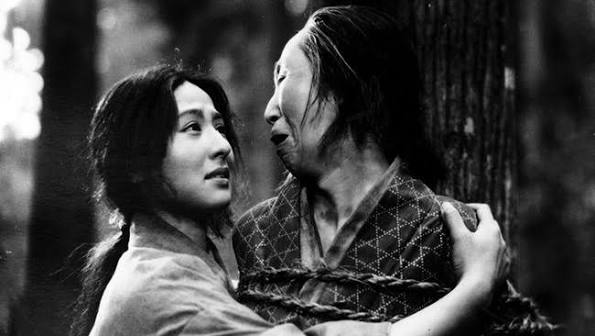
Zushio eventually recovers his sense of mercy and escapes, with Anju staying behind to protect his flight. After escaping, he learns that the father his family went searching for in the first place has already died, which empties out the entire premise of their journey in a single line. Anju drowns herself to protect him, and Zushio in turn comes to govern the very province where Sansho’s estate sits, moving to abolish slavery before learning of his sister’s death after freeing the slaves. Fearing and then hearing that his mother is dead as well, he finds a blind woman on the beach who turns out to be her, and she praises him for having acted under his father’s teaching. It is a reunion that offers no relief whatsoever, only the confirmation that the cost of becoming the man his father described was everything he had left to lose.
After the release of The Life of Oharu, Ugetsu, and Sansho in close succession, Mizoguchi became one of the most critically acclaimed Japanese directors ever, celebrated especially by the critics and directors of the French New Wave. He stands as one of the most complex and hardest-to-pin-down filmmakers of his era when set beside Ozu or Kurosawa, with a body of work that actively resists easy summary or categorization. Sansho the Bailiff was his eighty-first film, part of an extensive catalog, and his late career is unmistakably where he was operating at his absolute best. The film is based on a short story by Ōgai Mori, with the general plot edited considerably for the screen to fit Mizoguchi’s own style and thematic preoccupations. That reshaping is a large part of why the film works as well as it does, since he rebuilt the material into something constructed entirely around separation, endurance, and the slow erosion of a family across a lifetime
Sansho the Bailiff is a beautiful and devastating story packed with emotion and legacy, and one of the great achievements of 1950s cinema in any country. The setting and cinematography are fantastic, but the intricacy of this lifelong tale about a family constantly separated is what elevates the whole thing into a genuine masterpiece. Anju walking into the lake remains one of the most devastating moments any film had produced by this point in history, and it is always rightly cited as one of the keys to why this film endures. The ethereal score and the song that eventually reconnects Zushio to his mother frame the tragedy perfectly without ever once overplaying it. Earning a 92/100 from TwilightRoom, Sansho the Bailiff is Mizoguchi at the peak of a late career that produced some of the most reflective and emotionally complete films ever made.
TwilightRoom Score: 92.3/100