George Lucas’ final film before he completely changed cinema forever with his blockbuster Star Wars, American Graffiti is this week’s Throwback Thursday pick, taking its audience through one last
night of innocence before adult responsibility and the cultural chaos that would come to define the early 1960s. The film follows multiple teenagers across a single night in Modesto, California as they cruise through dinners, drag races, radio stations, parking lots, and late-night conversations before several of them leave for college or make giant life decisions on the tarmac the next
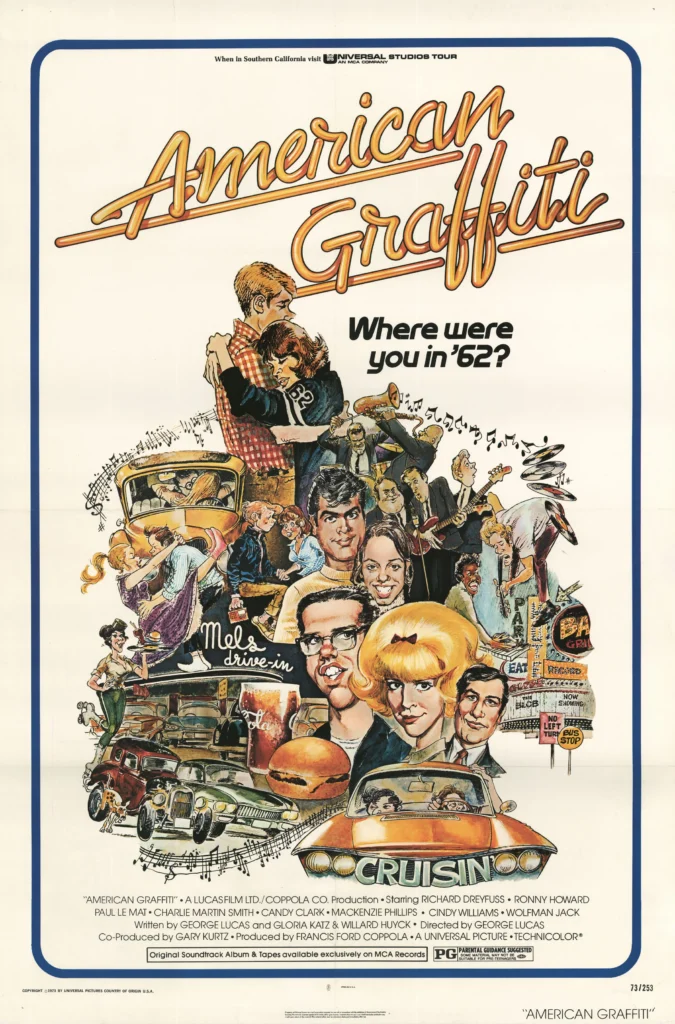
morning. Unlike most coming of age films before it, the film doesn’t focus on plot at all, instead leaning into nostalgia, allowing atmosphere, music, cruising culture, small town conversations, and teenage uncertainty to surround the audience through experience. Lucas creates an anthology-like structure where each character experiences different forms of insecurity, romance, freedom and fear about growing up, all while existing inside one needlessly moving summer night. American Graffiti succeeds because it feels deeply personal and authentic, transforming a simple late night teenage experience into one of the warmest, funniest, bittersweet, and most influential nostalgia films ever made.
American Graffiti thrives through its loose and episodic structure, allowing the audience to simply drift through one endless summer night alongside its characters rather than following one singular narrative objective. George Lucas directs the film almost like a memory, constantly jumping between cruising cars, diners, radio stations, parking lots, and late-night conversations that slowly build the emotional identity of the town itself. The movie understands that the actual “plot” is not necessarily the point, instead focusing on atmosphere, music, relationships, and uncertainty as the real emotional engine of the story. Every storyline feels interconnected through the shared energy of Modesto, California, where the neon lights, nonstop rock-and-roll soundtrack, and cruising culture create one of the most immersive nostalgic environments in film history. Lucas transforms what should be a simple small-town hangout movie into a deeply reflective coming-of-age experience that quietly captures the fear of growing up and realizing nights like this eventually disappear forever. It’s a film that fits equally as well in the theater as it does on a warm summer night with some nostalgia.
Curt Henderson functions as the emotional center of the film, spending the night searching for a mysterious blonde woman in a white Thunderbird while simultaneously questioning whether he truly wants to leave his hometown for college. His storyline initially feels adventurous and romanticized, but slowly becomes much more reflective as he encounters greasers, radio station employees, street gangs, and the legendary Wolfman Jack throughout the night. Curt’s wandering storyline symbolizes the uncertainty of adulthood itself, as he becomes increasingly torn between the comfort of nostalgia and the unknown future waiting outside his hometown. The late-night encounters constantly reinforce the idea that freedom and adulthood are exciting but also terrifying, especially when it means leaving behind friendships, familiarity, and innocence. By the end of the film, Curt deciding to leave feels bittersweet rather than triumphant, perfectly capturing the emotional core of the movie and the reality that growing up often means sacrificing parts of your youth forever.
Steve and Laurie’s storyline centers heavily around commitment, emotional maturity, and the fear that young relationships cannot survive major life changes like college and adulthood. Steve begins the night assuming Laurie will simply wait for him while he leaves town, creating immediate tension as Laurie slowly realizes how emotionally immature and selfish his perspective actually is. Their repeated arguments and reconciliations throughout the night feel surprisingly authentic, not because either of them is completely wrong, but because both are simply scared of what comes next for their relationship and their futures. The film smartly uses their storyline to explore how teenage love changes once real responsibility and separation begin entering the picture. By the end of the night Steve finally realizes he does not want to emotionally abandon Laurie or his hometown entirely, giving their storyline one of the more emotionally satisfying conclusions in the film.
John Milner initially appears as the coolest figure in town, a legendary drag racer trapped inside the same nightly routine while younger teenagers idolize him throughout the community. His unexpected partnership with Carol creates many of the film’s funniest moments, but underneath the comedy there is a quiet sadness to John as he slowly realizes he may already be stuck living in the past while everyone else moves forward. Harrison Ford’s Bob Falfa acts as the perfect rival figure throughout the night, eventually leading to the film’s iconic drag racing climax that reinforces the danger and recklessness hiding beneath cruising culture. Terry “The Toad” provides much of the film’s pure comedic energy, borrowing Steve’s car and pretending to be far cooler and more experienced than he actually is while slowly gaining genuine confidence throughout the night. Terry’s storyline ultimately becomes one of the most optimistic in the movie because the experiences of the night actually help him mature, unlike several other characters who remain emotionally trapped in nostalgia.
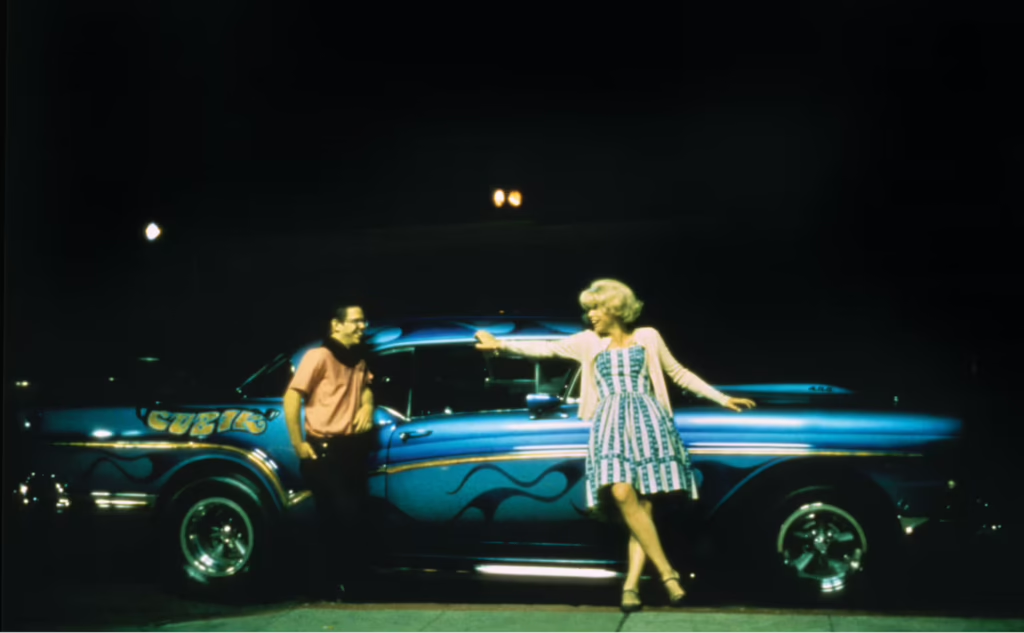
One of the film’s greatest achievements is its nonstop soundtrack, using classic rock-and-roll songs from artists like Chuck Berry, Buddy Holly, and The Beach Boys to create the emotional rhythm of the entire movie. Rather than relying on a traditional score, Lucas allows the radio music and cruising culture itself to become the heartbeat of the film, constantly reinforcing the freedom, excitement, and nostalgia of teenage life in early 1960s California. The neon lights, diners, late-night roads, drag races, and small-town conversations create one of the strongest atmospheric environments ever put onto film, making the audience feel fully immersed in the world. What makes the nostalgia especially powerful is understanding the story takes place in 1962, right before Vietnam, political assassinations, counterculture movements, and massive social changes would permanently reshape America. American Graffiti therefore becomes more than just a nostalgic comedy, functioning almost as a final goodbye to a simpler version of American youth before the country itself drastically changes forever.
American Graffiti became one of the defining coming-of-age films ever made while simultaneously launching George Lucas into the highest level of Hollywood filmmaking before he completely changed cinema forever with Star Wars only a few years later. Lucas heavily based the movie on his own teenage experiences growing up in Modesto, California during the height of early 1960s cruising culture, giving the film an authenticity many nostalgia movies fail to capture. The film’s loose anthology structure and interconnected storylines would go on to heavily influence future ensemble coming-of-age films like Dazed and Confused, Fast Times at Ridgemont High, Everybody Wants Some!!, and Superbad. Produced on a relatively tiny budget of around $775,000, the film became a massive financial success, grossing over $140 million worldwide and giving Lucas the creative freedom necessary to eventually make Star Wars. The movie also helped launch or elevate the careers of Richard Dreyfuss, Harrison Ford, Ron Howard, and Suzanne Somers, making it one of the most important transitional films in 1970s Hollywood history.
The ensemble cast works incredibly well because every character feels natural and believable rather than overly dramatized or exaggerated for comedy. Richard Dreyfuss especially stands out as Curt, balancing humor, uncertainty, curiosity, and emotional vulnerability throughout the entire night, easily the strongest section of the film. Harrison Ford’s small supporting role already showcases the charisma and discerning presence that would soon define his career after Star Wars a few years later. Beneath all of the comedy and nostalgia, the film quietly explored fear of adulthood, changing friendships, uncertainty about the future, and the realization that youth cannot last forever. The final text epilogue explaining where the characters eventually end up transforms the film from simple nostalgia into something much more emotional and reflective about time, memory, and growing older.
American Graffiti remains one of the warmest, most influential, and emotionally authentic coming of age films ever made because it captures the feeling of youth rather than simply telling a traditional story. George Lucas does a fantastic job transforming simple conversations, cruising culture, romance, music, and late-night adventures into a deeply nostalgic portrait of teenage life right before America itself drastically changes forever. The film’s loose structure, incredible soundtrack, memorable ensemble cast, and bittersweet emotional core allow it to feel timeless decades after its release, like a 1960s time capsule. What initially feels like a fun nostalgic hangout movie slowly becomes something far more reflective and emotional about growing up, leaving home, and realizing innocence eventually disappears. This week’s Throwback Thursday American Graffiti stands as not only one of the greatest nostalgia films ever made, but one of the defining American coming-of-age films of all time and one of George Lucas’ most personal accomplishments as a filmmaker.
TwilightRoom Score: 87.9/100