This week’s Throwback Thursday spotlights Denis Villeneuve’s—Arrival, a strikingly different take on the alien film. No space exploration, no spectacle-driven
mystery, just humanity grappling with communication and intent, resulting in a quieter, more introspective kind of sci-fi than the genre typically allows. Amy Adams plays linguistics professor Louise Banks, recruited to decipher an alien language after mysterious crafts land across the globe. Brought in by a special forces unit and sent to one of the sites, Arrival wastes no time establishing its intelligence and tone. Jóhann Jóhannsson’s score feels both ominous and transcendent, like a like a Nolan-esque
profound sci-fi thriller, setting an atmosphere of dread and wonder simultaneously from the very first approach to the craft. Compared to a Nolan film, the focus of discussion this week, it is not quite as complex, but it is far more digestible, a thoughtful nonlinear sci-fi built on clarity as much as concept. Strong across the board, even if it stops just short of masterpiece territory, exactly where it lands in our ratings. Arrival remains one of the defining sci-fi films of the 2010s, with ideas and execution equally compelling, and moments of scientific curiosity that rank among the genre’s finest of the century.
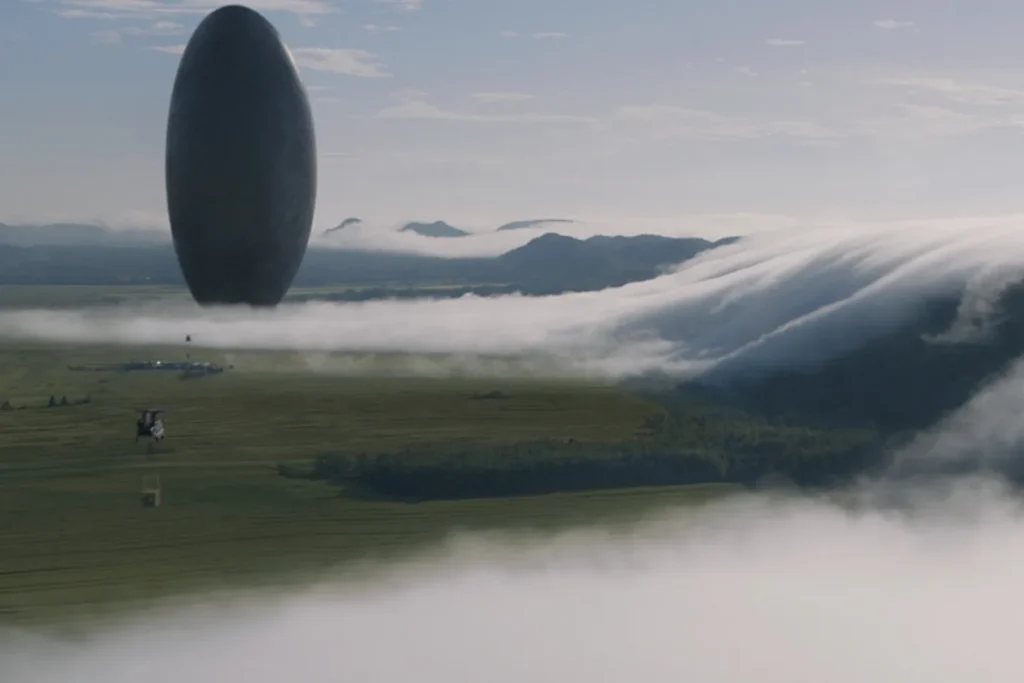
The film begins with Louise being brought to the towering monolith that has appeared, its shifting gravity reorienting her, and us, as she joins a team led by Jeremy Renner’s Ian Donnelly to explore its interior. From the outset, the audience is dropped into a world already grappling with the implications of first contact, where questions of religion, language, and global stability ground the sci-fi premise in a palpable, anxious reality.
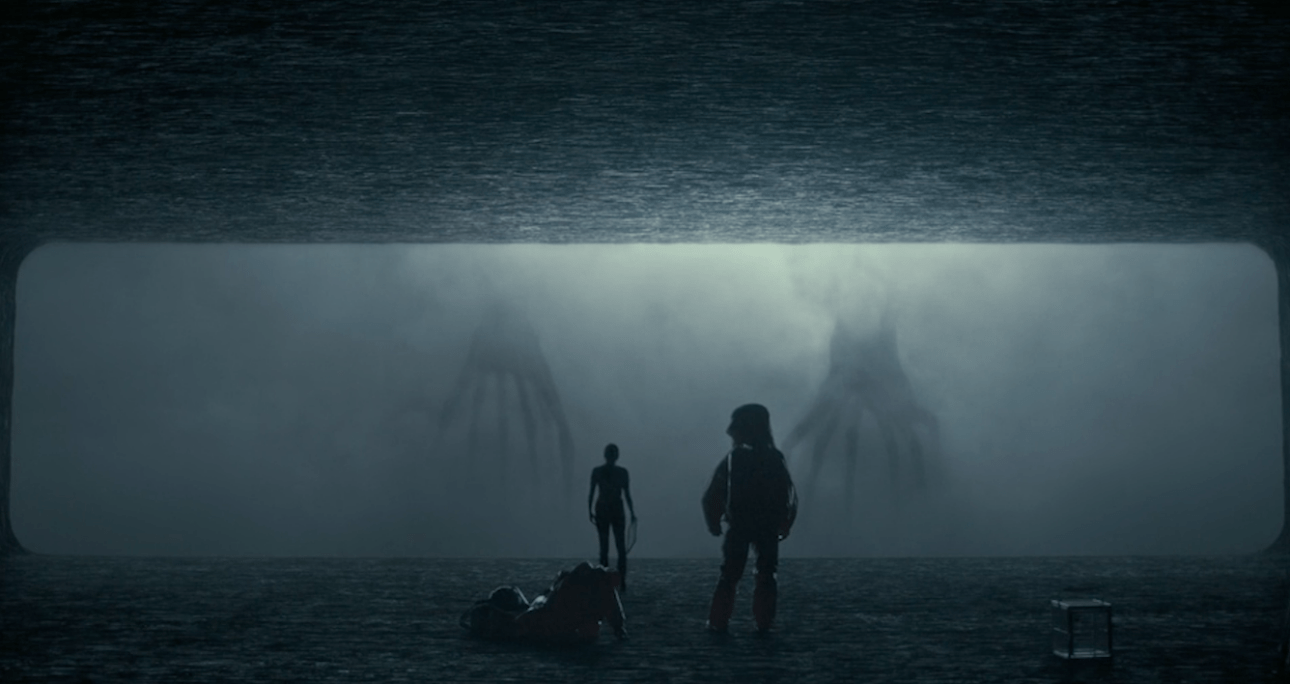
The aliens appear as mist-like, hand-shaped beings, communicating through an inky, circular language, one of the most genuinely otherworldly designs in modern sci-fi. From there, the film pivots away from the typical alien encounter framework: no space exploration, no hidden conspiracies, just the fragile process of communication and the search for intent. It is a quieter, more reflective approach that defines the entire experience. As Louise and Ian work together, they make steady breakthroughs, though much remains unknown, and the film builds tension not through action, but through the painstaking, fascinating act of translation itself.
As Louise and Ian make progress with their heptapods, it becomes clear that other nations are engaging with theirs in far more combative ways, raising the risk of a dangerous misinterpretation. With global tensions mounting, Louise is forced to accelerate her work, the stakes tightening around what remains, at its core, a quiet but urgent linguistic exercise. As the military and government officials overseeing the mission grow increasingly distrustful—both of Louise and the heptapods’ intentions—their patience begins to erode, reflecting a broader institutional fear of the unknown. When the creatures introduce the idea of a “weapon” they intend to gift humanity, that fragile uncertainty quickly tips toward potential catastrophe. The bombing of the chamber, and the heptapods’ response, reveals they possess far greater power and knowledge than previously understood, a jolt of danger that reframes everything without ever tipping the film into action. It only deepens the government’s panic, pushing them further from Louise’s pleas for patience and understanding. As nations begin to panic, the heptapods bring Louise deeper into their craft, revealing a far larger presence than anticipated. One of the two, Abbott, is dying, while the other, Costello, communicates that their purpose is to help humanity now, so that humans can, in turn, save their species thousands of years in the future. The one mark that lingers is the film’s persistent reluctance, clearly a deliberate choice, but one that can feel more frustrating than dramatically rewarding. For much of its runtime, those around Louise resist trusting her insight, a tension that reinforces the theme but occasionally tests the film’s otherwise measured balance.
Costello reveals to Louise that the “weapon” they offer is tied to time itself, soon understood to be their language. By learning it, Louise begins to perceive time nonlinearly, fundamentally reshaping how she experiences the world. In a single stroke, the film reframes everything—what once seemed like memories of her daughter are revealed to be glimpses of the future, a perspective shift that stands among the most powerful in modern sci-fi, and one the film carefully sets in motion from its opening moments. Louise uses her newfound understanding to de-escalate the growing global threat with the heptapods’ guidance, a resolution that may not match the sheer impact of the twist before it, but lands with a quieter elegance. It reinforces the film’s nonlinear design through the interwoven paths of Louise and Ian, favoring emotional clarity over spectacle. The nonlinear concept here is far more digestible than a Nolan-style puzzle box, trading layered complexity for emotional clarity in a way that largely works, even if it stops just short of the masterpiece tier its premise reaches for. The film’s closing stretch, Louise choosing her future with her daughter while knowing exactly how it ends, gives the twist a devastating emotional weight that elevates everything that came before it, transforming a story about alien contact into one about the choice to love in the face of certain loss.
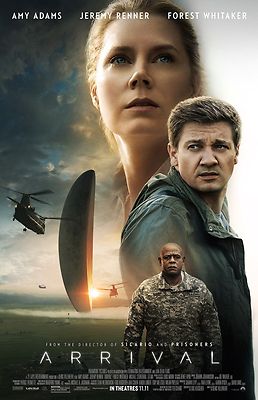
Arrival is adapted from Ted Chiang’s 1998 short story “Story of Your Life,” and the film had a genuinely transformative effect on Chiang himself, already a four-time Hugo Award winner, Arrival carried him to mainstream audiences for the first time, winning the Hugo Award for Best Dramatic Adaptation with Chiang co-credited. The film arrived as Denis Villeneuve completed his transition from indie Canadian filmmaker to a major Hollywood voice, building on Prisoners, Enemy, and Sicario. With Arrival, his first large-scale sci-fi project on a $47 million budget, he opts for precision over spectacle, using restraint to convey a sense of scale rather than overwhelming it. Amy Adams delivers one of the finest performances of her career at the film’s center, yet was notably absent from the Oscars lineup—widely considered one of the more significant acting snubs in recent memory. Artist Martine Bertrand designed the intricate heptapod language with scientific and mathematical consistency, with meticulous attention to structure and phonetics that gives the film a level of intellectual credibility few science fiction works achieve. The film earned eight Oscar nominations, winning Best Sound Editing—an outcome often viewed as underwhelming given its overall achievement. It grossed $203 million worldwide, while Jóhann Jóhannsson’s haunting, dissonant score stands among the finest of the 2010s, earning a Grammy nomination and marking his final major collaboration with Villeneuve before his death in 2018.
Arrival remains one of the defining sci-fi films of its decade, proof that a quiet, cerebral story about communication could reach mainstream audiences without sacrificing any of its intelligence. The persistent reluctance of those around Louise holds it just shy of the genre’s top tier, but the ideas at its core, language reshaping thought, time as perception, and love chosen with full knowledge of its ending, are among the most compelling science fiction has ever brought to screen. Villeneuve’s craft here propelled him into Blade Runner 2049 and eventually Dune, positioning Arrival as the film that solidified him as a leading voice in cerebral science fiction. Amy Adams’ unjustly overlooked performance, Jóhann Jóhannsson’s unforgettable score, and Martine Bertrand’s meticulously designed heptapod language all reflect filmmaking at the highest level, even if the film itself stops just short of true masterpiece status. Arrival is an essential work of 2010s science fiction, a film that has only grown in stature since its release. It falls just short of masterpiece status, but its ambition, emotional depth, and originality tower over much of what the genre has produced since—earning an 85/100 from TwilightRoom.
TwilightRoom Score: 85.4/100