This week’s Criterion Tuesday review selection is the 1930s pirate film directed by the great Michael Curtiz, Captain Blood, a film that paved the way for Curtiz to later direct some of the best films ever made.
Captain Blood captures the feeling of that old adventure tale, not just because it was released almost 90 years ago but also because it captures the now Disney-like island adventure story everyone knows and loves, before the concept was even created. The film is extremely classic in that it has linear storytelling, the common tropes of what the history books and Hollywood will tell you a pirate is, with goals of treasure and booze and duals, but also because it is extremely well made with strong dialogue and exciting old action. Captain Blood succeeds as a classic pirate adventure through its timeless and engaging story, with its main actor Errol Flynn’s charismatic performance and Michael Curtiz’s impressive naval battle sequences, the almost 90 year old film certainly deserves its spot in the Criterion Collection.
Dr. Peter Blood is wrongly accused of treason in the opening moments of the classic and is imprisoned pretty swiftly by the justice system while waiting for his trial. However, instead of being executed, he is sentenced to a plantation by boat, effectively being sold into slavery in the Caribbean. This turn of events is due to Ms. Bishop who purchases him to serve on her uncle’s plantation after something seemingly draws her towards him. While Blood works as a slave, and the conditions for his peers are extremely harsh, Blood experiences much better privileges because of his bond with Ms. Bishop. Blood eventually makes a deal that allows him to help free his friends and escape with his fellow prisoners and take control of a ship that is swiftly turned pirate. From there the newly coined Captain Blood establishes the rules for his pirate crew, and forms a new identity under the quote, “We’re to be hunted… Well now we hunt.”
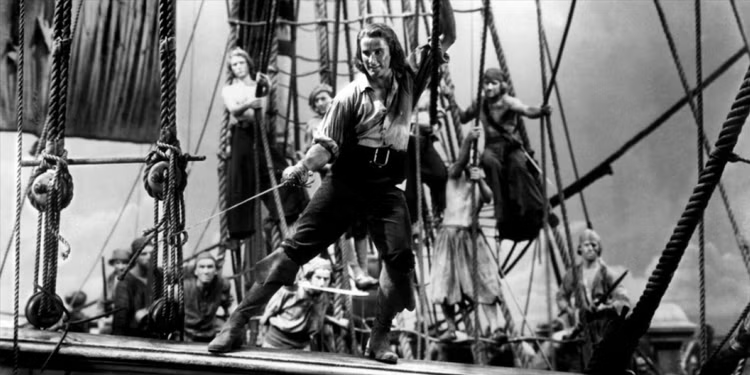
During Blood’s jounery he obtains the title as the Caribbean’s most notorious pirate, eventually landing on a pirate-friendly island, to interact with other crew and claim his title as the top. One of the major sequences that defines the film as special is in its sword fight against a fellow pirate Levasseur, a set piece that is as revolutionary in pirate action as it is crucial for the overall plot of Captain Blood. After speaking with Ms. Bishop once more, Blood learns that England has a new king and he can return to help fight for Great Britain in the war against France, slowly pushing his arc from pirate to hero, similar to a Disney-like arc that comes influenced from the film. The battle that then ensues is a large scale naval battle sequence that is career defining for Curtiz as it becomes one of his most famous attributes that he uses for the rest of his career. Blood ultimately succeeds in becoming the hero and winning the battle redeeming himself in the eyes of the country. By the end of the film he reunites with Ms. Bishop and completes the roundabout love-action-hero story that the audiences came to expect of the Hollywood hits in the 30s.
Errol Flynn’s performance as Captain Blood marked his breakout success for his career, it was crucial in helping to establish the young actor as a major swashbuckling star that would be a mainstay in Hollywood in the years to come. The Flynn and Olivia de Havilland (Ms. Bishop) pairing became iconic, earning them both roles in the more famous Curtiz film, The Adventures of Robin Hood (1938). Captain Blood was a film that was the jump-start for these two actors’ careers, and Curtiz as a director himself, much of what they achieved here felt like a one- off success that they needed to go and then improve upon in those later years — and they did. The film also helped to inspire many pirate and hero stories throughout the next 90 years until now, most importantly influencing the famous Pirates of the Caribbean and Captain Jack Sparrow, a similar and more modern telling of a story quite similar to the original Captain Blood. The movie for its wild and massive success received a best picture nomination for its unique hero story, though Flynn himself got snubbed from a Best Actor nomination — I guess something never changes when it comes to charismatic action actors never getting their flowers.
Overall, Captain Blood is a very classic pirate story, simple but extremely effective, that has stood the test of time as an old tale that is just as entertaining as it once was. The film works because of its strong dialogue made by the skilled Curtiz, Flynn’s charismatic performance as Captain Blood, its exciting and before-its-time set pieces, for its naval battles, and the confidence of Curtiz’s overall early direction. Captain Blood is as much a classic folk tale that anyone can watch and enjoy as it is a history lesson for how the Hollywood pirate movie should be made, earning it an 86/100 from the Twilight Room.
Twilight Room Score: 86.2/100