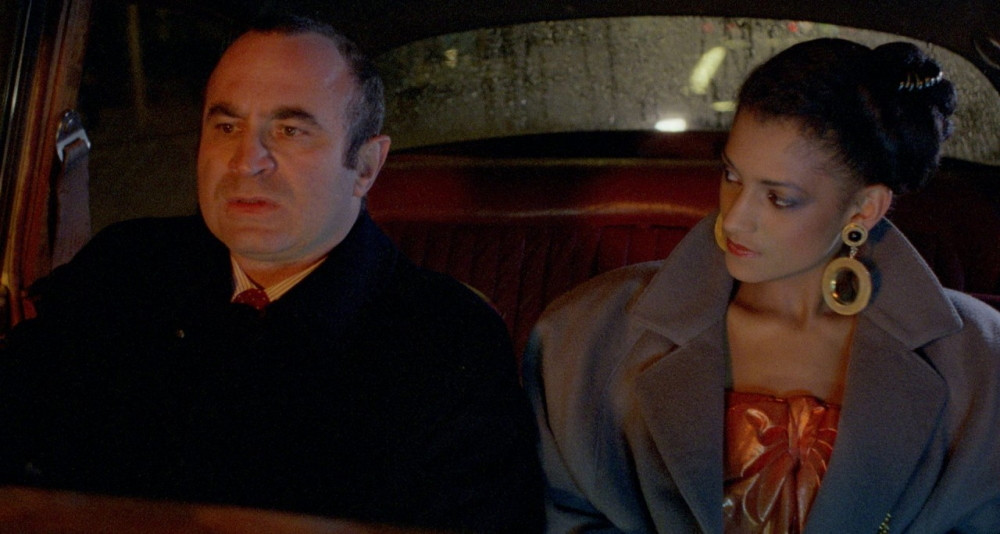
This week’s Criterion Tuesday highlights one of the most overlooked yet finest films featured so far: Neil Jordan’s 1985 Bob Hoskins–starring Mona Lisa.
The film opens with George (Hoskins) leaving prison after he served time for his boss, immediately establishing a man disconnected with his past life and the outside world, especially through his strained relationship with his daughter, which signals
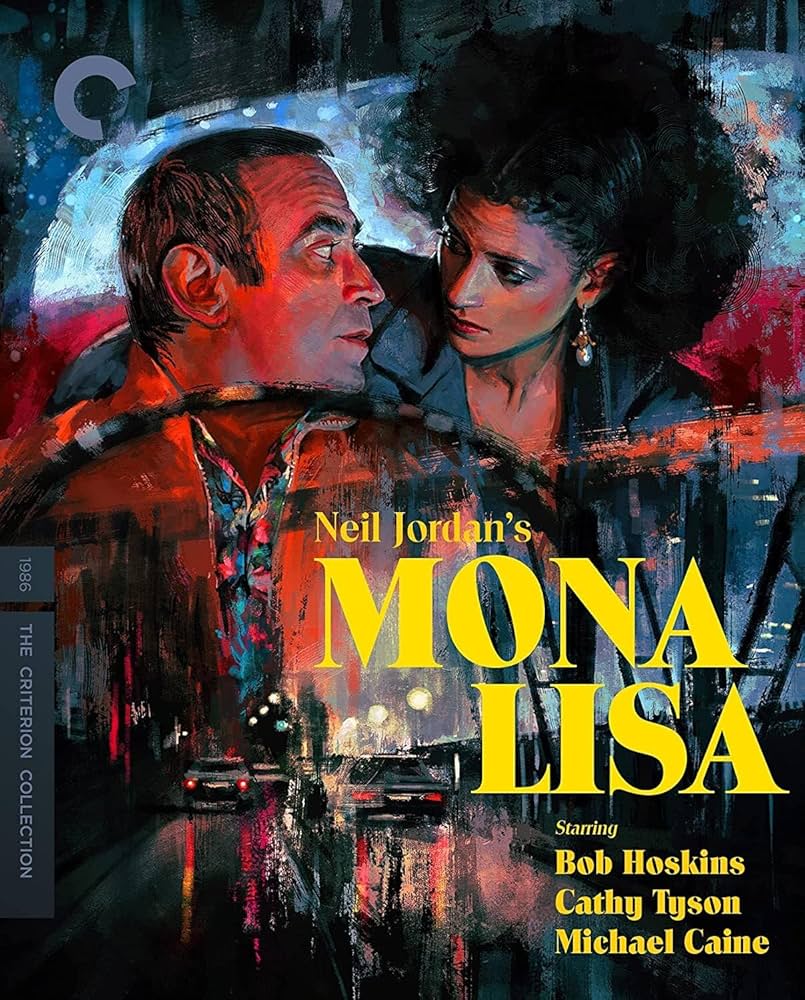
both regret and a lost identity. He quickly takes a job driving Simone, a high‑class escort, which pulls him into a world far removed from his past, a world he doesn’t fully understand but to which he’s inexorably drawn. Early interactions between the two are tense and awkward, with George trying to assert control while clearly being out of his depth, highlighted by moments like kicking her out of the car before realizing she is his only source of income. Simone’s profession is introduced not just as content, but as the central lens of the dark film, framing the story within this more sinister side of London, more exploitative of a society, that creates the foundation for the plot and their relationship. Mona Lisa is a deeply unsettling yet emotional character study that uses the underworld of prostitution to explore dignity, identity, and human connection, ultimately revealing how people define themselves through perception while desperately searching for something real.
The narrative centers less on plot progression and more on the evolving relationship between George and Simone, which slowly shifts from transactional to emotionally dependent and ambiguous. Simone introduces George to a world of wealth he was adjacent to previously but not familiar with, full of danger, and exploitation, while George offers her a form of protection and loyalty she otherwise lacks. As George realizes many of the women are around his daughter’s age, a fact that unsettles him, his initial concern deepens into obsession, particularly over Simone’s search for her missing friend and, as is later revealed, lover, Cathy. Their bond develops through shared vulnerability, even if both are using each other in different ways. The story uses this relationship to gradually expose deep layers of both characters, rather than relying on traditional plot beats, an extremely effective format from director Neil Jordan.
The film is extremely dark in tone and tantalizing in its format, both visually and thematically, immersing the audience in a world shaped by exploitation, control, and emotional isolation. Set in London in the 1980s, particularly the more unsupervised King’s Cross, the setting becomes essential and the driving impact that makes the film’s themes of disparity and division such a spectacular vibe. The environment so masterfully reflects a clear contrast between wealth and vulnerability. In a world where power dynamics dictate survival, it plays like an older, far more thoughtfully realized version of what Euphoria’s third season is currently failing to achieve. This atmosphere isn’t just background, it actively shapes the character’ decisions and relationships.
George is portrayed by Hoskins as a deeply flawed but human character, an unlikely main protagonist that is never focused on in this era of film, someone trying to reclaim purpose while always being in the background not understanding what he has entered into. Simone is far more complex in design and actions, navigating her profession with control and intelligence while still being vulnerable and desperate to escape beneath the surface. Their relationship evolves into one of mutual dependence, even if it is built on imbalance and manipulation, and eventually unravels brutally. George’s attempt to reconnect with his daughter parallels his growing attachment to Simone, showing his desire for redemption. Supporting characters reinforce danger and instability on both of the main characters’ worlds, adding tension nicely without intruding on the clear important driving dialogue of the film.
A central theme of the film is how identity is shaped by perception, particularly through Simone’s role as someone who must constantly perform for others, establishing this idea that people see what they want to see, reinforced through her interactions with clients and George alike. The film is suggestive, just as the profession is based on it, suggesting that individuals are ultimately unknowable, existing as versions of themselves tailored to different people. It ties into the concept that everyone carries their perception for the painting “Mona Lisa”, something hidden, guarded and never fully revealed, that has a different story to different people, communicating beneath the surface. Dignity becomes the emotional throughline, as characters struggle to preserve it in environments built to strip it away, forcing them to decide what darkness they’ll tolerate in order to escape something even worse. The search for Cathy becomes the central narrative driver surrounding these underlying tones, pushing George deeper into Simone’s world to do something he deems right. The storyline introduces higher stakes, shifting the film from a character study into something closer to a dark thriller driven narrative. Moral boundaries are blurred as George seeps deeper into the same position Simone is in, shifting from observer to participant sacrificing one darkness for another. The tension is built through the uncertainty of Cathy’s situation and the dangers around her as they search for her, revealing how far George is willing to go for his new employer, needing a purpose.
George’s discovery of Cathy marks a major turning point in the film, bringing the emotional and narrative stakes as a slow burn to the highest, thrilling point. Simone and George’s bond is tested as their motivations begin to diverge, revealing an underlying manipulation that just shows how cruel the film is in tone. The confrontation at Simone’s place, where George becomes physically involved, escalates the conflict into something more dangerous and immediate from every angle. This realization, that the boss George went to prison for and is now trying to reconnect with is also tied to Cathy, adds a layer of betrayal and moral conflict that nearly pushes him over the edge, especially once Simone reveals her love not for him but for Cathy, propelling the film into its final movement.
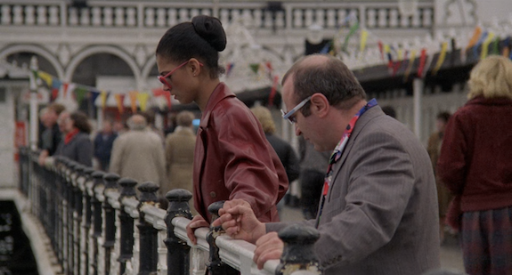
The final act of Mona Lisa shifts the film from a slow-burn character study into something far more emotionally revealing, as the truth behind Simone’s intentions begins to surface. The realization that Simone may have used George as a means to reach Cathy reframes their entire relationship, turning what once felt like a bond built on mutual understanding into something far more complicated and, at times, extremely manipulative. George’s reaction to this is what defines the ending, as despite this betrayal, he still chooses to protect Simone, highlighting just how deeply dependent he has become on their connection, both emotionally and psychologically. The film resists any kind of clean resolution, instead opting for an ending that prioritizes emotional honesty over narrative satisfaction, refusing to tie everything together in a way that feels forced or artificial. George’s journey concludes not with redemption, but with a quiet sense of perspective, suggesting that while he may not have fixed his life, he has at least gained a clearer understanding of it. In doing so, the ending reinforces the film’s central themes of identity, perception, and misunderstanding, leaving the audience with lingering questions rather than definitive answers, which ultimately feels far more fitting for a story built on the idea that people are never fully knowable.
Mona Lisa is extremely successful and underrated as both a character study and a thematic exploration of identity and human connection. Its dark tone and vibe mix well with the subject matter and create an emotionally heavy and throwback viewing experience that’s as compelling a viewing experience as it is harrowing. The performances and relationship dynamics elevate the film into something deeply memorable, ultimately making the film stand as a powerful and introspective approach that lingers through its themes rather than its plot, earning a 92/100 from the TwilightRoom.
Twilight Room Score: 92.9/100