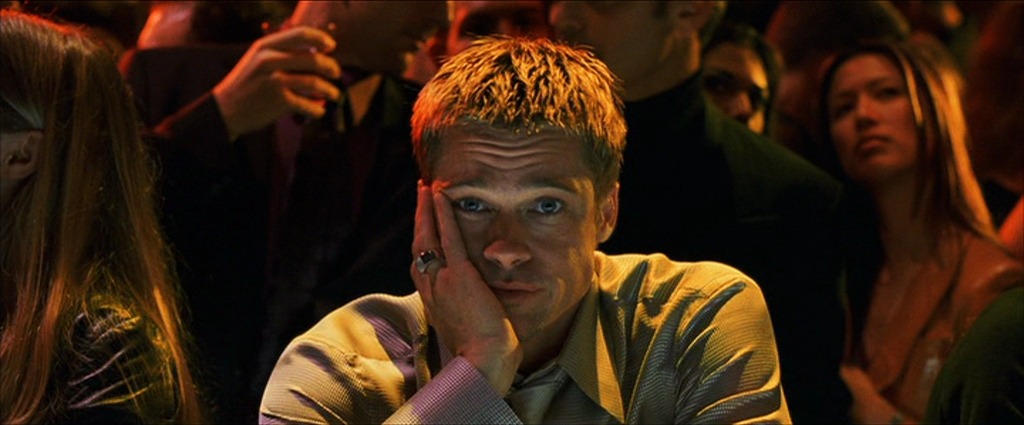
This week’s Throwback Thursday pick is Steven Soderbergh’s 2001 double-Oscar blockbuster victory lap, Ocean’s Eleven, one of the most rewatchable Hollywood
productions ever made and a film that laid the groundwork for the modern heist genre as we know it, all while staying absurdly fun from start to finish. A film far less interested in being a complex crime thriller like predecessors such as Heat, Ocean’s Eleven instead aims to be the best possible version of a crowd‑pleasing classic. Clooney and Pitt star as Danny Ocean and Rusty Ryan,

two career criminals who team up and recruit eleven specialists to pull off the biggest heist in Vegas history: stealing 150 million from the Bellagio in a plan that unfolds with an effortless cool the movie never loses for a single frame. Coming off a year where he won two Oscars for Traffic and Erin Brockovich, Soderbergh uses Ocean’s Eleven as a stylish victory lap—showing off his range with a sleek, crowd‑pleasing blockbuster that doubles as a creative palette cleanser and ends up as successful as anything he’s ever made. The film is a straightforward remake of the 1960 Rat Pack original starring Frank Sinatra, though this version is widely regarded as superior in virtually every respect, especially since the original is mostly remembered for its off‑screen antics rather than anything that actually happens on screen. Ocean’s Eleven now stands as one of the defining heist films of the 2000s—a legendary throwback that remains beloved 25 years later for its campy fun, childhood nostalgia, and infinite rewatchability, making it one of the most satisfying entries in the genre to this day.
The film opens by immediately establishing Danny Ocean in the beginning of his parole, a man with a fully formed plan already in his head before he even steps outside the prison doors, which tells the audience everything they need to know about him from the jump. Danny recruits Rusty Ryan first, and together the two start assembling a crew of specialists across a wide range of skills, each introduced with the kind of breezy confidence that makes the ensemble feel instantly alive and fully realized without the movie ever needing to slow down for lengthy exposition. The target is the Bellagio, along with the Mirage and the MGM Grand, as the plan, once laid out to the full crew, is every bit as wild and audacious as it sounds: stealing 150 million from the most heavily secured casino vault in Vegas history. The movie benefits enormously from its stacked star power, with Clooney in the midst of his transition from television to full-blown film stardom, Pitt riding the post–Fight Club wave, and Matt Damon bringing the fresh energy of the Bourne franchise into an ensemble that felt impossibly loaded with talent then and still does now. Ocean’s Eleven never wastes a moment of this setup, moving with the kind of assured fast paced energy that makes the assembly of the crew feel as entraining as the heist itself.
Once the group is in place and the plan is locked in, Ocean’s Eleven shifts into pure entertainment mode, following the crew through the heist as everything runs with an almost absurd level of precision and, more or less, exactly according to plan. This is a deliberate choice by Soderbergh that defines the film’s personality: instead of drawing the audience into layers of complication or catastrophic setbacks, the movie commits to Danny Ocean’s scheme being genuinely smart and relatively straightforward, with the tension coming from the pleasure of watching a perfectly constructed plan unfold rather than watching it crumble. Twists fly in from every direction during the heist, but none of them ever shake the central feeling that Danny Ocean is always ten steps ahead—if not more—of everyone else in the room, and that unshakable confidence becomes the single most infectious quality of the film and its soon-to-be franchise. The pacing never lets up, the needle drops land perfectly, and the tone stays locked in a register far closer to genuine fun than anything approaching self-seriousness, which is exactly the right choice for a movie like this. As the full heist and its final reveal unfold, booming needle drops punctuate the moment Danny’s master plan clicks into place and the money disappears in the most satisfying way possible, a sequence that earns every ounce of the crowd‑pleasing energy the film has been building toward.

The ensemble cast is as stacked as it could possibly be for the time, and the film knows it, leaning fully into the chemistry between its actors rather than asking any one performer to carry the weight alone. Clooney commands every scene with the kind of easy movie‑star charisma that made his transition from television to film feel inevitable, and his interactions with Pitt have a lived‑in, effortless quality that anchors the entire production without ever feeling stiff or over‑rehearsed. The supporting players: Don Cheadle, Bernie Mac, Elliott Gould, Casey Affleck, Scott Caan, Eddie Jemison, and Matt Damon among them, each bring distinct comedic and dramatic energy, making the ensemble feel genuinely unpredictable instead of interchangeable. The film works as a victory lap for Soderbergh and a palette cleanser from prestige filmmaking, proof that a director at the height of his powers can make something purely commercial without sacrificing craft or precision. It’s the kind of ensemble Hollywood rarely assembles and almost never uses this effectively, which is a major reason Ocean’s Eleven revived and redefined the modern heist genre, spawning two sequels and a spin‑off and creating a template the industry still reaches for today.
Ocean’s Eleven opened to strong reviews and became a massive commercial success, grossing over $450 million worldwide against an $85 million budget, and its cultural footprint has only grown in the twenty‑five years since its release. The 1960 original was known less for the film itself and more for the off‑screen mythology of the Rat Pack: Sinatra, Dean Martin, Sammy Davis Jr., Peter Lawford, and Joey Bishop are remembered more for their antics than for anything that happens on screen—and Soderbergh’s remake so thoroughly surpassed it that, for most audiences, his version has become the definitive telling of this story. Ocean’s Eleven revived and redefined the modern heist genre, setting a template built on charismatic ensemble casts, overlapping reveals, impeccably timed needle drops, and a final twist that recontextualizes everything—a blueprint Hollywood still reaches for today. It stands alongside classics like The Sting and Rififi as one of the most endlessly rewatchable entries in the genre, and its ending at the Bellagio fountain remains one of the most purely satisfying conclusions a heist film has ever delivered. Ocean’s Eleven is one of those movies that only seems to get better with every revisit, proof that a supremely well-made crowd‑pleaser built on movie‑star chemistry and a watertight script never really goes out of style.
Twenty‑five years later, Ocean’s Eleven remains as effortlessly cool and infinitely rewatchable as it was on its initial release, a film that succeeded precisely because Soderbergh never tried to make it anything more complicated than the best possible version of exactly what it is. Ocean’s Eleven still works because its campy fun and childhood nostalgia are baked into its DNA, giving the movie a warmth that smooths over its rough edges in ways pure thriller mechanics could never replicate. Clooney and Pitt remain one of cinema’s great onscreen pairings, and the ensemble around them is as close to perfect as a Hollywood production of this kind has ever assembled. As a Throwback Thursday entry, Ocean’s Eleven earns its legendary status not just through historical impact but through sheer enduring watchability, a quality very few films this popular actually manage to maintain over time. Ocean’s Eleven stands as one of the defining films of the 2000s and one of Steven Soderbergh’s most memorable achievements, a reminder that the most expertly crafted crowd‑pleasers deserve just as much reverence as any prestige drama. As a Throwback Thursday entry, Ocean’s Eleven earns an 87/100 from TwilightRoom.
TwilighRoom Score: 87.0/100