This week’s Throwback Thursday is a film that arrives during the prime of Will Ferrell’s comedy career in Talladega Nights: The Ballad of Ricky Bobby, with
comedy beats hitting exactly the way classic Ferrell always did, delivering nonstop laughs from the very first frame. The country accent, white trash NASCAR comedy at the film’s center is genuinely hilarious, and the reason it works so well is that it takes itself so completely unseriously while its two main roles Will
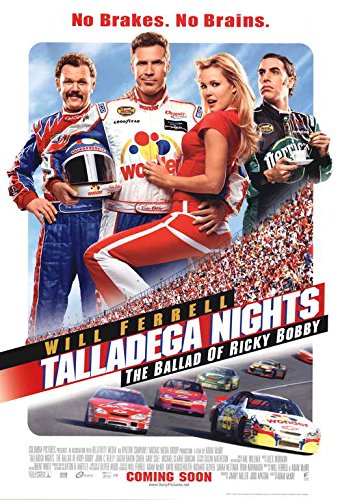
Ferrell and John C. Reilly play everything dead serious. That contrast between the absurdity of the material and the total commitment of the performances is the engine that makes the entire film run. Every single line here is a joke that lands successfully, a hit rate almost no comedy of any era can claim, and part of why this film has become one of the most quotable of the 2000s. Talladega Nights: The Ballad of Ricky Bobby stands as the apex of the McKay-Ferrell comedy era and one of the defining studio comedies of its decade.
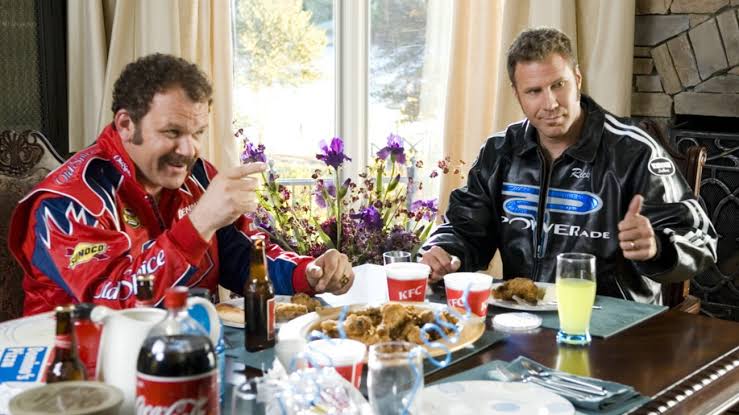
Ricky Bobby becomes the best up-and-coming-racer in the world, driving his way to the top of NASCAR as the film races through his ascent with genuine comedic momentum. As Ricky keeps winning, his buddy and racing partner Cal begins to think it may finally be his own time to win instead, planting the seed for the film’s side lines rivalry later in the film. Sacha Baron Cohen’s French accent as Jean Girard is one of the funniest things in the entire film, and his introduction with Ricky in the car is outpacing comedy on every level and every line. Ricky pushes the race too far trying to beat Girard, ends up crashing, and falls into a coma at what becomes his lowest point of the film, only to dive slower and slower into recovery. The film’s comedic twist is he is later revealed to not actually be injured at all, just mentally off, needing to dodge a severe ego death and seek solace in his white trash family to help him return to the top.
Cal steals Ricky’s wife while he’s down, and Ricky gets fired because he can no longer race, sending him to an all-time low that the film phrases and times with genuine comedic precision. What makes that stretch work so well is that the movie never lets the sadness undercut the comedy, playing his complete collapse for laughs without ever losing sight of the character underneath it. Ricky meets his dad delivering pizzas, and the two work together to teach him how to drive again so he can finally make his comeback to the track. At his absolute lowest, his old assistant Susan, played by Amy Adams, freshens him back up, and the two get together as he begins to find his fire again. That comeback arc is genuinely well structured for a film this silly, giving the entire back half real momentum heading into the finale.
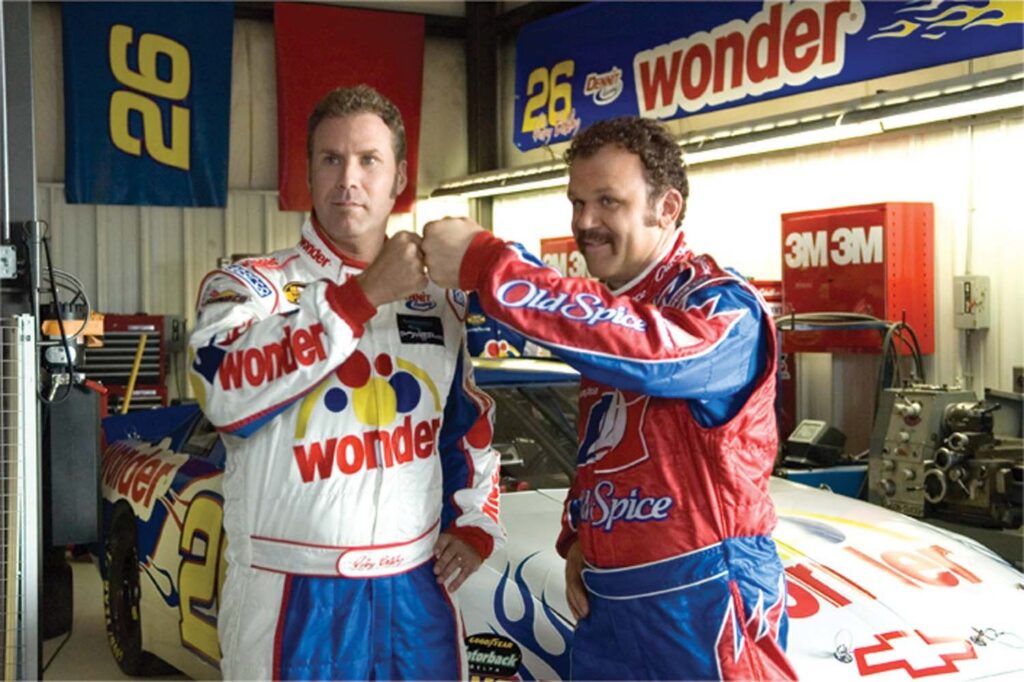
The film’s greatest technical achievement is its joke density, with essentially every line functioning as a gag that connects rather than filler sitting between set pieces. Ferrell and Reilly’s chemistry as actors is so strong here that it led directly into Step Brothers, and you can feel that partnership clicking into place across the entire runtime. Sacha Baron Cohen arrives right in the middle of his own success with Ali G and Borat, and his total commitment to Jean Girard elevates every single scene he appears in. The film worked closely with NASCAR, filming at Lowe’s Motor Speedway and Talladega Superspeedway, and Ferrell went through actual NASCAR driving school ahead of the shoot, riding shotgun with real drivers at speeds that reportedly left him and his castmates rattled. That authenticity gives the comedy a real foundation, grounding the absurdity in a sport the film clearly understands rather than simply mocking from a distance.
Sacha Baron Cohen’s Girard tries to make friends with Ricky, who obliges but declares his comeback to the track for the final act, setting up the film’s climax on his own terms. The final race begins with all three drivers going for the win, giving the movie a genuine competitive stake underneath all of its absurdity. The film ends with a final lap of pure craziness as Ricky wins the race and takes all the glory, even though he’s disqualified for leaving his car mid-race. That disqualification leads to Cal finally getting a win of his own, closing out their rivalry on a note that’s both funny and weirdly sweet. It’s a chaotic, ridiculous ending that fits the film perfectly, refusing a clean triumph in favor of something far stranger and more memorable.
Talladega Nights was the second collaboration between Will Ferrell and Adam McKay following Anchorman, a partnership forged during their overlapping years on Saturday Night Live. The film developed through the same loose improvisational format as Anchorman, this time built around the director and lead actor’s desire to capitalize on NASCAR’s growing mainstream success. It arrived at the absolute peak of the unrated DVD era, a format that showcased McKay’s loosely cut scenes and blooper reels with Ferrell and Reilly reigning as the kings of improvisational banter, a duo that would continue to dominate the comedy space. Made on a 72.5 million dollar budget, the film grossed 163.9 million and became one of the highest-grossing comedies of the mid-2000s. Talladega Nights is now regarded as the apex of the McKay-Ferrell comedy era and one of the most quotable films of the entire decade, a reputation that has only grown strong with time earning the film an 85/00 from TwilightRoom.
TwilightRoom Score: 85.0/100