Studio Ghibli animation feels like it is defined here in this week’s Throwback Thursday, Spirited Away, and there is a real argument
to be made that everything the studio did before and has done since exists in relation to this film. Spirited Away is the pinnacle of what Miyazaki and his animators were capable of, a beautiful, nostalgic fantasy built on visuals carrying a sense of wonder that remains unmatched twenty-five years later. What separates it from other great animated films is that the wonder is never decorative, because every lantern-lit street and every strange creature shuffling through the
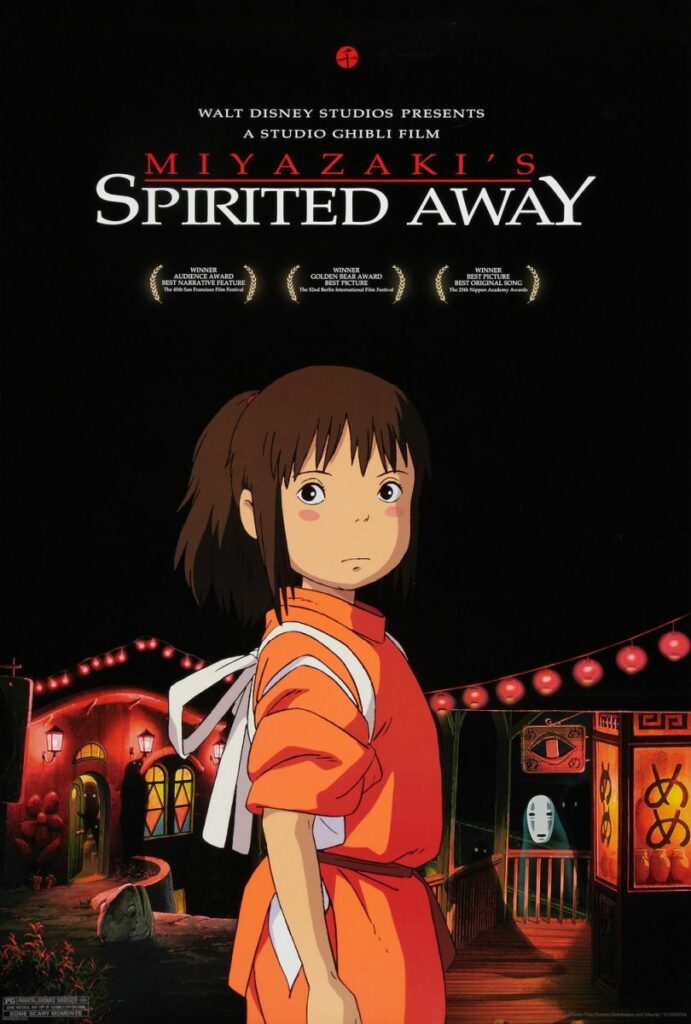
bathhouse exists to make a frightened child feel smaller and then, slowly, to make her feel capable. It is a rare work that is simultaneously the most imaginative thing in its medium and one of the most emotionally grounded, and it never once has to choose between those two things. I have gone back to it more times than almost anything else I have written about, and it has not lost a single step.
Our heroine is thrust into a spirit world and separated from her parents almost immediately, and the cruelty of that opening is what gives the entire film its engine. Chihiro is a sulky, ordinary ten-year-old being dragged to a new town she did not ask to move to, and within fifteen minutes her mother and father have eaten food that was not theirs, turned into pigs and left her completely alone in a place that has no reason to care whether she survives. She takes a job at a bathhouse for the spirits because staying useful is the only thing keeping her from vanishing, and the price is her name, signed away in a contract that reduces Chihiro to Sen. The genius of the setup is how little Miyazaki explains, because we learn the rules at exactly the pace she does and we feel the stakes in the same order she feels them. By the time she has scrubbed her first floor, the story has already made its central argument, which is that growing up is mostly a matter of doing frightening work before you feel ready for it.
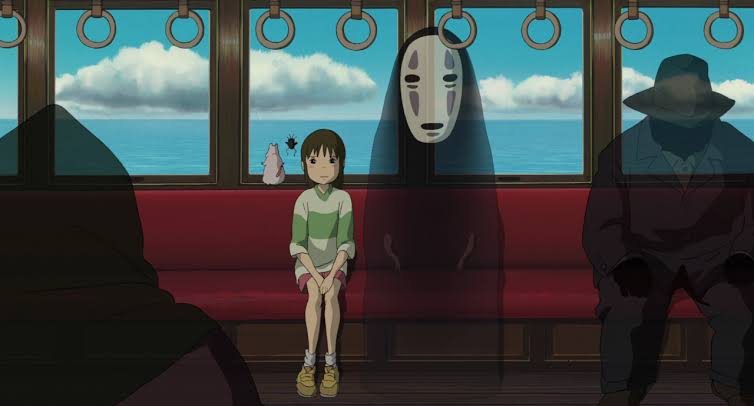
The way the animators handle characters’ mouths and facial expressions is flawless in every moment, and it is the real reason the film is so appealing and so unbelievably satisfying to watch. There is a precision to the smallest gestures here that most animation never attempts, whether it is the way Chihiro’s lip trembles before she decides not to cry, the way Haku’s expression tightens a half-second before he lies or the way No-Face’s mask stays blank while his body language does all of the acting. The backgrounds are the obvious showpiece, with the bathhouse rendered in a density of detail that still feels handmade rather than generated, but it is the character animation that makes the fantasy land emotionally. Joe Hisaishi’s score does the rest, carrying whole sequences with no dialogue at all, and the train ride across the flooded plain is as close to perfect as this medium has ever gotten. Every frame here rewards being looked at, which is not a thing you can say about much of anything else.
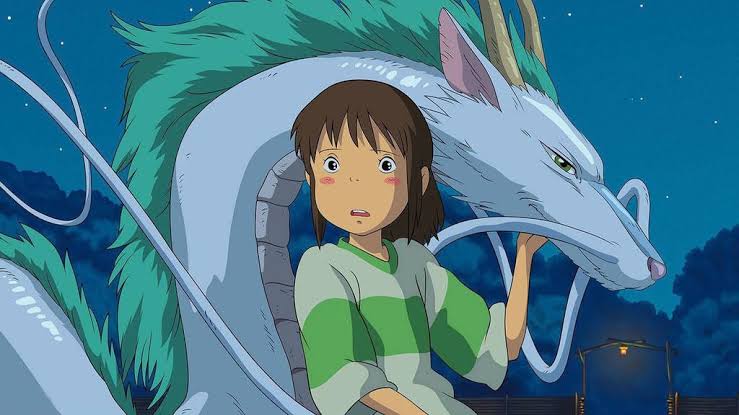
Chihiro and Haku’s central relationship drives the plot with a tenderness all its own, and it is the thread that holds together everything the spirit world throws at her. Their love and friendship for one another are what push the story forward through the obstacles that should otherwise crush her, whether it is No-Face swelling into something monstrous because nobody has ever told him no or Yubaba binding her to a contract that strips away her name and traps her in the bathhouse indefinitely. Haku starts as the only figure willing to protect her and ends as the one who needs saving, and the reversal works because the film earns it slowly, through small acts of care rather than declarations. Chihiro remembering his real name is the emotional climax of the entire movie, and it lands because Miyazaki has spent two hours teaching us that a name is the one thing no one can take from you permanently. Everything strange and frightening in this world is survivable because two children decide to be kind to each other, and no other film has ever made that idea feel less naive.
Miyazaki built the film around the ten-year-old daughter of his friend and associate producer Seiji Okuda, who visited his house every summer. He wanted to make something for a girl that age rather than another epic, which is exactly why Chihiro is an ordinary, sulky kid instead of a chosen hero. He turned to the project after two personal films he had been developing were rejected, and production began in 2000 on a budget of around $19 million, a figure that looks absurd next to what it ultimately achieved. Released on July 20, 2001, it passed Titanic to become the highest-grossing film in Japanese history at roughly 30.8 billion yen, held that record until 2020 and became the first film to earn $200 million worldwide before it had even opened in the United States, finishing at about $396 million. John Lasseter, a longtime friend and admirer of Miyazaki, convinced Disney to buy the North American rights and executive produced the English dub, though the American release was modest enough that the film reached Western audiences mostly through awards attention and word of mouth. It became the first animated feature to win the Golden Bear at Berlin in 2002, then took Best Animated Feature at the 75th Academy Awards, and it remains the only hand-drawn film and the only non-English-language film ever to win that Oscar.
The film finally reveals its coming-of-age fantasy as the audience realizes that the entire journey through the spirit world exists to provide the confidence needed to grow up, to make new friends, to face a new school and to be sure of oneself. That confidence visibly grows as the story does. Chihiro at the end of this movie is not a different person than the girl in the back seat of the car; she is the same person who now knows what she can carry, and Miyazaki stages the final walk back through the tunnel with almost no fanfare because that is the point. It placed at No. 75 on Sight and Sound’s 2022 list of the greatest films ever made, one of the highest-ranked animated films on it, and it is still the first title anyone reaches for when they want to argue that animation belongs in that conversation at all. It turned Studio Ghibli into a global brand and set a benchmark for hand-drawn filmmaking that nothing in the twenty-five years since has come close to clearing. It is, as far as we are concerned, the greatest animated feature ever made and one of the finest films of any kind, earning a 97/100 from TwilightRoom.
TwilightRoom Score: 97.9/100