War Machine opens like any traditional straight-to-streaming War Action film does in the last few decades, with a tragedy already established and a gruesome visual of war striking and apparent from the jump.
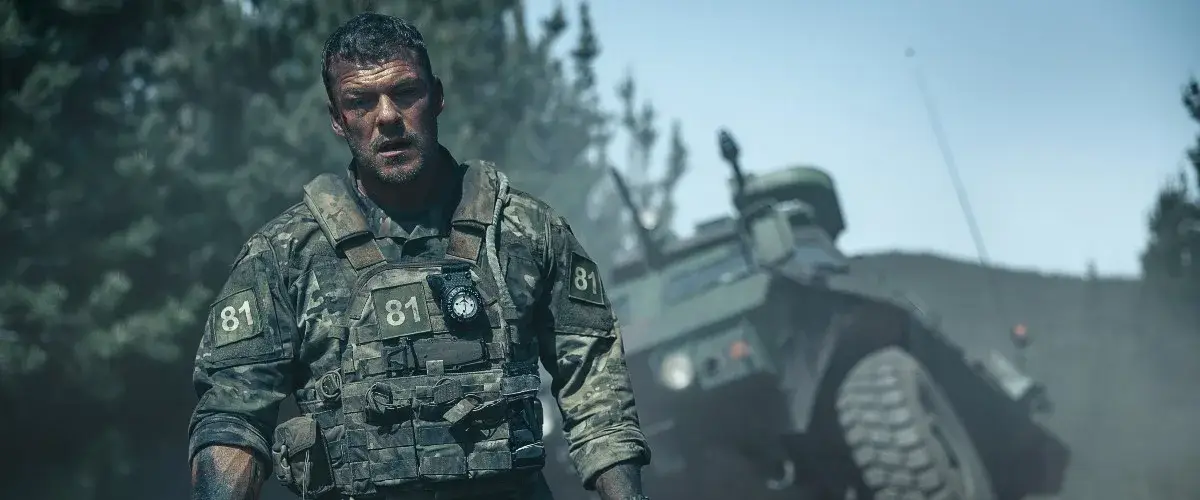
However, as the title, poster, and genre labels suggests the film hints early that Patrick Hughes has directed something much different than the typical war movies; he blended that standard trope with the elements of science fiction alien invasion that have seemed to flood the budget for Netflix’s biggest at-home releases as of late. The story follows a group of soldiers defined as Rangers, who are labeled as numbers instead of names for the entirety of the film, lead by a broken man character 81, as they deal with an unexpected death mission against a giant alien war machine. The film’s premise is its catch, as most of the budget and effort for the film goes into its battle between 81 played by Alan Ritchson and its giant CGI alien machine, and not its narrative, overall plot, or cinematography. War Machine attempts to merge the traditional war film with a sci fi horror, but while its practical action and gore elements succeed, weak storytelling and underdeveloped characters prevent the concept from reaching new heights.
The Rangers are set up through the first half hour of the film, as they are being trained to become a new unit in the military. Highlighted by 81, who is grieving the loss of his brother from the start of the film, the group in training is riddled down until a small battalion is created with a few important characters like 57 and 7, along with side characters that never really gain any sort of purpose. Much of the reason the Rangers lack depth as characters stems from what happens immediately after their final test mission begins: they stumble onto a real alien war machine instead of their simulated target and are wiped out one by one. As the soldiers die, the audience gradually learns how the robot operates, shifting the film from a grounded war story into a sci‑fi horror survival piece centered on 81. This twist is meant to be the film’s core conceptual hook, but it ultimately overcomplicates the story’s purpose instead of adding a genuinely intriguing new layer.
81’s journey through the film is defined through flashbacks to the loss of his brother and his inability to cross the “finish line” in his retreat. While his character is the only true piece of the story that does not feel like a plot device, he is still severely underdeveloped in his emotions, origin, and overall motivation for continuing beyond this generalized concept of the finish line that continues to be repeated. While the film pauses at key moments to gesture toward motivation and to give its characters’ determination against the machine some weight, the writing never commits to a clear thematic throughline, and it loses any chance at real nuance. Instead, it feels far too simple to be anything more than a disposable action concept, the kind of pure entertainment Netflix drops on a Friday in March.
What the film does succeed at and is mostly responsible for the ratings it will get, are its practical effect and action sequences as they generally seem to work well with both of the genres blended into the story. At times when the war feels grounded and tense, and the explosions feel more real, and injuries feel more gruesome, the film really thrives and pulls eyes away from the over-simplification and towards the action set pieces. In almost every case the practical effects, and mountain landscape skew way more positive over the CGI and sci-fi elements, despite the concept making me feel like there was some value here in there that got lost in too much complexity. The overall practicality of the war genre aspect of the film is the clear highlight and perhaps not something that would carry the film to a particularly high rating, but sees it from an outwardly low and harmful rating.
Where the film struggles, the most is in its narrative and storytelling. The plot feels loose as a whole, a mixed bag that feels randomly compiled instead of intricately placed. It struggles with a lot of pacing issues jumping from fast paced to slow paced and skips over too many points that needed to be developed more to mean anything special. It’s a film with multiple different story concepts that are solid at best, but are never fully brought together. Perhaps its biggest narrative decision that felt make or break to its success, was the decision to name the characters only numbers and not by real names. It’s an interesting take that brings some real life importance and commentary to how a military unit would operate, but ends up stripping every character of their humanity instead. Every side character is treated as a disposable piece with no emotion behind it, undermining the entirety of what the film is attempting to achieve by making this decision. Overall, the narrative is the clear stand out as the biggest struggle for War Machine as even its biggest characters fail to achieve a personal story that matters to the audiences as we move through the runtime.
The film’s final two interesting decisions were in its decision to kill off 57, its only real contradictor to the main character so early on, and the film’s decision to go global apocalypse with its final scene. First, the character 57 is created to oppose 81 for most of the first half of the film and despite 81’s believed to be here status, the two take the entire half to find common ground of trauma in the face of certain death. The moment between the two feels like one of the only real interactions, aside from 81 and 7 that has a conflict, substance and near resolution. As soon as War Machine picks up this crucial moment, they shoot a hole, literally, through 57, killing him almost immediately after he becomes the only pivotal and beneficial side character to the film’s success, a decision as puzzling as it was harmful to its rating. Second, after the final conflict has been resolved and 81 has completed his mission, the film maintains another 20 minutes of runtime to tell us that the world is being destroyed by these machines. The plot point is justified as 81 should have input on how to take them down, but with no real resolution, the film ends in a much worse place than it started despite the general vibe of the final sequence being success over tragedy. These two puzzling moments are clear examples of War Machine being much too jumbled in ideas to really convert on any of its bold decisions or even its safe ones.
Overall, War Machine is a very straightforward Netflix war action sci fi film, something we see from the company much too often . Its action sequences and practical effects work well enough to draw you in, and the genre blend is cool enough to make it a poster film for the week on the app. However the film struggles heavily with its plot cohesion, character development, dialogue, and overbalance on CGI and post production effects. Despite its solid action moments, the film ultimately feels like a good concept trapped inside a weak narrative execution, leading it to earn a 57/00 from the TwilightRoom.
Twilight Room Score: 57.4/100