I figured for the debut of the first ever Criterion Tuesday review on TwilightRoom, we should begin with a directors debut feature film, in one of the newest additions to the Criterion Collection, film #1293, Tim Burton’s Pee Wee’s Big Adventure.
While a lot of Burton’s later work is created within the confines of his own dark whimsical fantasy brain that has become his calling card, in this film he was tasked to take the crazy childlike expression bending mind of Paul Reuben and his famous character Pee-wee and transfer it to the big screen. The film does an outstanding job of taking the subtle odd or at points creepiness of the later Burton films and the eccentric mind of Reuben, and meshing them into perhaps one of the most famous modern slapstick comedies of the 1980s. While the film clearly has some glaring issues and is clearly an amalgamation of two artists working together in unknown territory, the film works best when Pee-wee is pushed out of his mental and physical fantasy world and is forced to interact with the ordinary people of the film.
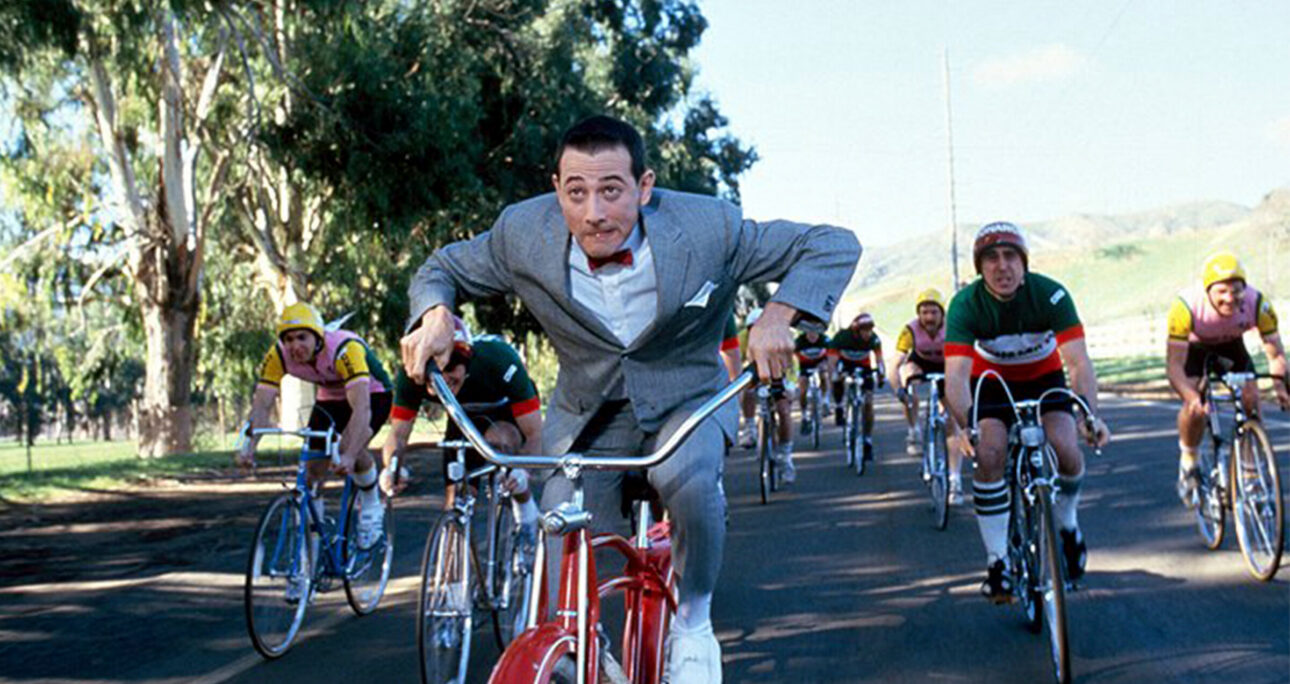
The film opens with a wild and rather unexplained dream sequence of Pee-wee, played by Reuben, crossing the finish line first at the Tour de France on his beloved bike, immediately establishing the intensely childish and ambiguously coded character that Pee-wee will represent. Further, post-dream the whimsy of his many household inventions and over the top expressions establish an aesthetic that to some long time fans really clicks with, but for me came off slightly unsettling and more of an acquired taste in comedy. The story as a whole feels like a childhood dream bordering on nightmare, as the film has a clear narrative, but the way in which Pee-wee navigates said narrative is intentionally rough and underdeveloped; similar to an unorthodox dream. Where the style and tone of the film truly shine is in the early signs of Burton’s creativity in film: using his famous stop motion art at moments and visual animation experimentation within live action films, to not only elevate this film but hint at his future work.
Despite the dream to begin the film feeling quite random, the one mainstay of the plot is Pee-wee’s beloved bike, which gets stolen fairly early into the film. The bike not only represents the central emotion of Reuben’s character but also the leading plot point that pushes the narrative forward as the bike robbery turns out to be the inciting incident of the entire film. Through this bike scavenger hunt, Reuben is able to really show where Pee-wee’s emotions and mental state are, as he is incredibly independent (refusing help from friends ), but also quite childish as he decides to trust a random fortune teller instead. The Film’s plot as a whole turns out to be a very episodic road-trip style where Pee-wee bounces from character to character to allow for a wide variety of jokes, that may or may not land with audiences, before leaving them for good to move onto the next episode.
Much of the problems with the film for me, are in how the character translated to the big screen initially; meaning most of the moments where we are left just with Reuben, the film seems to either frustrate, lack the comedy needed, or put off the audience due to the over childish quirky nature of the character. However, the film truly shines when we see Pee-wee stacked up next to normal characters during the road trip and have them interact. One of the best and most hilarious examples of this is the entire biker gang stop; as we get a real and heavily effective comedic glimpse at just how different the character is from other men his age, but just how effective that contrast is to an audience of new or returning viewers. The humor is clearly hit or miss, and for me there were much more misses than hits throughout, but the film is undeniably funny when it hits; to a point where it’s tough to only remember the rolling laughs and not the awkward stares.
When looking at the film from a historical perspective, which in the case of a Criterion review seems important as the film has clearly garnered some significance, we see perhaps the biggest example of the influence of the works of Buster Keaton and Charlie Chaplin in modern day comedy. Through the 80s and into the present time Paul Reuben is truly the gold standard for heavily stylized visual and physical comedy all thrown into this one-man-show style we don’t see much of nowadays. While most of the return of the slapstick is incredibly important and exciting to see in film, it brings back a lot of the discourse of the quality of some of those two great comedians’ lesser known work. Slapstick is incredibly subjective, and very reliant on not just the time period but the execution; perhaps much of the disconnect I had with Pee Wee’s Big Adventure, is a large example of the disconnect over time with certain comedy in the slapstick genre.
Returning to the film as we move towards the end of this review, Pee-wee in the final Chase act is able to reobtain his favorite bike, in what represents a chase scene that creates the most momentum, cohesion, and brilliant fourth wall breaks in the film’s entire runtime. A combination of action and controlled whimsy, while giving the audience a deserved payoff is something not too common in Burton’s work, but one that makes his first film one of his most unique and separating films. The film is clearly Tim Burton’s lightest film he made and extremely far from his darker work he creates later in life. In making this separation, Reuben is able to express his extremely complex, sexually ambiguous, and legendary character directly to the big screen. Overall, the film is a large success for Warner Brothers and this famous duo; as a cult character was successfully turned into a mainstream piece of media in a way we don’t get to see much anymore.
While the film is not perfect in its delivery or its comedy landing, it is stylized, well made and an enjoyable experience; a very worthy new addition to the Criterion Collection and enough to earn a 77/100 from the Twilight Room.
Twilight Room Score: 77.4/100