Wicker succeeds because it dares to do something most mainstream films won’t: be weird. A woman on the outside of her
community’s in-crowd commissions a local basketmaker to craft her a husband out of wicker who ends up being kind, helpful and great at sex? It doesn’t get much quirkier than that. But a strange plot isn’t enough. There have been plenty of films released this year with weird stories, from one where sex is only legal one night of the year to one where ballerinas become deadly, gangster-fighting killers. The
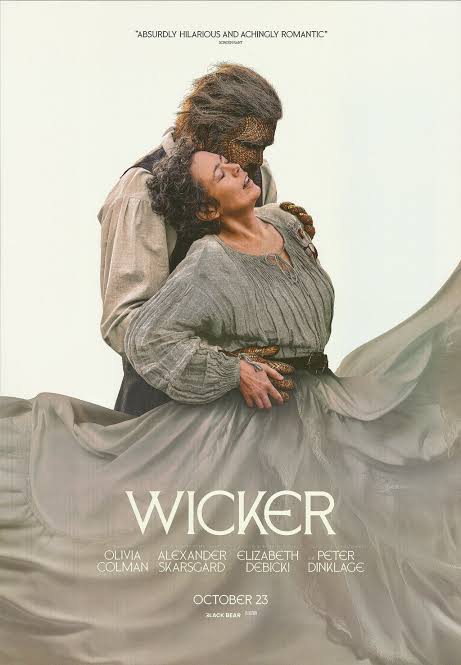
difference is that Wicker fully commits to the bit, leading to an unapologetically original theatrical experience.
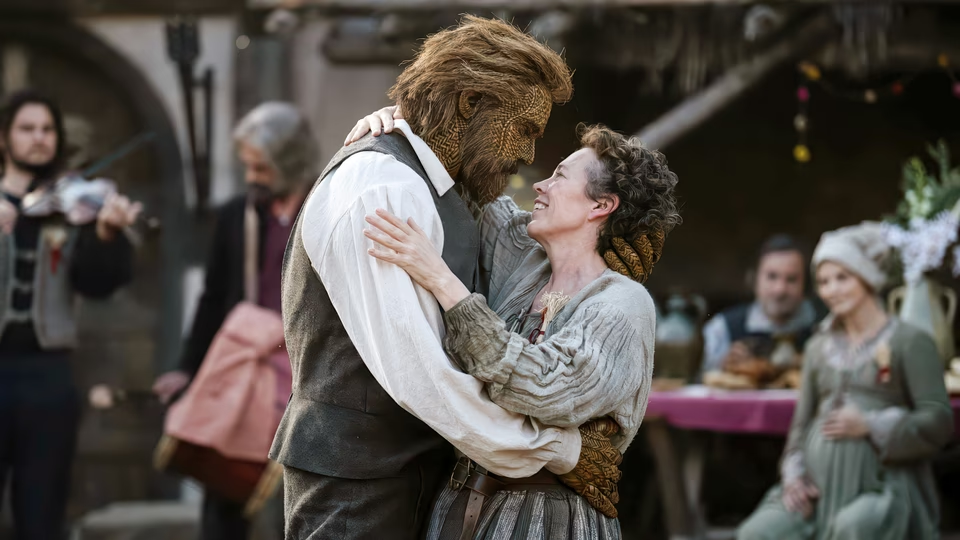
The film is set in a fairytale-like universe, which allows it to immediately break away from cultural norms. In this fantasy world, no one has a name, they’re simply referred to by their profession (or their husband’s or father’s profession if they don’t have one of their own). As two are wed, the man cuffs a ceremonial collar around the woman’s neck in a reinforcement of the patriarchy. They shake a wicker egg that explodes with colored powder to dictate who from the community will get married next. And that’s how Fisherwoman (Olivia Coleman) finds herself pondering the idea of a husband for the first time. She’s been content to live alone, but the sneers from the other women in town have become unbearable. That’s when inspiration strikes and her Wicker Husband (Alexander Skarsgård) is born.
Despite there being no other magic in the film, no one is particularly surprised that a man made of wicker is walking and talking. They’re more shocked that this tall, handsome man chose Fisherwoman as his bride. But that’s only the beginning for Wicker Husband. He’ll go on to subvert every expectation the villagers have of what a man should be, particularly in his attitudes towards marriage. The other men in the village see marriage as transactional—they get a wife and in turn, they have someone to raise their kids and take care of their household. So when the women see a husband treating his wife with love and devotion for the first time, the village is flipped on its head. Suddenly, the women begin to see their worth, and the men begin to panic. Fisherwoman and Wicker Husband refuse to assimilate, chartering their own path. And just like in our own world when the status quo gets challenged, oppressive forces begin to emerge to snuff the resistance out.
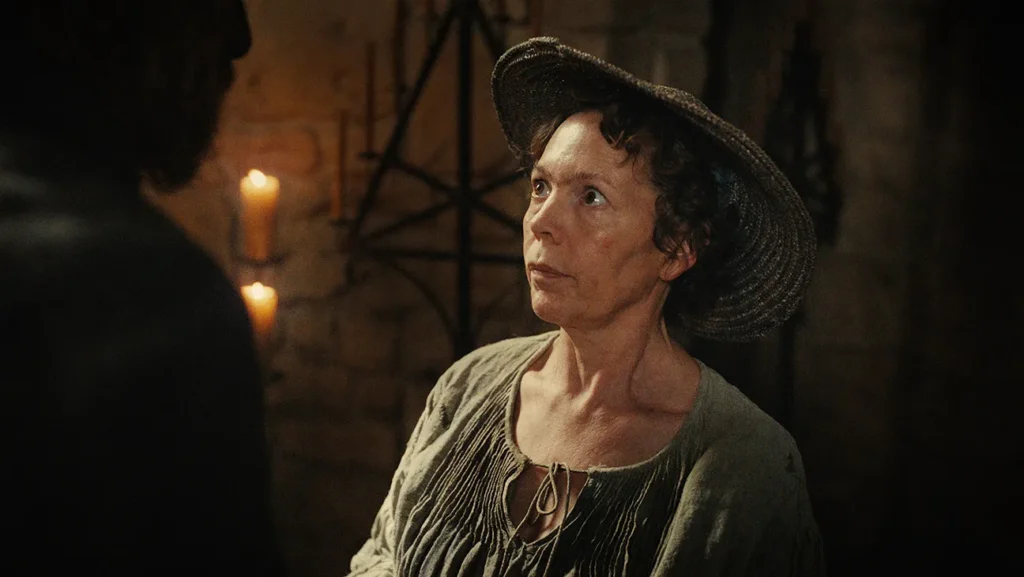
Co-directors Alex Huston Fischer and Eleanor Wilson bring this whimsical world to life with bursts of warmth and ornate set designs, while Lol Crawley’s stunning cinematography makes it all pop. It feels like you’re flipping the pages of a storybook you’d read as a kid, each frame offering something new and exciting to grab your attention. But the real star of the show is Wicker Husband’s meticulously crafted, practical costume. Skarsgård even said in an interview that the nipples of the costume had to be screwed on. It’s just another example of the film refusing to skimp on any of its eccentricities. There are tons of other directors who would’ve hired a CGI studio and called it a day. But the living, breathing costume adds so much to the film and the performance. Skarsgård disappears and for the 105-minute runtime, you genuinely believe you’re watching a man made of wicker live his life, right down to the intricate details, like Fisherwoman dabbing her husband with vinegar to help fight against mold. So much of Fischer and Wilson’s world is grounded in nature and being surrounded by the trees and the wildlife really helps the fantasy world leap off the screen.
But none of this comes together without the trio of committed performances at the center of the film. Coleman’s portrayal of the village’s pariah is nothing without her villainous foil, played by Elizabeth Debicki. Debicki’s buttoned up, reserved and judgemental demeanor contrasts perfectly with Coleman’s unkempt, unserious and unbothered depiction. But Debicki has to walk a fine line here. Because ultimately, she’s just as much a victim as Coleman, we just don’t realize it right away. Existing in this patriarchal society is just as hard on her as it is on any of the other women in the village. By the end, she makes us sympathize with her plight, forgiving her actions as just another symptom of a system working against her. Rising above it all, both literally and figuratively, is Skarsgård and his immense versatility. The last three roles he’s taken on have been an eccentric concert director in The Moment, a security robot who achieves sentience in Murderbot, and a motorcycle-riding leather daddy in Pillion. He has to be one of the most exciting actors in the business right now and this role continues to push the boundaries of what he’ll agree to. What he’s able to do despite being shielded by such a restrictive costume is beyond impressive. Not just the physicality, but the heart and humor he’s able to bring to the role is beyond impressive.
The film’s strangeness not only allows it to reach some kinky, comedic highs, but it also allows it to drill into something much more profound in its examination of societal expectations. I went in thinking I’d get a sprightful sex comedy, perhaps a play on Pinocchio, but it’s not his nose that does the growing (wink wink). But I left feeling moved by the film’s beautiful depiction of romance. It shows how revolutionary simply outwardly respecting and caring for a woman can really be and how much power there is in breaking free from public norms. That’s exactly what Wicker does—it dares to be different, it’s unashamed by its weirdness and it’s why it surpassed every expectation I had, earning itself an 81/100 from TwilightRoom. Perhaps more mainstream films should follow its lead. We could all use a bit more whimsy in our lives.
TwilightRoom Score: 81/100