The original 1950s 3:10 to Yuma is our Criterion Tuesday Review of the week on TwilightRoom, and it stands as one of the defining Westerns of the era, a film that strips the genre down to its core elements a few decades after the genre was created.
It builds a slow-burning, character-driven story rooted in immorality, tension and inevitability that is almost perfectly indicative of the vintage Western. The film opens with Ben Wade and his gang causing chaos, immediately establishing a sense
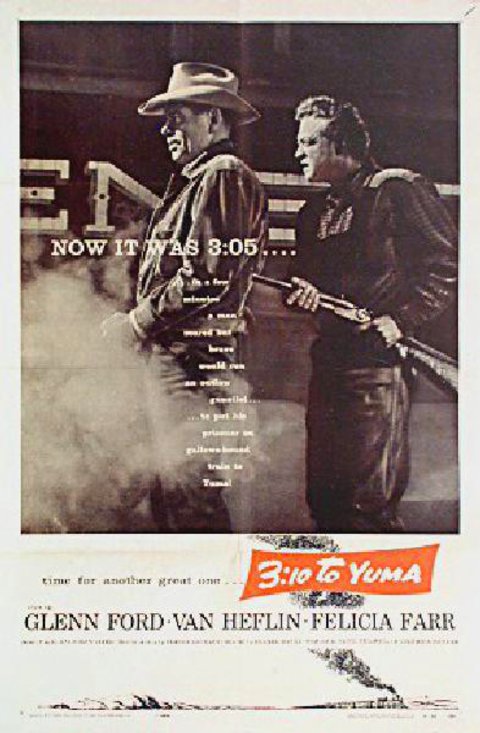
of threat while grounding the story in a classic Western setting defined by strong, realistic set design. Next comes Dan Evans, as good a man as there can be in this world, struggling to provide for his family, setting up the emotional and moral stakes that pull Wade down to earth and drive the story’s building tension. It’s a simple but effective premise, escorting a captured outlaw to a train while his gang closes in, leaning heavily on the dialogue between the two men and a time-driven tension that recalls the legendary High Noon. 3:10 to Yuma succeeds as a foundational Western by embracing simplicity in story while using time, character tension, and moral conflict to create a slow-building but highly effective and influential genre piece.
The film operates on a tightly controlled, linear narrative, centered entirely around the mission of getting Ben Wade onto that train soon as promised. Stakes are clearly established early and remain consistent, allowing the tension to come from how the situation evolves rather than what the situation is. This simple, time-bound structure creates a Western-style ticking-clock pressure that reinforces both the inevitability of the final confrontation and the charged conversations between these fundamentally different men. Narrative simplicity works in the film’s favor 70 years later, keeping the story easy to follow while linking it to one of the genre’s most famous structural tropes: a seemingly predetermined outcome where the tension lies entirely in the journey.
The character dynamics are where 3:10 to Yuma really begins to separate itself, built almost entirely around the relationship between Dan Evans and Ben Wade. Evans is presented as a morally grounded but desperate man, someone doing what he believes is right while also trying to survive in a world that doesn’t reward that mindset. Wade, on the other hand, is calm, calculated, and almost disturbingly composed, a man who rarely needs to raise his voice or his gun to control a situation. As the two spend more time together, their dynamic slowly shifts from a standard outlaw and captor relationship into something far more layered, as Wade’s demeanor begins to influence Evans, and Evans’ commitment begins to earn Wade’s respect. It’s this push and pull between the two that drives the film forward, making every conversation feel just as important as any action sequence could have been.
That dynamic feeds directly into the film’s core themes, which revolve around morality, duty, and what it truly means to be a “good man” in a world that constantly challenges that idea. Evans represents responsibility, sacrifice, and the desire to do right by his family, even when it comes at personal risk, while Wade represents freedom from consequence, operating on his own code that doesn’t align with society’s rules. The film constantly places these two perspectives against each other, questioning whether morality actually holds weight in a setting where power and control often win out. There’s also an underlying exploration of pride and masculinity, especially in Evans’ decisions, as he feels the need to prove something not just to others, but to himself.
From a direction and pacing standpoint, the film is incredibly restrained, choosing to build tension through patience rather than spectacle. Delmer Daves leans heavily into dialogue and silence, allowing scenes to breathe and letting the weight of each moment settle before moving forward. The pacing is intentionally slow, but never dragging, as every scene contributes to the gradual build toward the final act. This approach keeps the tone grounded and serious, avoiding exaggerated Western tropes and instead focusing on realism and character-driven tension. It’s a style that may feel simple on the surface, but is incredibly effective in maintaining a consistent sense of unease throughout.

Visually, the film embraces a classic Western aesthetic, using its setting to enhance the story rather than overshadow it. The town, the landscapes, and the interiors all feel authentic and lived-in, reinforcing the grounded tone the film is going for. There’s nothing overly stylized here, but that simplicity works in its favor, keeping the focus on the characters and their interactions. At the same time, it still manages to be one of the more visually striking Westerns of its era, proving that strong composition and setting can carry just as much weight as larger-scale visuals. The environment itself adds to the tension, especially as Wade’s gang closes in, making the space feel increasingly smaller and more dangerous.
As the film progresses, the tension continues to build in a very controlled and steady way, never relying on sudden spikes but instead maintaining constant pressure. The presence of Wade’s gang looms over the entire second half of the film, even when they are not directly on screen, creating a sense that danger is always just around the corner. At the same time, the psychological tension between Evans and Wade becomes just as important, if not more so, than the physical threat outside. As the 3:10 train approaches, Evans becomes more visibly uneasy, while Wade remains composed, further highlighting the contrast between the two men. Every moment feels like it is pushing closer to something unavoidable.
That slow build leads directly into the film’s final act, where everything begins to tighten and move with more urgency. The journey to the train becomes the film’s most intense stretch, as Evans is forced to navigate increasing danger from all sides while still holding onto his mission. The pacing shifts here, becoming faster and more immediate, but still grounded in character decisions rather than action-driven spectacle. Wade’s behavior adds another layer of unpredictability, making it unclear how the situation will ultimately resolve. It’s a payoff that feels earned because of how carefully the film has built toward it from the very beginning.
The ending itself reinforces everything the film has been building toward, resolving more through character choices than traditional action. Wade’s decision in the final moments adds a level of complexity to his character that elevates the entire story, showing a sense of respect that had been quietly developing throughout the film. Evans, in turn, achieves a kind of moral victory, proving his commitment to doing what is right despite the odds stacked against him. The resolution avoids anything overly clean or dramatic, instead focusing on emotional and thematic closure, leaving the audience with a lasting sense of what the journey actually meant.
3:10 to Yuma ultimately stands as a simple but highly effective Western, a key 1950s genre piece that helped solidify the form and later inspired a strong contemporary remake of its story. The film relies on strong character work between Wade and Evans, and tension rather than large-scale action or spectacle. Its influence in later Westerns is clear and it works as both a classic Western story and a deeper exploration of human behavior under pressure and conflict. It’s a foundational film that certainly deserves to be in the Criterion Collection and proves how powerful a straightforward Western narrative can be when executed with precision and focus earning it an 86/100 from the TwilightRoom.
Twilight Room Score: 86.6/100