The Irishman is the most ambitious work of Martin Scorsese’s career, an epic in the truest sense with more locations and more sets
than anything else the great director has ever mounted, and it functions as a deliberate and fatal closing statement on the gangster genre Marty spent five decades redefining. The film is enticing in its movement, built on the slow tension build that only Scorsese can execute, though it takes nearly two hours to arrive at the real tension and philosophical commentary that pull the audience all the way in. It’s an extremely slow burn that won many patient viewers over and
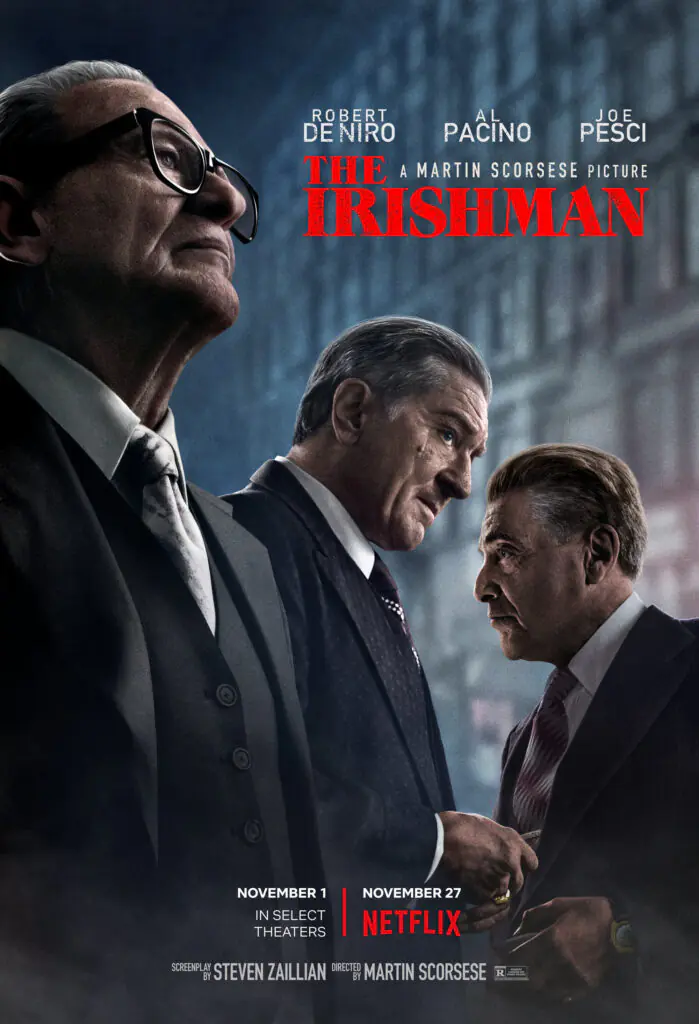
lost an equal number who needed a quicker payoff. The visuals in The Irishman are genuinely interesting, and the camera frames every scene exactly the way a Scorsese film has always been framed, but the color saturation pushes this toward a far more mainstream look than a gritty mob picture of this subject matter actually needed. The performances across the board from the legends of the gangster genre, led by Pesci, De Niro and Pacino, are well executed without anything reaching the heights of what these actors have done for Marty in the past, which is strange given the number of legends in the cast and is likely why the film has divided audiences since its release. The Irishman is Martin Scorsese at his most meditative and his most intelligent, his final word on the gangster genre, and the final act following De Niro’s Frank alone justifies every slow stretch that precedes it.
We open on an old Frank Sheeran sitting in a wheelchair, and the entire film unfolds out of his account of a road trip he took with Russell Bufalino decades earlier, a structure that sets the whole picture up poetically as a tale beginning in the middle of a man’s life rather than anywhere near the start of it. Frank begins as a meat-truck driver quietly selling off portions of his own inventory on the side, an arrangement he runs illegally until he is caught and brought into mob-related business in Chicago, and from there he gets steadily positioned toward the Teamsters world and toward Jimmy Hoffa without ever appearing to make a single decision of his own. The film traces the full arc from infantryman to truck driver to Teamster to hitman to convict without once announcing any of the transitions, letting each stage simply become the next one in a way that mirrors how Frank seems to experience his own life. That framing is the reason the film works as well as it does, because Frank is already at the end of everything when he starts talking, and every choice we watch him make has long since been settled by the time we hear him describe it. The film is adapted from the real Frank Sheeran’s admission of guilt in the killings of Joe Gallo and Jimmy Hoffa, though the actual events remain unknown and disputed to this day, which gives the whole picture the texture of a story told by a man whose account nobody can verify.
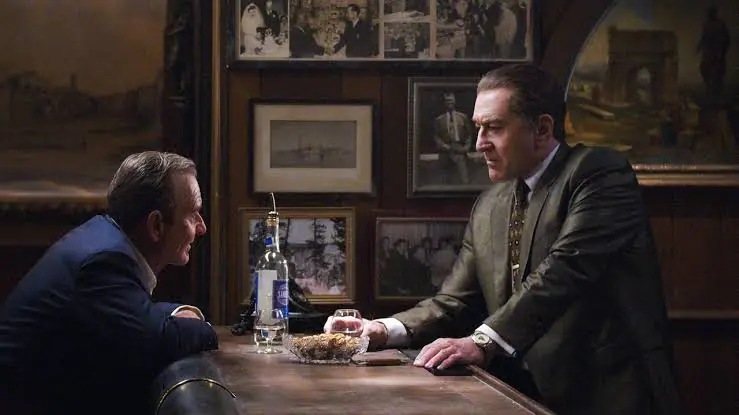
Robert De Niro carries the picture as Frank by playing him as a fundamentally passive man, someone who follows instructions for fifty straight years and never once stops long enough to ask himself what he is actually doing or who he is becoming. Joe Pesci’s turn as Russell Bufalino is the quietest work of his entire career and a complete inversion of the explosive characters that made him a legend in this genre, a man who gets every single thing he wants by lowering his voice rather than raising it, and the restraint is unnerving once you adjust to it. Al Pacino’s turn as Hoffa supplies the only real energy in the picture and is the one performance here permitted to be loud, which is precisely why his absence from the final stretch hangs over the film as heavily as it does. The best scenes in the whole movie are the conversations about enormous news stories conducted as quiet, almost banal exchanges between men sitting in rooms, and that is where Scorsese’s control over this material is most visible, because he trusts the understatement completely. Whether you read the ensemble’s reserve as deliberate or as a genuine limitation is the entire argument people have been having about this film since it arrived.
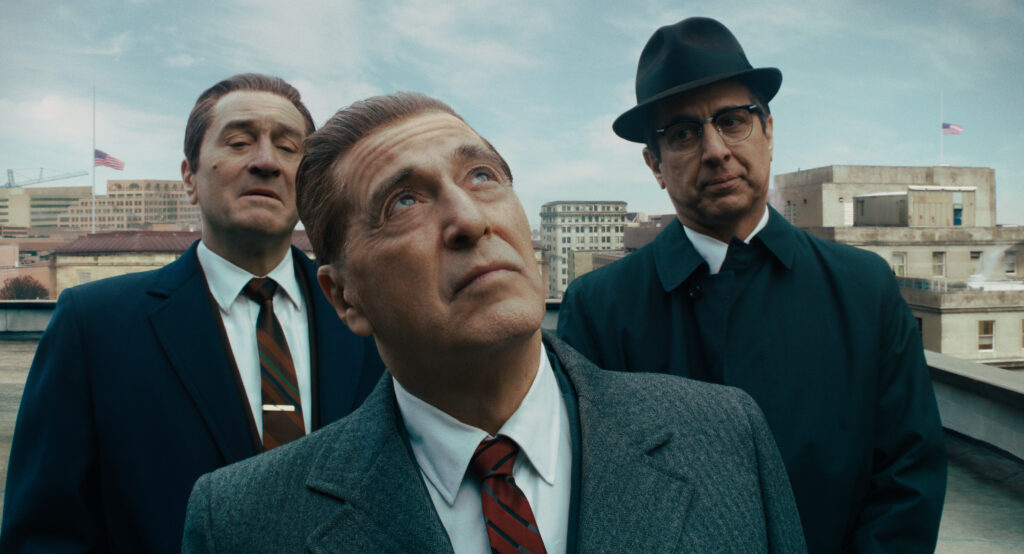
The scale here is unmatched anywhere in Scorsese’s filmography, with more locations and more sets than anything else he has ever mounted and a story that spans decades of American life without ever collapsing into montage. The pacing is the single most divisive element in the film, because the movement is enticing throughout, and yet it requires nearly two full hours before the tension and the philosophical commentary that define the picture finally take hold. That extremely slow burn is a deliberate structural choice rather than any kind of mistake, since this is a film about a man looking back on a life that has already finished happening, but it unquestionably costs the film a portion of its audience. The color saturation is the one craft decision worth pushing back on, since it gives a gritty mob story a cleaner and more mainstream sheen than this subject matter ever called for. Everything else about the framing is exactly right, with the camera composing each scene the way a Scorsese film has always been composed and the whole thing moving with the confidence of a filmmaker who has nothing left in the world to prove.
The end of this film is truly amazing precisely because all the commotion is gone, and what remains is simply Frank living out the last years of his life alone, methodically planning the details of his own death. Selecting his coffin and picking out the crypt he will eventually occupy is a reflective final act carried out by a man who is finally beginning to feel some measure of remorse for lying to Hoffa earlier in the film, and Scorsese stages all of it with no music and no release whatsoever. There is no reckoning here, no punishment and no confession that anybody actually hears, only an old man asking the departing priest to leave the door open a crack, which is the bleakest possible conclusion this genre could have been given. It is Scorsese at his most meditative and his most intelligent, deliberately refusing the operatic violence that closed out Goodfellas and Casino in favor of something far quieter and considerably worse. This is a fatal end to his career in the gangster film genre he redefined, and every frame of that last stretch makes clear he knew exactly what he was doing when he made it.
The Irishman rewards patience more completely than almost anything else in Scorsese’s catalogue, and the viewers who bounce off it are almost always bouncing off those first two hours rather than off the film as a whole. Its greatest achievement is the structural decision to begin in the middle of a man’s life rather than at the start, which quietly converts the entire picture from a story into a memory. The craft is impeccable even in the places where its choices are debatable, and the sheer scale of what was assembled here is staggering for a film this interior and this withdrawn. It is the clearest statement Scorsese has ever made about what his gangster films were actually about underneath all the energy, delivered by a man sitting alone in a room with nobody left alive to tell. Earning an 87/100 from TwilightRoom, The Irishman is Martin Scorsese’s most ambitious work and the quiet, devastating full stop on a genre he spent his entire career redefining.
TwilightRoom Score: 87.7/100