The triple-short-story anime anthology using that hand-drawn animation style that has gone viral again over the past few years, this week’s Throwback Thursday
review is the 1995 collaborative project Memories — a three-part anthology whose stories share key attributes while exploring different forms of psychological, environmental, and war-driven horror through a distinctly ’90s anime lens. The film immediately establishes itself as a throwback in tone and style, leaning into a gritty sci-fi visual and experimental storytelling format that
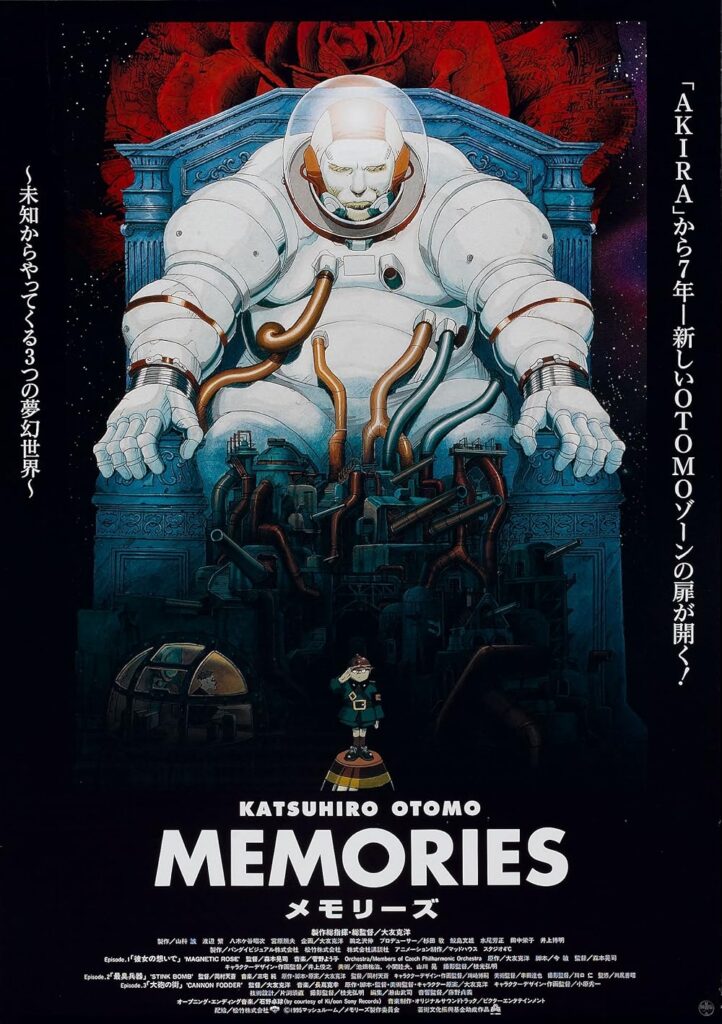
feels so raw and creatively unfiltered. Each segment presents a completely different narrative and world, but are all tied together through themes and memory, control, and human vulnerability, using the anthology format to allow for a wide range of storytelling approaches, from slow psychological horror to chaotic bio-disaster to anti-war allegory. Memories thrives on its bold creativity and distinct visual identity, delivering three uniquely compelling stories that vary in execution yet collectively showcase the power of animation as a medium for psychological and thematic exploration in ways live action simply cannot match.
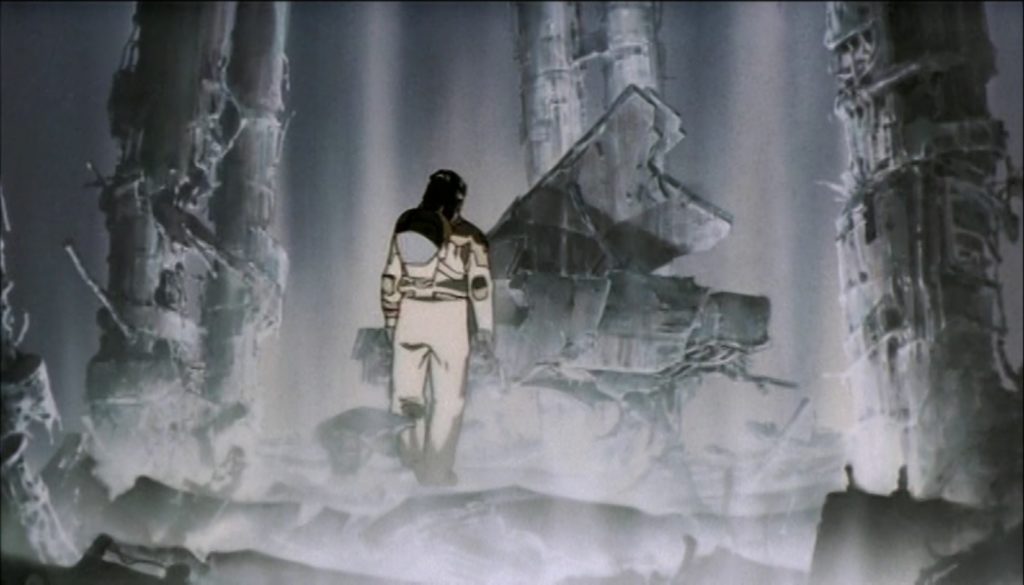
The first story, Magnetic Rose, begins with a space crew responding to a distress call, immediately grounding the audience in a classic sci-fi setup before shifting into something far more psychological and horrific. As the crew investigates the abandoned spacecraft in response to the distress signal, the environment begins to distort reality, folding their memories into the physical space in ways that trap them not only mentally but physically as well. The reveal that the station is shaped by the memories of a deceased opera singer, its rose-like, regal design feeling plausibly real because, on some level, it is, adds a haunting emotional core to the narrative. The story quickly transitions from exploration and curiosity in this weird environment into a psychological horror, as the crew becomes increasingly influenced and manipulated by the illusions around them. The concept of memory, in a film pointedly titled Memories, is weaponized here and pushed to the center, transforming what begins as a nostalgic curiosity into a longing gaze at a dangerous, inescapable force with startling speed.
The station itself functions as a siren-like entity, drawing the crew in through familiarity and emotional attachment, echoing ancient myth while translated into a sci-fi setting. Each of the three segments, in turn, feels deliberately shaped in the image of a distinct historical moment. In Magnetic Rose, the visuals shift into surreal and psychedelic territory, reinforcing the idea that the characters are no longer grounded in reality. The manipulation of personal memories, especially family and past trauma, creates a deeply unsettling psychological tension. The ending of this segment reveals the full extent of the illusion, showing just how completely the characters have been consumed by the fabricated world, led down a new road of delusion. As a whole, ‘Magnetic Rose’ stands as a strong first segment, combining emotional depth, horror, and visual storytelling into a psychological 40-minute short story that blows the doors off this seemingly fun throwback title.
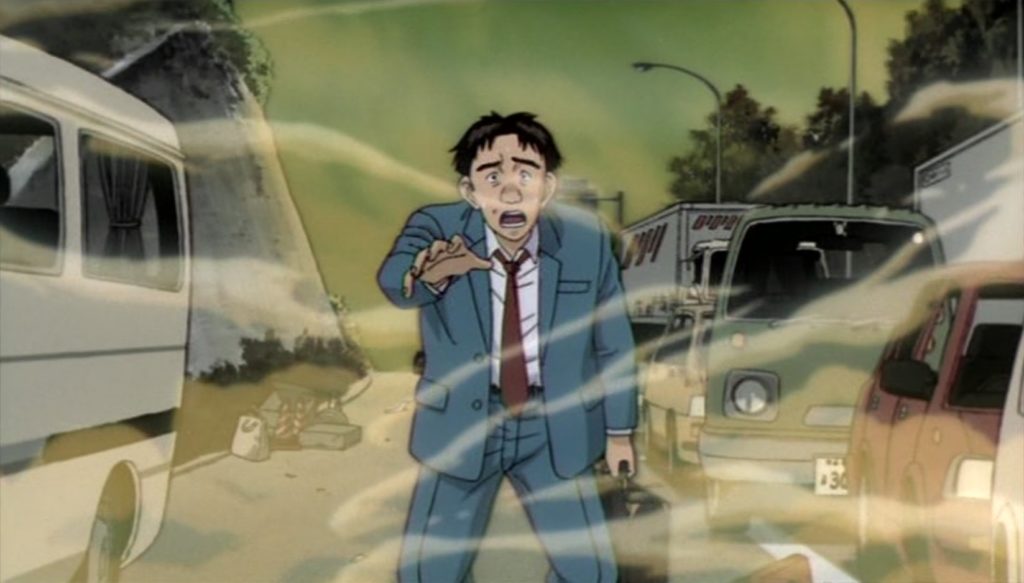
The second segment, Stink Bomb, is an immediate tonal shift from the psychological horror of Magnetic Rose into something far more chaotic, absurd, and satirical, while still maintaining the film’s overarching themes of control and human vulnerability. The story follows Nobuo, a low-level lab assistant who unknowingly ingests an experimental pill, only to become a walking bio-weapon emitting a deadly gas that kills anyone who comes near him. What makes this segment so effective is its complete commitment to irony, as Nobuo moves forward believing he is simply completing a normal assignment, completely unaware that he is leaving a trail of destruction behind him that escalates from a small incident into a full-scale national disaster.
As the military and government attempt to contain the situation, the narrative expands in scale, showcasing a satirical breakdown of authority and control, where no system in place is capable of stopping something so unintentionally catastrophic. The animation becomes more exaggerated and chaotic to match the tone, leaning into fast-paced sequences and large-scale destruction that contrast heavily with the slow, controlled pacing of the first story. While it lacks the emotional and psychological depth of Magnetic Rose, Stink Bomb thrives on its dark humor and commentary, turning a simple concept into a wildly entertaining critique of institutional incompetence and the dangers of unchecked scientific experimentation.

The final segment, Cannon Fodder, stands as one of the most striking and impressive pieces of the entire anthology, and for me, it’s right there, tied as the best of the three with Magnetic Rose. From the jump, it separates itself stylistically, presenting a bleak, militarized society where every aspect of life revolves around firing massive cannons at an unseen enemy. The story follows a young boy and his family through a day in this world, showing how normalized war has become, not as an event, but as a routine, a job, and ultimately a purpose. What makes this segment so effective is how grounded it feels compared to the others, stripping away the surreal chaos and instead leaning into a rigid, almost oppressive structure where everything is controlled, repetitive, and unquestioned.
Visually, Cannon Fodder is incredible, using a steampunk-inspired design and a continuous, almost seamless flow of movement that makes the entire city feel alive yet completely trapped within its own system. The lack of a visible enemy becomes one of its most powerful elements, reinforcing the idea that the war itself is more about control and conditioning than actual conflict. Through the child’s perspective, the film explores themes of propaganda, indoctrination, and generational repetition, showing how a society can raise its people to accept and even take pride in something so destructive. Unlike the other segments, this one doesn’t rely on spectacle or twists, it builds its impact slowly through world-building and theme, and by the end, it leaves one of the strongest impressions of the entire film, cementing it as one of the most powerful and memorable parts of Memories.
Each story escalates in a different way, from internal psychological horror to external biological chaos and then to systemic societal control. Magnetic Rose builds tension through isolation and memory manipulation, culminating in a full mental collapse, making it the short typically associated most with the title. Stink Bomb is the weakest entry but escalates through scale, turning a small mistake into a nationwide disaster. Finally Cannon Fodder is the most conceptual as it escalates, revealing the long-term consequences of a society built on war fighting an enemy they will never see. The anthology structure allows these different forms of escalation, horror, and animation to coexist, showcasing a wide range of storytelling approaches. The film doesn’t rely on a single climax in any of its parts, instead leaving the audience with distinct emotional and thematic conclusions.
Memories (1995) stands as a bold and creative entry into the 90s anime climate as an anthology that takes the medium and uses it to highlight the strengths of the storytelling and the ability to dive deep. While not every segment reaches the exact same level of quality, the overall experience remains compelling, memorable, and conceptually connected. The film succeeds most when it leans into psychological depths and thematic exploration as its visual identity and willingness to experiment make it a standout piece of 90s animation. Ultimately the film remains fascinating and worthwhile, particularly for fans of sci-fi and experimental storytelling through a throwback lens, earning it an 81/100 from the TwilightRoom.
Twilight Room Score 81.0/100