This week’s Throwback Thursday review revisits Sydney Pollack’s frontier western Jeremiah Johnson, a deliberately paced Technicolor western that strips the genre
down to isolation, survival, the natural world, and the emotional cost of life in the mountains. The film opens with a full overture and immediately establishes itself as heavily driven by music, atmosphere, and gorgeous national park western imagery rather
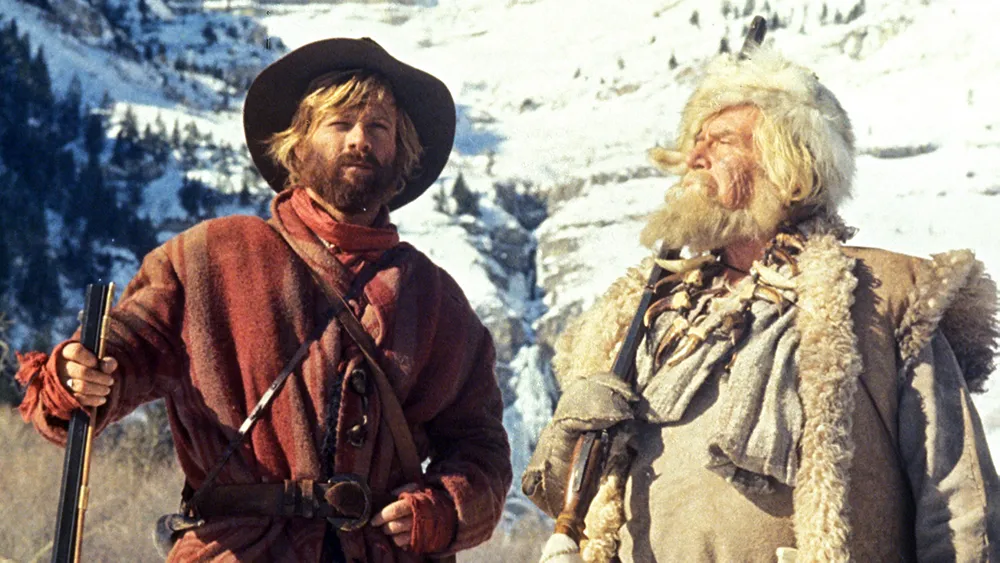
than traditional Hollywood set fast-paced storytelling. Robert Redford’s Jeremiah Johnson is introduced as a mountain man attempting to live peacefully and independently as a hermit in the wilderness, operating outside society with only his horse and the brutal yet gorgeous environment around him. From the very beginning, the film’s cinematography of snowy mountains, forests, rivers, and open landscapes creates one of the most visually stunning western settings of the 1970s while reinforcing the harsh beauty of frontier life. Jeremiah Johnson succeeds because it uses the western genre not simply for gunfights and survival, but as a film that must find you at the right moment; when it does, it becomes a deeply reflective character study of loneliness, human connection, violence, and the emotional consequences of isolation in the American frontier.
The narrative begins in an intentionally quiet, isolated way, following Jeremiah Johnson as he tries to survive alone in the mountains as a self-reliant mountain man, almost entirely separated from society. Rather than immediately leaning into western shootouts or major conflict, the film instead spends a large amount of time simply observing the brutality and unpredictability of frontier life itself. Jeremiah discovers frozen bodies in the snow, struggles for food and warmth, and slowly learns how unforgiving nature truly is, despite the beauty constantly surrounding him. The film’s episodic structure allows different characters and survival situations to naturally enter Jeremiah’s journey, making the wilderness itself feel like the main driving force of the story rather than a singular plot objective. Early interactions with Native Americans initially seem peaceful enough, but there is always an underlying tension surrounding land, territory, and survival that Jeremiah repeatedly finds himself caught in the middle of throughout the film.
Jeremiah Johnson is presented as a man constantly searching for isolation and peace, but the film repeatedly shows that he cannot emotionally separate himself from the suffering of others around him. One of the strongest early examples comes when Jeremiah discovers a woman surrounded by the dead bodies of her family outside her cabin, clearly broken emotionally while still waiting for hope to somehow return. Jeremiah helps her rebuild parts of the cabin and slowly becomes tied to a life he never originally planned for himself, eventually taking responsibility for her young son despite initially wanting to remain completely alone. Robert Redford’s performance works so well because so much of the character is communicated through silence, expression, and physical presence rather than large emotional speeches. Even while Jeremiah consistently attempts to return to isolation, the film slowly reveals him to be someone naturally drawn toward helping others despite how badly he wants to disconnect from humanity altogether.
One of the film’s greatest strengths is unquestionably its cinematography, with the snowy mountains, rivers, forests, and massive frontier landscapes creating some of the most beautiful western imagery of the entire decade. Sydney Pollack constantly frames Jeremiah as a small figure against the overwhelming scale of nature, reinforcing both the beauty and danger of the wilderness around him. The western score and overall sound design heavily strengthen the atmosphere, helping the film feel meditative and reflective during long stretches where very little dialogue is spoken. There are moments where the film almost feels experimental in how focused it becomes on pure visual storytelling rather than traditional narrative movement, particularly through long traveling sequences and environmental imagery. Even when the plot slows considerably, the atmosphere remains engaging because the world itself is so immersive and visually striking throughout nearly every scene.
The strongest thematic conflict in Jeremiah Johnson comes from the battle between isolation and companionship, with Jeremiah constantly being pulled away from the lonely life he originally sought in the mountains. After taking in the young boy and eventually forming a family unit, the film begins exploring how difficult true isolation actually becomes once emotional attachments are formed. There is even an almost comedic quality at times watching Jeremiah attempt to navigate family life with a wife he cannot fully communicate with and a child suddenly relying on him in the middle of the frontier. Beneath that lighter surface however, the film constantly reinforces that companionship gives Jeremiah purpose in ways isolation never fully could. Even as he tries to live detached from society, Jeremiah continuously becomes emotionally responsible for the people around him, reinforcing the idea that complete separation from humanity may not truly be possible.

The film consistently places Jeremiah in the middle of larger frontier conflicts surrounding territory, prejudice, and cultural division between settlers, soldiers, and Native American tribes. Early interactions with Native Americans are handled with a calm, surprisingly respectful restraint compared to many westerns of the era, though tension always simmers beneath the surface as violence slowly escalates around Jeremiah’s journey. The cavalry storyline especially reinforces how arrogance and misunderstanding from outsiders needlessly intensify conflict, even as Jeremiah understands the dangers of the land far more clearly. Jeremiah slowly becomes almost a bridge between worlds, connecting with Native Americans while still clearly existing within white frontier culture, even as prejudice around him remains obvious. The film avoids making these conflicts feel simplistic, instead portraying frontier life as morally complicated and constantly shaped by fear, survival, and misunderstanding between cultures trying to coexist on the same land.
Jeremiah Johnson is undeniably a slow-moving western, taking a long time to fully reveal its emotional direction and larger thematic impact, but the pacing ultimately works in favor of the film’s reflective tone. The episodic structure can occasionally make the narrative feel loose or wandering, though that style also mirrors Jeremiah’s actual life drifting through the wilderness from one survival situation to another. Rather than building toward one singular explosive climax early on, the film patiently develops Jeremiah’s relationships, emotional attachments, and gradual transformation over time. Because the story spends so much time establishing his quiet life and emotional growth, the later tragedy surrounding his family becomes genuinely devastating and shifts the tone of the film dramatically. The slower pacing may not immediately appeal to viewers expecting a more action-heavy western, but it allows the emotional payoff and atmosphere to linger much more powerfully by the final act.
The emotional core of the film completely changes once Jeremiah returns home to discover the loss of the family and peaceful life he had slowly built throughout the story. From that point onward, the film becomes much darker and more emotionally exhausting as Jeremiah abandons the happiness he briefly found and fully commits himself to survival and revenge. The later battle sequences show years of violence slowly wearing him down physically and emotionally, with Jeremiah appearing increasingly broken, exhausted, and detached as conflict continues surrounding him. Even though the film becomes more violent in its second half, the focus never shifts toward glorifying revenge or action spectacle, instead emphasizing the emotional emptiness that follows Jeremiah after losing everything meaningful in his life. The montage of battles and survival throughout the final act reinforces how the frontier has completely stripped Jeremiah down emotionally, leaving behind only a man continuing forward because he no longer knows anything else.
Jeremiah Johnson separates itself from many traditional westerns because of how reflective, atmospheric, and emotionally philosophical it allows itself to become rather than relying primarily on spectacle or action. Sydney Pollack’s direction combined with Robert Redford’s restrained performance creates a deeply personal frontier story centered around loneliness, survival, and the emotional consequences of isolation. Even when the narrative becomes episodic or slower moving, the cinematography, music, and atmosphere consistently remain powerful enough to keep the film emotionally engaging. The western genre is often remembered for gunfights, heroes, and large-scale conflict, but Jeremiah Johnson instead focuses on the psychological weight of surviving in the wilderness and the emotional cost of choosing to separate oneself from humanity. It may not be the absolute pinnacle of the western genre, but it remains one of the most hauntingly beautiful and emotionally thoughtful westerns of the 1970s, delivering a frontier story that quietly stays with the audience long after the credits roll.
Jeremiah Johnson ultimately succeeds for me because of how it approaches the western genre from a far more reflective and emotional angle, focusing less on spectacle and more on psychological weight, an approach common to many 70s westerns but done especially well here. Sydney Pollack’s direction paired with the incredible cinematography turns the mountains, forest, and snowy landscape into one of the most immersive and visually beautiful settings in any western of its era. Robert Redford gives a restrained performance that perfectly captures a man constantly pulled between the desire for total isolation and the emotional need for human connection, family, and purpose. The slower pacing means this film will not work for everyone, but by the final act the emotional payoff surrounding Jeremiah’s loss and loneliness becomes genuinely powerful and quietly devastating. Even when the narrative drifts or becomes episodic, the atmosphere, music and philosophical themes surrounding survival, violence, and companionship continue carrying the film forward. Jeremiah Johnson remains one of the most thoughtful and emotionally haunting westerns of the 1970s, paving the way for films like one of my favorite modern westerns in Train Dreams, ending as a tragic story about a man who finally attains the isolation he thought he wanted, only after losing everything that once made his life meaningful, earning it a 90/100.
TwilightRoom Score: 90.1/100