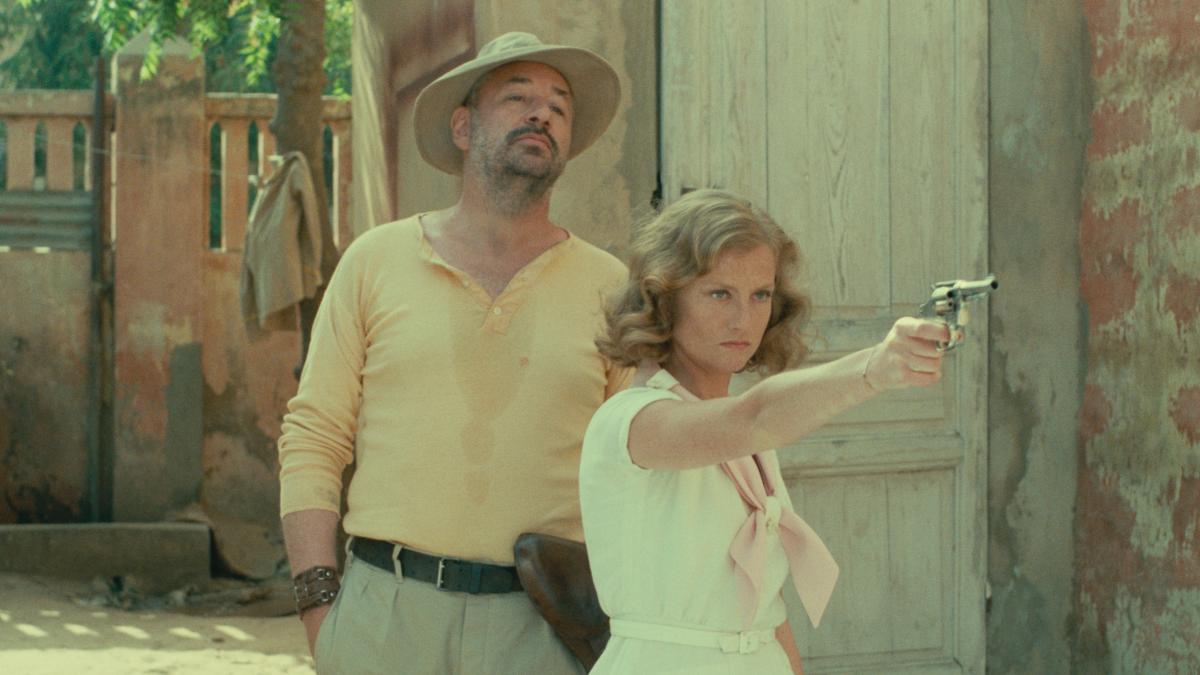
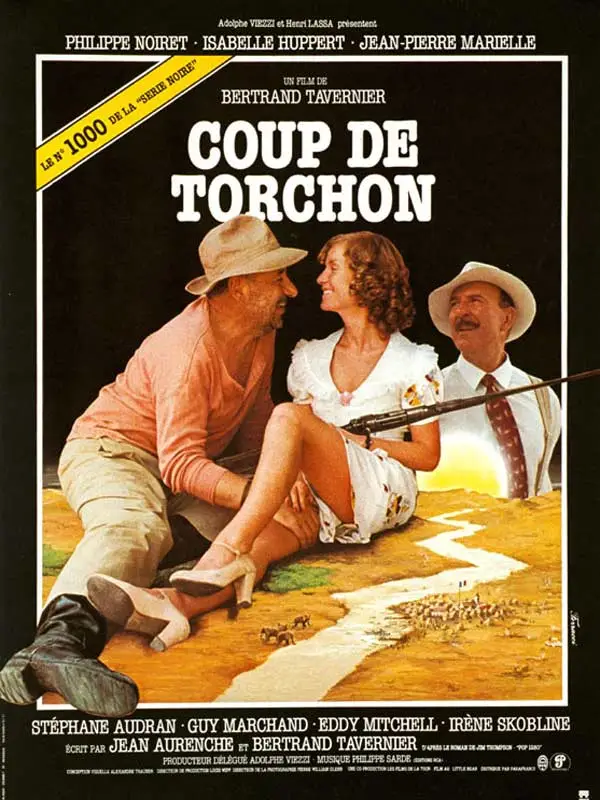
Coup De Torchon is this week’s entry for Criterion Tuesday directed by Bertrand Tavernier, it feels like a noir story at its core, but flipped entirely on its head, taking familiar structure of moral descent and placing it in a French environment that visually and tonally contradicts that which it imitates.
Instead of dark city streets, the film is set in French West Africa, where the heat, openness, and stillness create a completely different kind of tension. The film presents itself almost casually
at first with its downfall on its main characters, but slowly reveals itself as something much darker and more unsettling. Coup de Torchon reworks the noir into something far more uncontrollable and ironic of a story, using its setting, tone, and character descent to expose violence and moral decay in a way that feels both detached and deeply disturbing.
The film follows Lucien Cordier, a police officer who is openly disrespected by nearly everyone around him, including his wife and both the criminal, and normal everyday community of the town he works in. He exists in a constant state of humiliation, gossip, and powerlessness, making him feel almost invisible within a place he is designed to be enforcing. This positioning through the film’s first 30 minutes sets up his eventual shift and overall premise of the film, building him towards reacting to the humiliation in much more sinister ways than expected. Lucien’s breaking point comes when he kills the two pimps who had been humiliating him for the entirety of the beginning of the film, marking a clear turning point in his character and setting the tone for the reason this film is entered into the Criterion Collection. From there, he begins to change, becoming more confident and controlled, but also increasingly detached and dangerous, in an unorthodox time progression of a main character. His transformation is subtle at first but gradually becomes much more extreme, as he finds new relationships and continues committing acts of violence with a growing sense of his own justification.
Perhaps the most striking aspect of the film is how the writing and design balances humor with violence and murder, often making moments feel oddly casual and lazy despite their severity and overall inhumanness. The humor never fully relieves the tension created, instead making the violence feel more unsettling because of how moral certain things are treated by Cordier and how the film portrays his actions. This tonal balance really creates a strange viewing experience, especially for a French film, where the plot feels both ironic and disturbing at the same time.
Lucien’s dynamic with Rose, his wife’s sister, becomes central as the film progresses and he falls deeper and deeper into self justification, especially after he confesses his actions to her. Their relationship grows more and more intimate, but it is rooted in a manipulation, secrecy, and shared detachment from morality. Even moments that feel like a true connection between the two are constantly left unstable, existing within a much larger chaos surrounding Lucien’s actions and the environment he lives within. As Lucien continues his killing spree subtly, the acts begin to feel less shocking and more like a natural and moral extension of his increasingly deranged character. The film shows how quickly he adapts to this new identity, moving from passive victim to active source of aggression that seemingly always loomed in his mind but was just waiting for a breaking point. The normalization of their transformation and violence makes up the film’s trademark unsettling moments and identity. Characters like Rose and his wife become more and more affected by Lucien’s actions, even when they are not directly responsible or involved. Rose’s relationship with her sister becomes increasingly violent as well, showing just how much Lucien’s presence disrupts everything around him, like an ecosystem breaking apart. Rose ultimately turns to killing as well, reflecting how the cycle of violence spreads beyond just our main character himself.
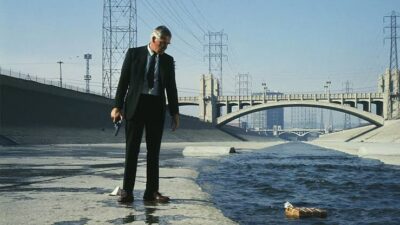
Visually the film is the opposite of a traditional noir, like The Big Heat, using bright, beaten down, open spaces instead of shadow, Hollywood sets, and confinement. The setting in French West Africa plays a major role in how the tone of the film is shaped, emphasizing heat, stillness, and discomfort. The contrast between narrative and visual style makes the film feel extremely unique and defining, reinforcing its thematic inversion of the noir as an inspired but opposite piece of film history.
The final scene, in which Lucien pulls a gun on a boy, serves as the culmination of his complete moral collapse. At this point, there is no ambiguity left in his character, Lucien has fully embraced his detachment and lack of humanity. The film ends on a note that reinforces how far Lucien has fallen from the passive figure that is introduced in the beginning of the film. Coup de Torchon stands out by taking a familiar genre structure and completely reshaping it through its tone, and setting finding a new way to deliver international thrillers. Lucien’s transformation is not explosive but gradual, making it feel more realistic and more disturbing. The film’s box of humor, violence, and detachment creates something that lingers, not because of shock, but because of how normal everything begins to feel.
Twilight Room Score: 73.7/100