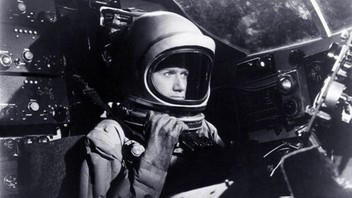
First Man Into Space immediately begins with a fifties-vibe science fiction premise that exudes the atmosphere of its exact moment
like almost nothing else from the decade, arriving at a point when the question of what was waiting beyond the atmosphere was still up in the air and every studio was scrambling to provide the most entertaining answer. What separates this film from the enormous pile of films chasing the same idea is that it is far more interested in the cost of ambition rather than in the monster doing the killing, falling into the Criterion DVD box set Monsters and Madmen that places it as my Criterion Tuesday review of the week. The film is unmistakably a
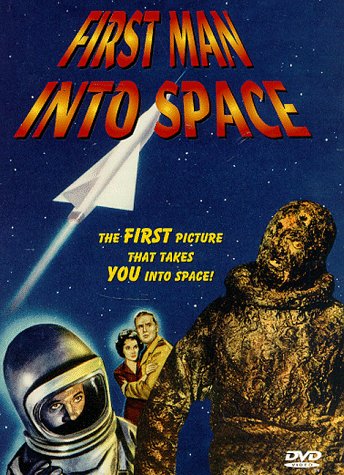
product of its era in texture, pacing and construction, built on long stretches of men in uniform talking through readouts in sparse rooms, and while that approach gives it the vibe it is looking for, it also means a modern audience needs to allow some patience to come into play. It’s a solid film, that doesn’t quite hold up half a century later, persistent to the time period it is a part of, which is the single biggest thing holding it back from the reappraisal its fans continue to call for. First Man Into Space delivered an entertaining film that was rather impressive in its commentary, which is the correct expectation to carry into a film of this size and reputation from MGM, and the final ten minutes do enough heavy lifting to make the film worth checking out as a short 80 minute throwback watch.
We enter a base positioned squarely between Earth and a space mission and are tossed directly into the fray of a military operation that blends sky, space and ocean into one continuous theater, with a score clearly building toward something enormous long before the film has anything enormous to show us. Commander Chuck Prescott opens the picture doubting whether his brother Dan should be flying the rocket-powered Y-13 at all, and Captain Ben Richards and Dr. Paul von Essen overrule him on the grounds that Dan is simply the best pilot they have, which is the entire film compressed into a single argument that nobody ever actually wins. Dan then ignores his instructions outright, refuses to level off at six hundred thousand feet and keeps climbing to roughly two hundred and fifty miles purely so that he can be the first man into space, passing through a dense cloud of unknown material before losing control of the aircraft entirely and ejecting into something nobody on the ground has a category for. The wreckage comes back encased in a rock-like substance that defeats X-rays, infrared and ultraviolet light alike, and almost immediately afterward something begins moving through New Mexico killing cattle and then a blood bank nurse, draining them completely, with the only physical evidence being shiny specks of meteor dust left in the wounds. The structure here is genuinely clever and almost never gets credit for it, because the film runs a full police investigation into a creature whose identity the audience has known since the twenty-minute mark, which converts what should be a mystery into a slow and increasingly uncomfortable walk toward a conclusion we are already dreading on Chuck’s behalf.
Marshall Thompson carries the investigative half of the film as the pilot’s brother and is steady enough to keep a very talky middle section upright, doing the thankless work of making procedural exposition register as a man’s private horror rather than as a scientist reading findings aloud. Bill Edwards has the considerably harder job of playing both the reckless man at the start and the thing he becomes by the end, and the creature make-up is genuinely effective for the era and the money, an encrusted, wheezing, barely mobile figure that the film consistently frames as pitiable rather than monstrous, which is essential to everything the ending is trying to do. The seams show most badly in the geography, because this was shot mostly in England while being set in America, and the British countryside stubbornly refuses to look anything like the American Southwest no matter how carefully Robert Day frames around it, producing a contradiction that never fully stops nagging. The film also leans heavily on stock footage of the Bell X-1A and a Redstone launch to sell its flight sequences, and it works far better than it should, partly because black and white flattens the difference between the real footage and the staged material and partly because the score pulls you past the point where you would otherwise notice. Day’s direction is the quiet strength of the entire production and the real reason the film still has defenders, because he is patient in a way the genre almost never was in 1959, holding on faces and empty rooms rather than cutting to the monster at the first opportunity, and that restraint is what lets the final act land as tragedy instead of spectacle.
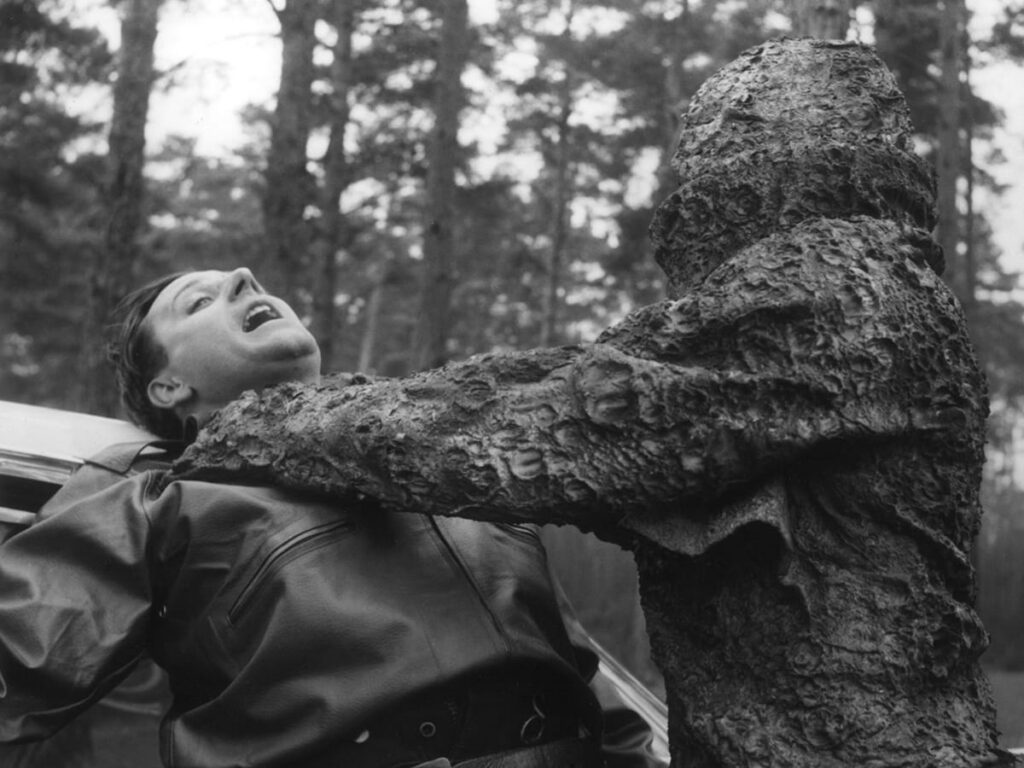
The film finishes not with horror but with a conversation, as Dan, now fully morphed into the creature, is tracked into the high-altitude chamber and the pressure inside is deliberately lowered to thirty-eight thousand feet so that he can breathe well enough to speak, with von Essen talking Chuck through the controls from outside. That is a very different ending for a creature flick than most audiences of that period or any period since are used to, because the monster is not hunted down, cornered and destroyed, it is accommodated, given the atmosphere it needs and then asked what happened up there. His humanity returns for a single moment and he says that he just had to be the first man into space before he dies, and the entire film reorients itself around that line in a way that recontextualizes every slow, procedural scene that came before it. What has looked for forty minutes like a blood-draining monster picture becomes a tragedy about a man who got precisely the thing he wanted at the exact cost of being able to enjoy it, changed irreversibly by the cosmic rays into something that could not survive its own achievement, with his brother standing in the room for all of it. It is the best sequence in the film by an enormous margin, it is the single strongest argument for seeking the film out, and it is the reason a largely forgotten B-picture from 1959 is still being written about at all.
This is a low-budget British monster film from Amalgamated Productions and functions as a direct companion piece to the studio’s much more famous Fiend Without a Face from 1958, which along with The Haunted Strangler had performed well enough commercially to convince Richard Gordon and Charles Vetter that there was room for another swing at the same audience. The story grew out of Wyott Ordung’s script Satellite of Blood, which American International had already rejected, before Alex Gordon passed it along to his brother and its ideas were folded together with Vetter’s own, and the finished film borrows heavily and openly from The Quatermass Xperiment in 1955, right down to the central premise of an astronaut who comes back from orbit as something that is no longer a person. Selling the picture to MGM lifted the budget to a hundred thousand pounds, considerably higher than the producers’ two previous films had been working with, and MGM premiered it in February of 1959 before putting it into fifty Los Angeles theaters that May as the second half of a double bill with The Mysterians. Most of the studio work happened at a mansion near Hampstead Heath chosen specifically because it resembled Central Park, with additional location shooting near a Brooklyn air base and in New Mexico, which explains both the geographic ambition and the persistent sense that the American exteriors are not quite where they claim to be. Edwards’ creature costume ran so hot and ventilated so poorly that he could only wear it for short stretches before having to come out of it, and every line of his dialogue in the final act had to be dubbed in during post-production, a small production constraint that ends up shaping the strange, disembodied quality of the film’s best scene.
Released directly into the space race at the exact moment when every studio was racing to get something cosmic in front of audiences, the film arrived with a built-in intrigue it did not entirely have to earn, and it converted that timing into a real if modest commercial success at roughly six hundred thousand dollars worldwide. It has been largely forgotten in the decades since, surfacing mainly through its inclusion in Criterion’s Monsters and Madmen set, and the people who do remember it tend to regard it as an underrated entry in fifties British science fiction specifically because of Robert Day’s unusually restrained style of directing. It is a fun creature flick built on a genuinely interesting science fiction premise with a real streak of body horror running underneath it, and an ending considerably smarter and sadder than the picture surrounding it ever prepares you for. Nothing here is monumental though, and the film never fully escapes the feeling of being one of a great many that looked, sounded and moved exactly like it in 1959, which is ultimately what keeps it from the status its champions keep arguing for. A solid, largely forgotten piece of its era that rewards the curious without ever quite demanding to be rediscovered, carried across the line by a final act that understands exactly what its monster really is, earning a 67/100 from the TwilightRoom.
TwilightRoom Score: 67.9/100