Rather than trying to reinvent the franchise after a major misstep with the first entry, Mortal Kombat II goes all in, fully embracing the ridiculous fantasy
chaos, tournament structure, and over-the-top violence that audiences actually want from this franchise. The sequel immediately upscales everything introduced in the first film, kicking off with a call to tournament action via Shao Kahn’s invasion of Edenia and the looming threat to Earthrealm,

establishing a much more fan-service-driven fantasy atmosphere than the original. The film takes a step back from its main character of the first by establishing new additions like Kitana and Johnny Cage that lead the way and help give the sequel a slight bit more personality and entertainment value, even as the dialogue and storytelling remain extremely messy, sloppy at times and surface-level consistently. The film clearly prioritizes spectacle, gore, and fight choreography, delivered through fan-service kill cuts—over coherent writing, leaning fully into video game adaptation energy rather than attempting emotional depth or realism. Mortal Kombat II is a dumb, occasionally entertaining sequel that improves on the first film with larger-scale action, fan-service character moments, and ambitious tournament spectacle, but its sloppy writing and weak emotional stakes keep it from being anything more than disposable fun.
The opening scene of the film establishes Shao Khan’s takeover ambitions, as well as Kitana’s main character inclusion, introducing the higher stakes and a more fantasy-heavy direction centered around realms, power struggles, and large-scale invasion. The film fast-forwards from Kitana witnessing her father’s death at the hands of Shao Kahn to years later, letting characters and rivalries feel pre-established without actually developing them, and simply dropping Kitana in as a double agent alongside characters we’ve barely been introduced to. Earthrealm’s fighters are once again pulled together after the events of the first film, this time through the more direct tournament structure involving all the champions, and leads to the recruitment of their final fighter in Johnny Cage. The narrative structure, especially when establishing the new plot, functions mostly as setup for character pairings and fights rather than as a carefully developed fantasy story.
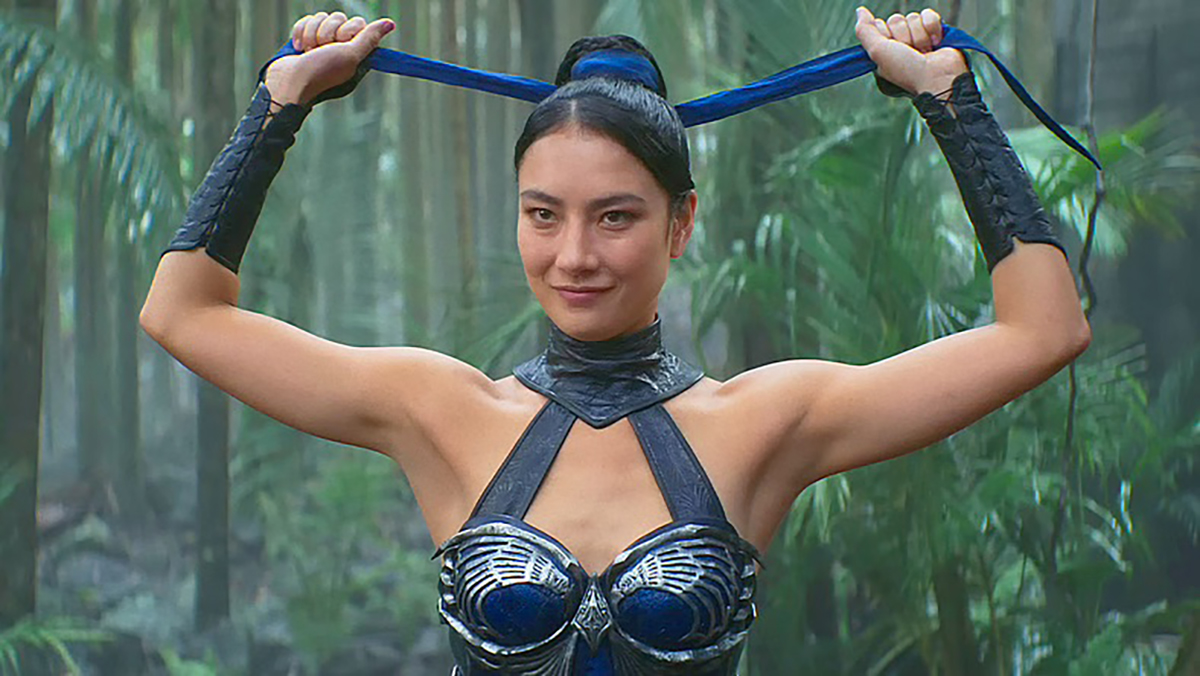
Johnny Cage, played by Karl Urban, is the real draw here and quickly becomes one of the film’s main focuses, bringing comedic arrogance and a much older, more down-on-his-luck version of the character that, while not always well realized, at least injects some life into an otherwise stiff script. Kitana works surprisingly well as both a fighter and a conflicted figure, revealing her allegiance to Earthrealm while carrying much of the sequel’s emotional core and responsibility as a protagonist. While Shao Kahn serves as an intimidating, large-scale villainous presence, he remains quite shallow, defined more by spectacle and brute domination than by any real complexity. The film leans heavily on the return of Kano, the only real bright spot of the first movie and, once again, perhaps the only consistent comedic element of the second, adding a chaotic energy and comic-book-style antihero vibe that fits the exaggerated tone and makes him the one character who actually feels perfectly realized. Most of the supporting characters are also serviceable, serving as recognizable franchise pieces around the board for fan service and action sequences moving the plot forward rather than having much substantial development. Making most characters fall on the same scale of medium to mildly entertaining at best, that perform best when fighting to the death against each other.
The dialogue throughout the film is consistently weak, often sounding like exposition dumps or setup lines designed only to move towards the next fight scene and not to really connect with an audience. Emotional moments, especially those involving Jade and Kitana, or Cage and his newfound purpose, rarely land, because the screenplay moves far too quickly, with too much going on, and refuses to sit with any dramatic consequence for long. Characters’ motivations shift abruptly, like Jade’s back-and-forth allegiances, making parts of the narrative feel rushed and underwritten, with unclear stakes as a necromancer simply runs around resurrecting fighters left and right, undercutting any real threat of death. The writing clearly understands that audiences are primarily here for spectacle, but from a critical perspective this approach leaves much of the film feeling dramatically empty between fan-service scenes; it’s a one-dimensional strategy. Despite these massive structural flaws, the film’s self-awareness and commitment to silliness occasionally work in its favor, because it never pretends to be smarter or less gory than it is.
The fight choreography emerges as the film’s biggest strength, delivering bloody, exaggerated battles and game-inspired callbacks that finally feel closer to the chaos associated with the IP. Early tournament fights clearly establish what the film is going for, showcasing a more ambitious sequel with faster pacing and a willingness to move rapidly between combatants and locations. Gore and brutal kills, especially the film’s final fatality, are genuinely entertaining and provide some of its most striking visuals, particularly during the larger-scale battles. Even when individual scenes and camera work lack emotional stakes or a focused vision, the sheer energy and momentum of the combat keep the film entertaining on a surface level and make it feel like an improvement over the 2021 original.

The sequel leans much further into fantasy-world imagery, embracing portals, magical realms, oversized sets, and supernatural powers constantly throughout the runtime, forgetting about the backdrop of earth and playing to the IPs strengths. Costume design really strengthens the adaptation’s feel, with characters like Kitana and Shao Kahn visually pulling much more directly from the games than many designs in the first film. Although this section is quite positive, a lot of the CGI effects look rough or unfinished, especially during larger magical sequences, but the practical environments and production design still carry visual charm, I just wish they tapped into that more, as the CGI dominates the film and is quite jarring. Visually, the film succeeds most when it stops trying to appear realistic in nature and instead fully commits to exaggerated game-style insanity, but tackles it with more practical effects and costuming than CGI.
When talking about themes in a massive-scale game adaptation, it can feel a bit like going through the motions, but loyalty does emerge as one of the film’s recurring ideas, particularly through Kitana’s growing rejection of Shao Kahn, her relationship with Jade, and her eventual decision to fight for Earthrealm in the final act. The film repeatedly frames power through domination and fear, showing Shao Khan ruling through intimidation and conquest while Earthrealm’s fighters survive mostly through trust and alliance building despite constantly being outmatched physically. Ideas surrounding destiny and chosen warriors are naturally embedded in the tournament structure itself, but the film never slows down enough to explore them with much nuance beyond surface-level fantasy blockbuster storytelling. Sacrifice and responsibility are also briefly touched on through Johnny Cage and the Earthrealm fighters putting themselves into impossible situations, despite knowing how overwhelming the odds are becoming. Ultimately though, Mortal Kombat II is much more interested in spectacle, violence, and crowd- pleasing franchise moments than deep thematic exploration, using these ideas more as connective tissue between fights than anything emotionally profound.
The racing is extremely fast for most of its runtime, constantly moving between locations, fights, and reveals without slowing down enough for emotional investment. The middle section becomes quite restive and tedious for something that is supposed to be so high octane, as it cycles through battle steps and alliance shifts without adding much narrative depth. The tournament framework helps maintain the momentum the film does possess even when the actual story becomes messy or difficult to follow logically, making the structure resemble a series of connected game missions or battles, more than a traditionally balanced film narrative, a common struggle for the transfer of mediums. Despite pacing issues and slight tedious moments, the sequel does overall avoid becoming as boring as its original, as it has some fun comedic moments and consistently introduces new fights, settings, and conflicts at the speed of light.
The final act fully embraces spectacle, intercutting Earthrealm’s battle against Shao Kahn with Johnny Cage’s mission to destroy the amulet that protects him. Kitana’s full turn toward Earthrealm becomes one of the emotional highlights of the finale, giving the climax at least some personal stakes and fun battles. The final tournament battles are messy but entertaining, filled with exaggerated violence, fantasy visuals, and chaotic energy, and they are definitely the highlight of the film. Johnny Cage’s role in destroying the amulet, with Jade turning to help, gives the climax a split-objective structure that keeps the movie running quickly, but from a technical standpoint it’s as messy as it gets—especially because Kitana and Shao Kahn’s fight is so much stronger. Earthrealm’s victory feels more earned through spectacle and momentum than narrative depth, but the finale succeeds as loud blockbuster entertainment.
Mortal Kombat II is ultimately a heavily flawed but more ambitious sequel that knows exactly what its audience is here for, prioritizing fights, gore, fantasy spectacle, and franchise fan service above all else. While the writing and dialogue remain consistently weak, the film improves with larger-scale action, a stronger visual identity, and a clear willingness to fully embrace the absurdity of its source material. Characters like Johnny Cage and Kitana aren’t the strongest, but they inject personality into the chaos, even if most of the more emotional storytelling remains heavily underdeveloped. Ultimately, this sequel to the Mortal Kombat film franchise may not function as a genuinely strong fantasy movie, but as a loud, chaotic, game-faithful fan-service blockbuster built around tournament spectacle, it delivers just enough entertainment to justify its existence, earning it a 44/100 from the TwilightRoom.
Twilight Room Score: 44.4/100