One of the more unsettling and under-the-radar indie horror releases of the month, Passenger has opened with mixed reviews, blending road-trip thriller, relationship
drama, religious horror, and modern jump-scare filmmaking into a tense but greatly imperfect supernatural horror experience. The film opens with two friends driving through isolated backwoods in the middle of the night, a moment pulled from the film’s hit, horrific trailer, with a surprisingly comedic and relaxed tone before immediately shifting into brutal horror through an abrupt

disappearance and bloody roadside sequence. Early scenes after the title card establish a strong atmosphere of paranoia and unease, with a strange figure appearing along the road, disturbing imagery, and the sense that something is deeply wrong during our main couple’s journey. The narrative transitions toward Maddie and Tyler, where we stay for the whole film, as their relationship slowly becomes intertwined with the entity of the passenger, in a film whose horror elements and cinematography deliver much more than the narrative even imagines. Passenger succeeds most through atmosphere, jump-scare execution, lighting, and psychological tension, creating a modern horror film that feels heavily inspired by online horror stories while struggling in many of the more narrative and lore-based aspects of the film.
The opening roadside disappearance sequence immediately throws the audience into discomfort as Daniel suddenly vanishes after stepping away from the car, later reappearing bloodied and begging for help before the film launches into its first major horror moment. The horror arrives almost instantly and very aggressively, functioning almost like an anthology-style nightmare-sequence intro to the passenger before the actual central narrative surrounding Maddie and Tyler begins. Maddie and Tyler being introduced as a couple traveling across the country are shown as two very different people, both interested in going on the road as nomads, but perhaps one being much more inclined to remain in the lifestyle in Tyler, as Maddie would like to eventually settle down. Their long nighttime drives through forests, empty highways, rainstorms, and isolated roads create a strong atmosphere early on, constantly reinforcing the vulnerability of being stranded far from civilization. Reports of missing travelers and strange roadside incidents slowly begin to surround the couple, creating a paranoia that the roads themselves may somehow be connected to it, just as the two begin to have their own internal struggles about their future together.
Passenger relies heavily on oppressive camerawork, dark lighting, road imagery, and carefully timed jump scares designed specifically to keep the audience uncomfortable, almost constantly serving as the clear standout aspect of the film. The film feels very representative of modern internet-era horror filmmaking, almost like a creepy Reddit horror tale at times, where atmosphere and disturbing imagery matter far more than a fully fleshed-out, coherent story. Strange roadside appearances, from the shadowy figure known as the Passenger to sudden visual distortions, reinforce the feeling that something trapping and unnatural is following the couple throughout their journey, making the impending sense of doom the most horrific aspect. The sound design and nighttime lighting work extremely well together, especially during the driving sequences, where the film creates fear almost entirely through tension and visual camerawork. While the narrative cohesion does weaken as more supernatural lore gets introduced, the atmosphere itself remains consistently effective and genuinely creepy for most of the runtime.
The central supernatural figure known as “The Passenger” is the clear draw here, slowly emerging as a demonic roadside entity closely tied to Maddie, and eventually Tyler, as well as the deteriorating psychological state of their relationship on the road. Initially, Maddie appears to be the only one capable of seeing the Passenger, creating uncertainty over whether the horror is truly supernatural or rooted in emotional and psychological instability. The Passenger works best when used sparingly, with the film relying on glimpses, silhouettes, sudden appearances, and unsettling imagery rather than constantly exposing the entity directly until the final act. Religious symbolism and demonic themes slowly become more prominent as the film dives deeper into faith, and spiritual corruption surrounding the creature itself. The mythology of the entity becomes much rougher and less effective once it is fully explained later in the film, but the ambiguity surrounding the Passenger helps maintain tension throughout the film’s most unsettling sections.
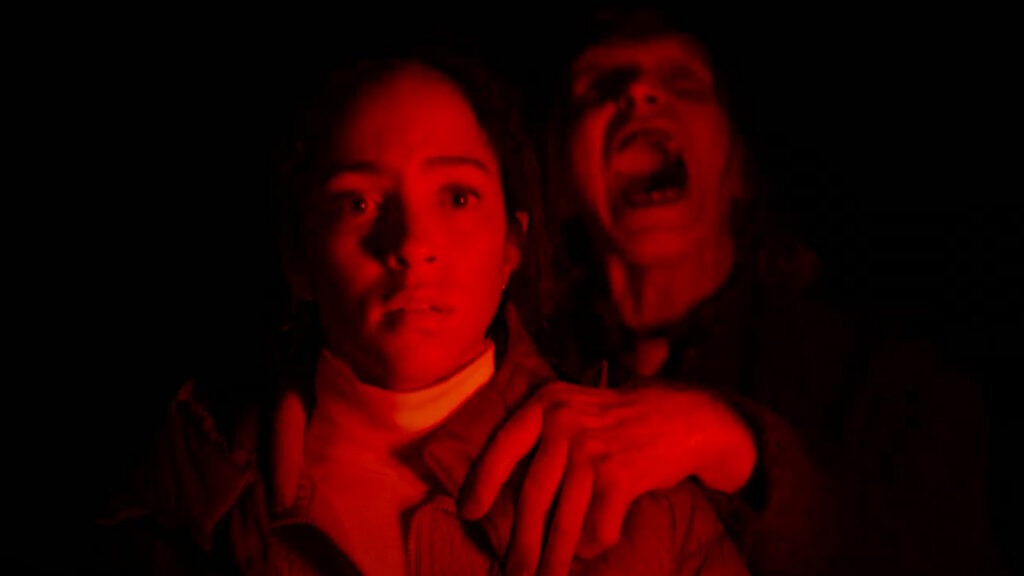
Much of the horror throughout Passenger actually comes from Maddie and Tyler’s failing relationship, with the supernatural terror acting as an extension of emotional distance and unresolved tension, and eventually a shared trauma that pulls them closer together once again. Conversations about their future, goals, and emotional disconnect are really the only type of narrative we really get in this film and thus become fundamentally what drives the film forward. The combination of relationship drama and supernatural horror works surprisingly well at times because both conflicts constantly fuel one another. Even during the quieter scenes without direct horror, the film maintains discomfort through awkward conversations, emotional exhaustion, and the growing sense that the relationship needs some fixing. As the narrative really surrounds the two it does a nice job weaving with the horror but as a standalone aspect falls quite short and hurts the films overall rating.
The visual direction throughout Passenger is easily the film’s strongest and most memorable aspect, using darkness, headlights, isolated roads, forests, and nighttime lighting to create a constantly unsettling atmosphere. Several horror sequences stand out purely because of how well the cinematography and lighting are handled, particularly the projector scene playing Roman Holiday in the woods which creates a surreal and genuinely creepy visual sequence through projected imagery and shadow work. The repeated imagery of endless roads disappearing into darkness reinforces the film’s themes of emotional isolation, uncertainty, and feeling trapped both physically and emotionally within the relationship itself. Once both Maddie and Tyler begin seeing the Passenger, the horror escalates significantly because the supernatural threat becomes undeniably real rather than potentially psychological or emotionally symbolic. Even as the story itself begins losing some structural cohesion later in the runtime, the visual atmosphere and strong horror direction continue carrying scenes through sheer tension and aesthetic execution alone.
The final act shifts much more heavily into organized religious horror involving St. Christopher’s church, demonic mythology, and the larger supernatural explanation behind the Passenger itself. While some of these ideas are interesting conceptually, the shift slightly weakens the grounded paranoia and mystery that made the earlier portions of the film much more effective and unnerving. The horror becomes far more lore-focused and structurally traditional compared to the eerie road-trip terror and relationship anxiety that dominate the first two acts. Maddie ultimately confronts the Passenger within the hidden church setting, leading to the destruction of the entity during the climax while Tyler becomes more directly involved in the supernatural conflict itself. Although the ending resolves the central supernatural threat, the final act lacks some of the atmospheric ambiguity, emotional discomfort, and psychological tension that made the buildup considerably stronger than the payoff.
Passenger ultimately feels like a film that understands exactly how to create fear visually, even if it struggles at times to fully connect all of its mythology, themes, and narrative ideas together cohesively. The atmosphere remains genuinely effective throughout most of the runtime, driven by oppressive camerawork, strong sound design, and excellent nighttime cinematography that constantly make the audience feel isolated and uneasy alongside Maddie and Tyler. The relationship drama at the center of the film works surprisingly well during many of the quieter moments, helping the horror feel more emotionally grounded rather than relying solely on supernatural imagery and jump scares. While the final act and lore explanations weaken some of the mystery surrounding the Passenger itself, the film still succeeds as an unsettling modern horror experience heavily driven by mood and visual execution. Passenger may not fully stick the landing narratively, but it absolutely succeeds at making audiences uncomfortable, tense, paranoid, and emotionally trapped throughout the majority of the journey, its not perfect and certainly lacks in many areas but is overall a solid new indie horror film and earns a 77/100 from the TwilightRoom.
Twilight Room Score: 77.2/100