Introduction
The partnership between Marlene Dietrich and Josef von Sternberg stands as one of the most famous director-star collaborations in Hollywood history, spanning seven films in total, six of them made in Hollywood at Paramount between 1930 and 1935. The arc of that collaboration is the story this article traces: the same partnership that launched Marlene Dietrich into immortal stardom slowly consumed Josef von Sternberg’s career, with her rise and his fall unfolding simultaneously across those same six films. Sternberg’s style, shadow, veils, smoke, and meticulous lighting, did not simply photograph Dietrich; it manufactured her screen image entirely from the ground up, creating not just a style but her very own art that no other director could replicate. Across these six films, Dietrich’s persona traveled the world, from Morocco to Russia to China to America to Spain, assuming male privileges of easy confidence, sexual authority, and emotional unavailability that made her unlike any other star of her era. What follows is a review of each of the six Hollywood films in order, from the generic beginnings of Morocco through the commercial peak of Shanghai Express to the partnership-ending The Devil Is a Woman, examining each film on its own merits, its story, and the state of the collaboration behind it at every step along the way.
The Blue Angel & Paramount’s Gamble
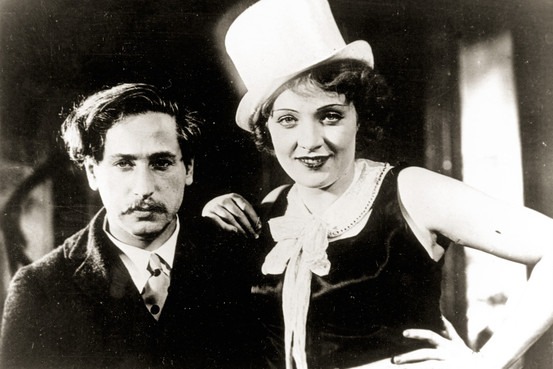
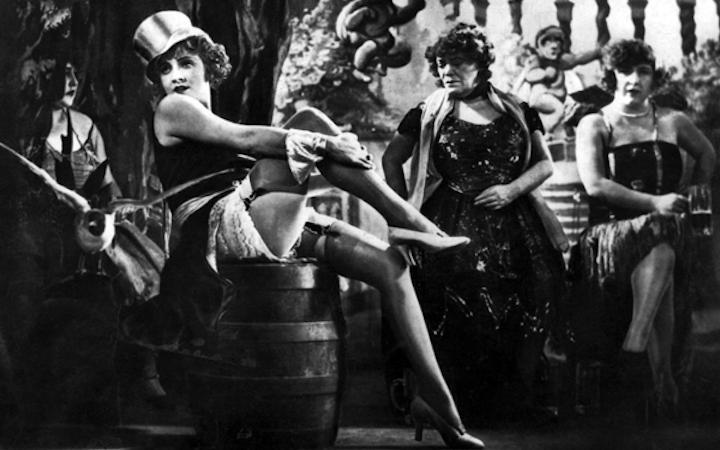
The partnership began between the two in Germany with a film called The Blue Angel, the film that made Dietrich a sensation and introduced the von Sternberg–Dietrich dynamic to the world, though American audiences would not see it right away, as its US release was deliberately delayed by Paramount in favor of their first American film, Morocco. Similar to what the studio had done earlier with Ernst Lubitsch, Paramount brought both director and star from Germany to Hollywood to capitalize on their overseas success, betting that the chemistry that made The Blue Angel a phenomenon could be recreated for American audiences. Morocco was cast specifically as the vehicle to launch Dietrich into American stardom, with the studio building its entire release strategy around introducing this mysterious German import to the American public before they had even seen the film that made her famous. Von Sternberg arrived with enormous creative leverage and an obsessive, singular vision for his star, establishing a dynamic of total control over Dietrich’s image, her lighting, her framing, her costuming, and her every gesture that would define and eventually destroy their partnership over time. Only Paramount was able and willing to help von Sternberg shape his vision of Dietrich, unveiled and mysteriously beautiful, and for roughly five years that gamble produced some of the greatest filmmaking of early Hollywood.
Morocco
69.8/100 - 1930

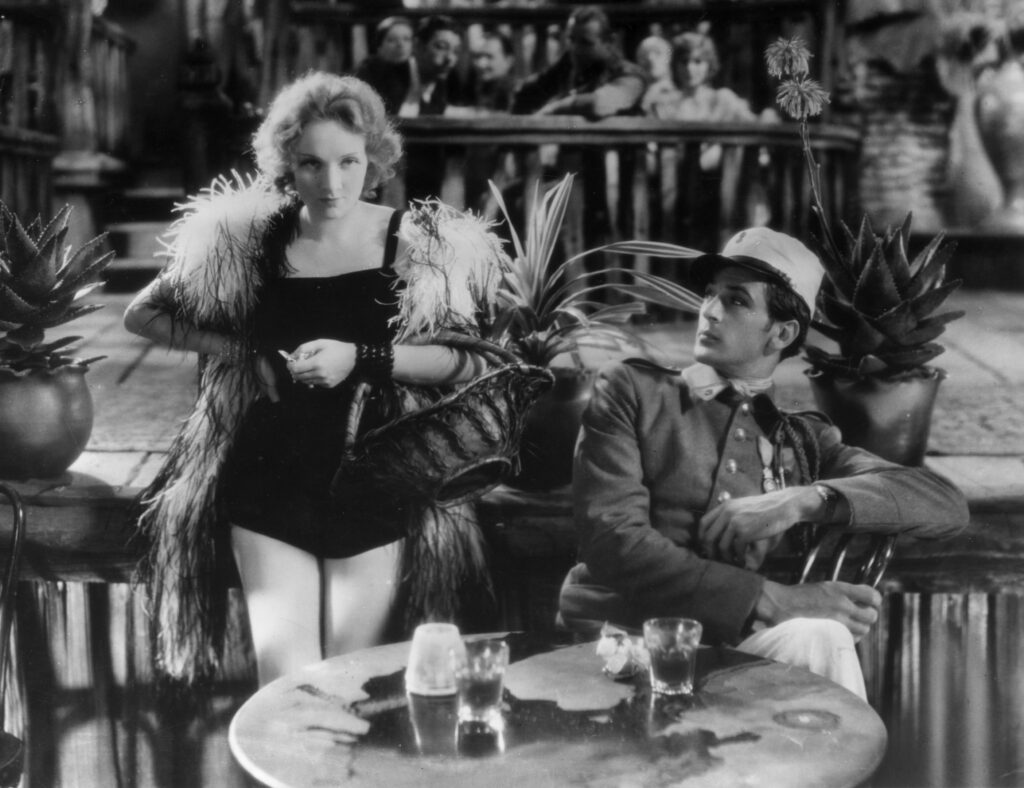
Morocco arrives as a quite generic version of the romance drama, with Gary Cooper playing Legionnaire Tom Brown who takes interest in von Sternberg’s favorite Marlene Dietrich’s cabaret singer Amy Jolly, in a story that rarely rises above its familiar Hollywood romance framework. The film features almost no score at all, relying instead on background conversation to fill its scenes, a choice that stands in stark contrast to Ernst Lubitsch’s work at Paramount during the same era and leaves long stretches feeling noticeably flatter. Von Sternberg’s framing and showing of Deitrich is the clear standout of the entire production, immediately stunning in a way that announces exactly what this partnership would become even when the story around her is thoroughly ordinary. Cooper plays comfortably to his preestablished rugged persona, and while the chemistry between the two leads works, it is Dietrich’s presence rather than the writing that gives the romance the real pull. Morocco succeeds as a launching pad more than a great film in its own right, a serviceable romance elevated entirely by its star and its style, and the essential first chapter of Hollywood’s most famous director-star-collaboration of the time.
The film establishes Amy Jolly performing in front of a large crowd with extreme appeal, immediately catching the eye of Tom Brown and announcing the magnetic screen presence that would define Dietrich’s entire career from this moment forward. Tom is a clear womanizer and Amy attracts every man in the room, setting up a classic opposites-attract dynamic where two people used to being pursued find themselves genuinely pursuing each other for the first time in their lives. Another lieutenant, Caesar, becomes jealous of the budding romance between Amy and Tom, harboring a deeper hatred for Tom after he engaged in an affair with Caesar’s wife, a thread that adds real danger to the courtship beyond simple romantic rivalry. Tom’s journey to war away from Amy causes her a great deal of concern as she realizes the depth of her feelings, running to find him while hoping he is not injured, wounded, or dead, and discovering that he feels exactly the same for her. The film closes on one of early Hollywood’s most striking images, as Tom must join the army once again and Amy abandons safety entirely, joining the women who follow the soldiers into the desert to maintain their love as the film ends.
Morocco was Marlene Dietrich’s first American film, made after her star-making turn in The Blue Angel similar to what it did with Lubitsch and von Sternberg, Paramount intentionally brought her to Hollywood from Germany to capitalize on that success and used Morocco specifically to launch her into American film. Gary Cooper was already established as a leading man throughout the 1920s and the role plays directly to his preestablished rugged persona, giving the film a bankable anchor opposite its unknown import. This is the first of six films in the pairing of von Sternberg and Dietrich together in Hollywood, marking the true beginning of one of the most famous collaborations, with Sternberg’s style, shadows, veils, lighting, creating Dietrich’s screen image from the very first frame. Dietrich’s tuxedo singing performance became instantly famous, with the moment where she kisses another woman standing as an iconic touchstone in gender film discussions, a product of the pre-Hays Code craze that also fed the film’s exotic Orientalist aesthetic typical of early sound-era productions. The film earned four Academy Award nominations, Best Director, Best Actress, Best Cinematography, and Best Art Direction, with Dietrich’s nomination remaining the only one of her entire legendary career, as the film earned a 69/100 from Twilight Room.
Dishonored
75.7/100 - 1931
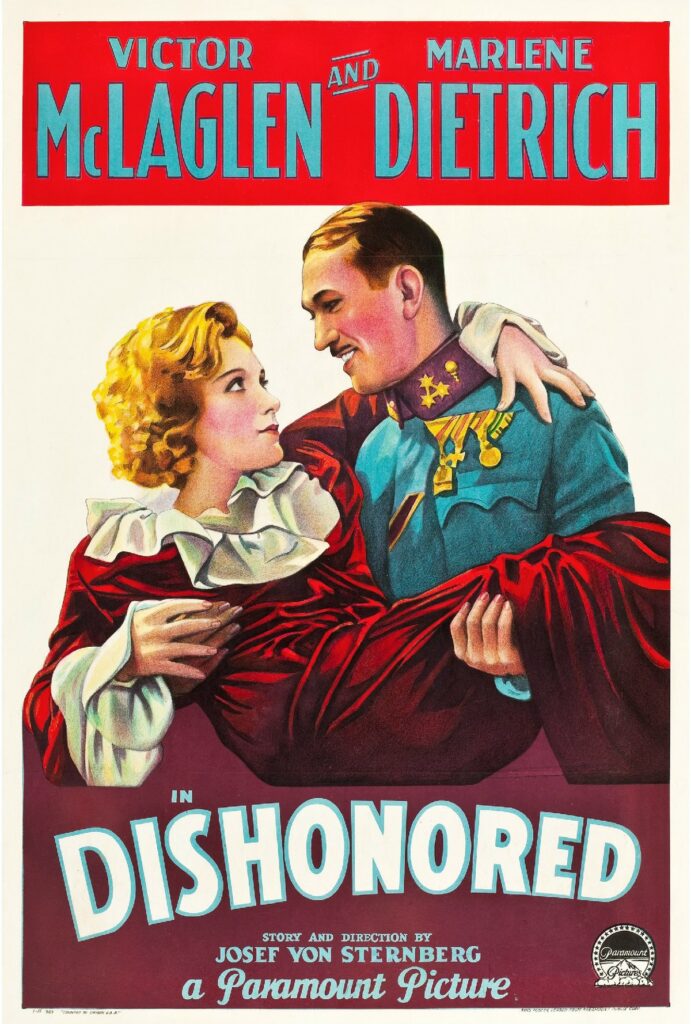

Dishonored gives Dietrich her first truly commanding role of the Hollywood run, playing the great spy X-27 with an intelligence, confidence, and total control that pushes well past the more passive romantic figure of Morocco. The film is very silent-film coded yet again, still using dialogue-free quiet scenes throughout its runtime, making it a fascinating document of the sharp transition between silence and talkies that Hollywood was navigating in real time. This is noticeably a different role for Dietrich than usual, more camp, more playful, and more dangerous and independent, and she carries every scene with a knowing theatricality that anticipates decades of spy fiction to come. The ornate black-and-white camerawork is some of von Sternberg’s finest of the era, with the elaborate masked-ball sequence standing as a clear visual highlight of the collaboration’s early years. Dishonored is generally regarded as the most overlooked entry in the Dietrich/von Sternberg Hollywood run, though modern reviews are positive, and it genuinely deserves far more attention than it has historically received.
Marie is a war widow who witnesses a suicide and is recruited by the secret service to become the spy X-27, Vienna sending its great new operative to Russia where she is unexpectedly tested by Colonel Kranau. She is sent in as an attractive female spy to expose Colonel von Hindau, a suspected traitor, beginning her mission by meeting Hindau directly and proving her abilities by revealing the truth and catching him in an impressive first operation. She moves on to her next target now quite confident, with the film establishing X-27 as a genuinely brilliant operative rather than simply a seductress, her intelligence always operating a step ahead of the men around her. Her next mission is Colonel Kranau himself, which goes sideways when he discovers her identity, and the two begin flirting well beyond their spy purposes, blurring the line between the mission and something genuinely felt on both sides. In the fray it seems like Marie is turning him in, but she ends up helping him escape as the two kiss before he leaves, and for this decision Marie is sentenced to death, sacrificing her life for Kranau, dressing in a beautiful gown for her execution and guilting the executioners into seeing her humanity as one declines to kill her, showing yet again her intelligent use of her beauty before the film ends in her death.
The film is a pre code Paramount espionage romance loosely based on Mata Hari but relocated to von Sternberg’s home city of Vienne during World War I, giving the familiar spy template a personal geography for its director. It’s the second in the collaboration, rushed into production by Paramount to immediately capitalize on the success of Morocco, with von Sternberg wielding totally creative control now, writing the screenplay, directing, and scoring the film itself. Gary Cooper, the male lead of Morocco was again offered the part for the male role but turned it down, reportedly because of his unwillingness to work with von Sternberg again rather than anything to do with Dietrich, highlighting one of the first cracks, and was replaced by Victor McLaglen in what is widely considered to be a gigantic miscast. Further, MGM released a competing film, Mata Hari starring Greta Garbo in the same period, formally kicking off the famous rivalry between Garbo and Dietrich that would define much of the era’s star discourse and female lead role hierarchy. No major awards attached themselves to the film, but it remains known for its final execution scene, one of the most memorable death scenes in all of von Sternberg’s career and their time in Hollywood, and for the ornate camerawork and camp register that makes it the run’s great hidden gem, earning a 75/100 from TwilightRoom.
Shanghai Express
83.4/100 -1932


Shanghai Express pivots the film as a romance into a more thriller political-oriented setting, a Hitchcockian train film that brings far more intrigue than the first two collaborations combined, in our opinion. The film features the best example of quick-paced early Hollywood dialogue yet, snapping between characters with an energy and wit that neither Morocco nor Dishonored ever approached. Von Sternberg clearly focuses on Dietrich’s lighting and shadow imagery more than anything else in these films, and here that obsession reaches its most refined form, building a landmark of shadow use, smoke, and light entirely around his star actress. The contained train setting gives the film a propulsive structure the earlier collaborations lacked, with the civil war backdrop, keeping genuine danger pressed against every conversation. Shanghai Express stands as the most accessible and definitely the most famous Dietrich/von Sternberg film, the commercial and creative peak of the entire partnership and the entry where everything the collaboration promised finally arrives at once.
A woman by the name of Shanghai Lily, dressed in lavish clothes and carrying a clear reputation, boards a train in a hurry, giving Dietrich perhaps the most iconic entrance of her entire career. Shanghai Lily and Doc Harvey have history, with her aimless, reckless life traced directly back to Doc leaving her years prior, and there is visible contempt and tension between the two from their very first scene together on the train. The film takes place in civil-war-torn China, leaving the passengers in danger throughout the entire journey and transforming what begins as a romantic reunion story into a genuine survival thriller with stakes that never let up. After Doc Harvey is taken prisoner due to her interference by Chang, revealed to be a rebel leader, Shanghai Lily becomes desperate to save him, deciding to sacrifice her own reckless lifestyle to do so — still in love with him while doubting Harvey is still in love with her. After escaping the train, the two remain together, closing the film on a hard-won reunion that the entire journey has genuinely earned.
Shanghai Express marks the commercial peak of Sternberg and Dietrich’s collaboration, the third of the six films together and the highest grossing film of 1932, a favorite of many, with total creative control achieved by the director at the height of his powers in the industry. Anna May Wong’s role as Hui Fei is one of the most complex roles given to an Asian woman in Hollywood at the time, with critics citing the film’s surprisingly progressive dynamic between her and Deitrich’s role. The film was nominated again for three Academy Awards, Best Picture and Best Director among them, but winning for Best Cinematography, although the award going to Lee Garmes prompted real controversy and commentary as to whether it should have gone to von Sternberg himself, a quite egotistical claim by the director which had become the norm by this time, but also a claim that was heavily defended by Dietrich herself who always took her director’s side. The film is frequently discussed within Hollywood’s Orientalist tendencies, with its lead villain played by a Swedish-American actor in Yellowface and China treated as an exotic backdrop rather than a real lived in location, yet it also portrays many of its white characters as flawed and racist, making ita genuinely interesting film in early Hollywood precedence and study. It is listed as one of the best films ever to not win Best Picture and stands as the most accessible of the collaboration and the most notable, a landmark of shadow use, smoke, and light built around the star actress, and our personal second favorite of the films earning an 83/100 from TwilightRoom.
Blonde Venus
86.9/100 - 1932
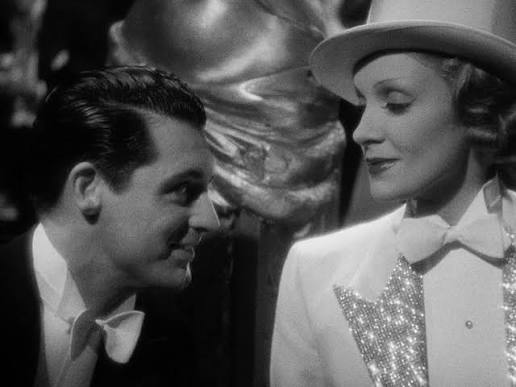
Blonde Venus is certainly a detour for von Sternberg, and a very intelligently taken one, blending the partnership into a new type of story entirely and emerging as the most polarizing — but, for us, the strongest film he ever made. That is a hot take by most standards, yet the film gives Dietrich a more vulnerable and emotionally complex character than anything we have seen before, delivering one of the most fully realized women and performances of her career and one that genuinely blew us away. Blonde Venus continues the trend of huge center-stage performances for von Sternberg–written Dietrich characters, but this time with genuine emotional stakes beneath the spectacle rather than pure style carrying the weight. Cary Grant’s presence adds yet another new dynamic to the formula, his easy charm playing against Dietrich’s guardedness in a way none of her previous co-stars were able to manage. While critical assessment has been divided for decades since its release, Blonde Venus stands as a personal favorite and one of the best performances of all time, the moment where the partnership’s style finally fuses with real feeling before the collaboration begins to decline.
Dietrich plays Helen Faraday, also known as Helen Jones, who tries to make money as a cabaret performer — the “Blonde Venus” — to pay for treatment for her ill husband, setting up the film’s central tension between duty and desire from its opening act. She attracts the attention of a man in the crowd, Cary Grant’s Nick Townsend, who falls in love with “Helen,” leaving her deeply conflicted by her motivations and the pull of her new lifestyle. When she reveals how she got the money to save her husband’s life, he responds harshly and threatens to take her child away, breaking her stone-cold and creating a rift that makes her keener on Nick than ever before. Helen takes her child and goes on the run, leaving both lives behind for her son in a stretch that transforms the film from backstage melodrama into something closer to a fugitive road picture. After giving her son up, believing she is unfit to be a mother, Nick finds her and helps her regain the confidence to return to her family and be present in her son’s life again, closing the film on reconciliation rather than punishment.
Blonde Venus is the fourth film in the collaboration and by far the most emotionally complex, with the story originally written by Dietrich herself, a detail that reframes the entire project as something closer to self-portrait. The film features Cary Grant’s earliest significant Hollywood role; he was selling men’s shirts as a side job on the Paramount lot when this film gave him his first co-star billing, launching one of the great careers in film history. The Hays Office intervened multiple times and caused reshoots during production, forbidding any explicit affair or direct prostitution for Dietrich’s character, and the film was never re-released by Paramount because of von Sternberg’s own distaste for the work, despite it being one of his most brilliant films. Its very strange musical centerpiece is famous for many reasons: Dietrich emerges from inside a gorilla costume and launches into “Hot Voodoo,” a moment that is extremely iconic but equally problematic, where von Sternberg’s baroque visual style reaches an outlandish peak. A massive commercial disappointment on release, the film marked the start of a slow decline for the director despite how strong it truly is, and his partnership with Paramount began to sour. Critical assessment has been divided ever since, although it remains a personal favorite, showcasing a more vulnerable Dietrich and now cited as a film made directly in the shadow of the Hays Code rulings and a key text in feminist film studies, earning an 86/100 from TwilightRoom, the highest-rated entry in the run.
The Scarlet Empress
81.4/100 - 1934
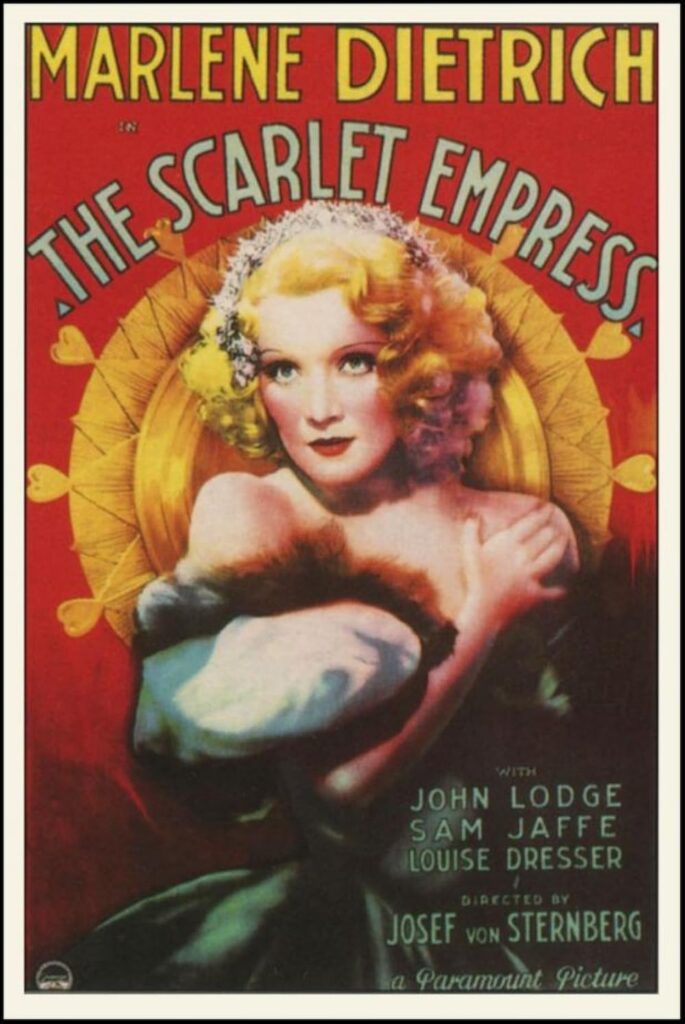
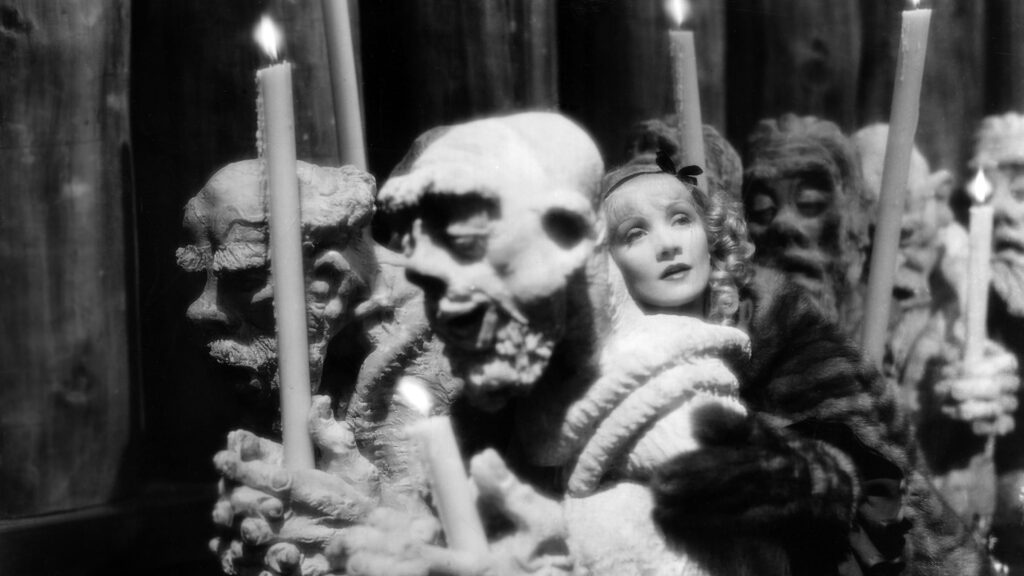
The Scarlet Empress is von Sternberg’s journey into a more historical type of film, and the most visually extreme entry of the entire collaboration, a relentless excursion into pure style that plays like nothing else Hollywood was producing at the time. The film operates on a much wider scale than anything before it, with ensemble shots, B-roll, long text screens, and a far more intense score than any previous entry in the partnership. Dietrich delivers her most adventurous, distinct, and craziest performance yet, a career best, supported once again by great use of shadow and lighting from a director operating at his most unrestrained. The film uses very minimal dialogue throughout, letting its imagery carry nearly everything, a choice that makes it as demanding as it is hypnotic to sit with. While Lubitsch remained in rom-com territory at Paramount, Sternberg explored a drama-history approach no one else in Hollywood was attempting, and the sheer audacity of the result makes it one of the collaboration’s essential films.
Dietrich plays Catherine, a curious young woman born into corrupt, unfaithful royalty and forced into marriage with a royal halfwit in an arrangement she has no power to refuse. The marriage is depicted as Catherine’s first step toward becoming Russia’s most sinister empress, with the film charting her transformation from wide-eyed innocent into calculating ruler across its runtime. The film’s expressionist sets, grotesque statuary, and endless shadows externalize Catherine’s corruption at every turn, telling her transformation almost entirely through visuals rather than conventional dialogue-driven storytelling. After her husband becomes ruler, she moves to dethrone him, completing her evolution into the Scarlet Empress of the title in a final act that plays as both triumph and damnation simultaneously. Dietrich’s shifting performance, from girlish curiosity to imperial cruelty, carries the entire arc and marks the most complete character transformation of any film in the collaboration.
The Scarlet Empress is the penultimate film of the partnership and was made as the two’s relationship deteriorated, with Paramount growing more frustrated with von Sternberg’s failures and need for control; Ernst Lubitsch, then heading production at the studio, granted him control for this film, but it would functionally be the last time he ever received it. The film is very explicit in suggesting out-of-wedlock sex, military orgies, and exotic palace scenes, using the “historical drama” label as a shield against the Hays Code. It was a commercial disaster made during the depths of the Great Depression, and it took three decades of defending from critics for the film to be fully given a second chance — it now sits as one of von Sternberg’s highest rated films. Von Sternberg cast Dietrich’s young daughter in the film, an odd but telling choice, as the daughter plays a younger version of her mother’s character, making the film double as a sort of monument to Dietrich herself. The film stands as the most visually extreme work of the collaboration, a relentless excursion into style that represents both the artistic peak of von Sternberg’s obsession and the commercial breaking point of his relationship with Paramount, yet still earning an 81/100 from TwilightRoom.
The Devil is a Woman
67.9/100 - 1935
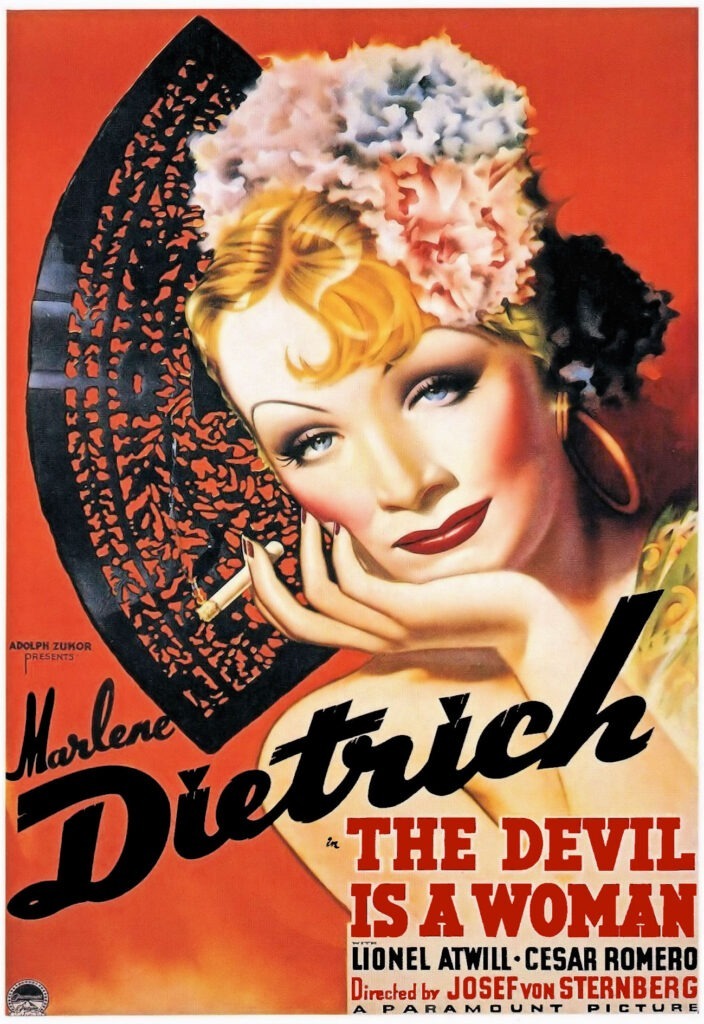
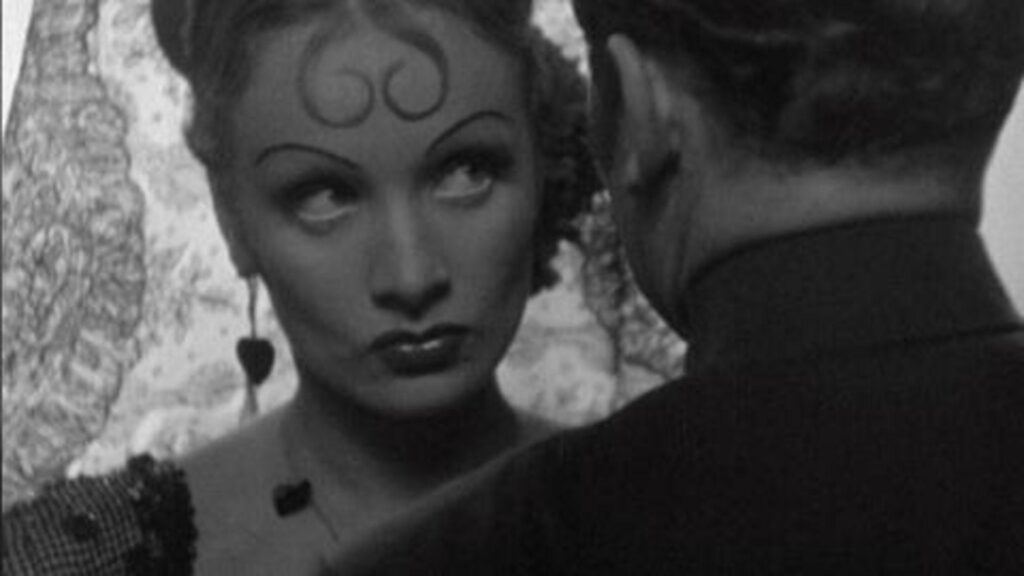
The Devil Is a Woman is the final collaboration between Dietrich and von Sternberg, set during carnival in turn-of-the-century Seville, and stands as von Sternberg’s most cynical portrayal of romance ever put to film. The film is widely acknowledged as the last and most unpopular entry in the collaboration, yet Dietrich herself claimed it as her personal favorite of everything they made together, a contradiction that defines its strange and fascinating legacy. This is the most divisive and least accessible film in the run, demanding real patience from its audience while offering little of the warmth or momentum of Shanghai Express or Blonde Venus. Many have read the film as a direct reflection of von Sternberg’s own obsession with Dietrich, a reading never confirmed by the director but nearly impossible to ignore when watching it now, nearly a century removed. Whatever its flaws as pure entertainment, it is certainly the most historically rich film of the collaboration, and as a final statement on the partnership it is devastating in ways no other ending could have been.
Dietrich plays Concha Perez, whose treatment of an older military officer is told in flashbacks as a warning to a younger man falling under her spell. The flashback structure turns the film into a cautionary tale about romantic obsession, an older man recounting his own destruction at the hands of a woman he could never truly possess. Concha is Dietrich at her most cruel and controlling, weaponizing beauty and indifference in a register that plays as the dark, bitter endpoint of every character von Sternberg ever wrote for her across the entire collaboration. The carnival setting drapes the story in masks, streamers, and celebration, making the emotional brutality underneath land even harder against the festive surface surrounding it. Read against the collaboration itself, the film becomes almost uncomfortably autobiographical, a director telling the story of a man destroyed by his devotion to a woman who never needed him back, and releasing it as his final film with that very woman.
Von Sternberg called off the partnership around the film, calling it a commercial negative and formally ending the most famous director–star collaboration of early Hollywood on his own terms, or at least framing it that way in the years since. The Spanish government issued a formal protest to the United States over the film’s unfavorable portrayal of the Civil Guard, leading Paramount to withdraw the film from circulation and privately burn the master print. Dietrich, however, secretly kept her own copy in a vault because it was her favorite, one of the great acts of star-driven film preservation in Hollywood history. After winning an award at the Venice Film Festival in 1935, von Sternberg brought his own personal copy, long thought to be destroyed, back to the festival in 1959, leading to a re-release in 1961 that saved the film for future generations. A commercial failure on release but defended by a growing number of critics ever since, The Devil Is a Woman endures as the most divisive, least accessible, and most historically fascinating film of the entire run, the collaboration ending not with a triumph but with a confession, earning a 67/100 from TwilightRoom.
The Rise and Fall
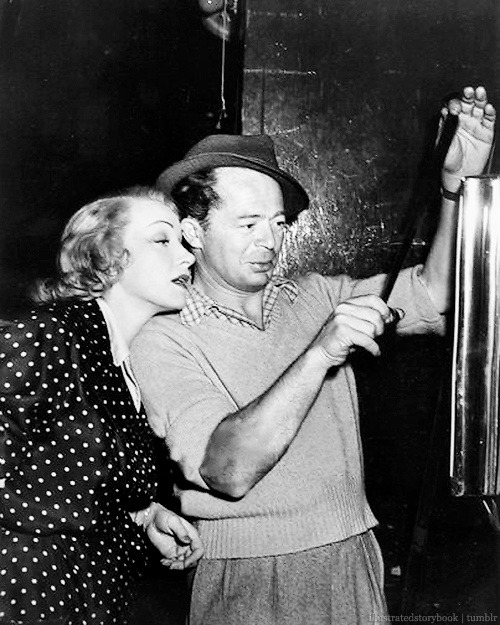
By the end of the collaboration there was simply too much power held by the director over the legendary actress, actively holding her back; von Sternberg was the original micromanager, his arrogance legendary, refusing to give credit to any writers or influences aside from his obsession with Marlene Dietrich. That refusal obscured the genuinely talented individuals he needed to realize his creations, figures like set designer Hans Dreier, a German architect and expressionist-trained art director who became head of Paramount’s design department and crafted the dense, reality-warping sets for many von Sternberg films, collaborators whose work has been swept under the rug of von Sternberg’s career and needs to be far more widely credited. Dietrich, meanwhile, had been fully transformed by the run: von Sternberg was the only man who could photograph her correctly, making her beauty blatant, and she often starred in the most romantic films of the era where the true romance was never really with her co-stars but between her and the camera, likely why rumors of a deeper connection between the two arose in the first place.
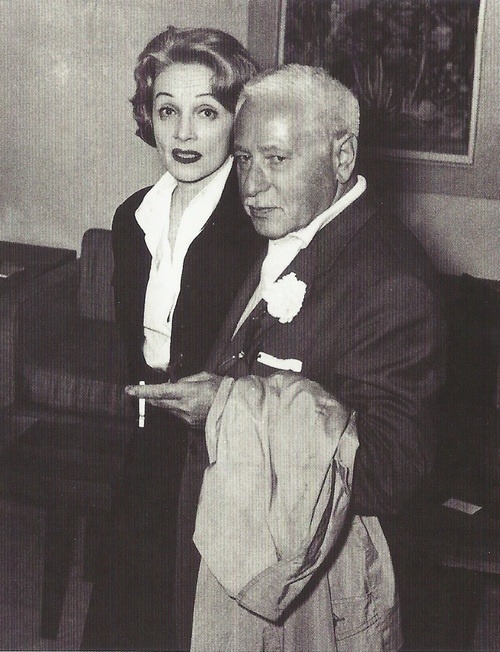
After the shot with von Sternberg that immortalized her, Dietrich went on to work with some of the most legendary directors of all time on some of their best films, including Ernst Lubitsch, Orson Welles, Billy Wilder, Alfred Hitchcock, and Fritz Lang, able to transform her roles across her career; her singing performances remained highlights well into works like Wilder’s A Foreign Affair (1948) and laid groundwork for later collaborations such as Welles’s Touch of Evil (1958). Von Sternberg would go on to make a few more films, including a Crime and Punishment adaptation with Peter Lorre and a return to Shanghai with 1941’s The Shanghai Gesture, plus a couple of films in the 1950s, but he never again approached the critical or commercial success he had with Dietrich; although Dietrich remained very complimentary of him for the rest of her life, von Sternberg’s career never recovered, embodying the rise-and-fall arc named in this article’s title.
Conclusion
The six Hollywood films of the Dietrich/von Sternberg collaboration chart one of cinema’s great creative arcs, from the generic romance of Morocco through the espionage camp of Dishonored, the thriller peak of Shanghai Express, the emotional height of Blonde Venus, the visual extremity of The Scarlet Empress, and finally the bitter, self-immolating farewell of The Devil Is a Woman. The title of this article is the story the films themselves tell: the same obsessive control that built Marlene Dietrich into an immortal icon consumed the man who built her, with her rise and his fall inseparable from one another across that exact same stretch of years. Von Sternberg created not just a style but Dietrich’s very own art, and the shadow, smoke, veils, and light of these six films remain a permanent blueprint for how a camera can love a face and how a director–star partnership can define both careers forever. The films themselves range from generic to masterful, from commercial smashes to burned master prints, and it is exactly those contradictions — creative, personal, and historical — that keep the entire run endlessly worth revisiting nearly a century later. Taken together, the Dietrich/von Sternberg run stands as early Hollywood’s best collaboration, a partnership that gave cinema one of its greatest stars, cost it one of its greatest stylists, and left behind six films that tell the whole story of both.