Jim Jarmusch’s Dead Man is a haunting and perhaps metaphorical western from the 90s, whose slow narrative is elevated by its sound design, philosophical undertones, and atmospheric filmmaking.
It’s a film that is intentional in its rejection of the traditional energy and narrative of the genre, as it stands on its own as unique as it is perceptive. The famous Ghost Dog director takes the genre of Western that included the heroic gunfights and frontier adventures and leaves it all behind, in favor of a commentary of death, isolation, and existential wandering equally present in the West. The story follows one of the best Johnny Depp performances as William Blake, a quiet and reserved accountant who has traveled west for a job offer. A character seemingly representing the simplicity of the Western Film, only to be denied the job and slowly transform into an outlaw that may be more of a representative of death than a living man. With the film’s star cinematography, slow moving pace, and hypnotic soundscapes made by Neil Young, the film attempts to separate the idea of the Old West from the more nuanced modern world that comes after it. Jim Jarmusch’s Dead Man is a haunting and perhaps metaphorical western from the 90s, whose slow narrative is elevated by its sound design, philosophical undertones, atmospheric filmmaking.
Dead Man immediately establishes a harsh western world that is as unique as it is real to the time, through its landscape but more its sound which is relied heavily upon to set the mood for the film. Further, its use of cinematography is its greatest aspect yet its not used for the action of the film or a gunfight, it’s used to further the atmosphere of the world created by Jarmusch, its emphasizing dirt-sleazy towns, decay, and the bleakness of death mixed with the Frontier Life never fully explored. The setting presents the West not as the heroic mythology it usually is shown as, but as a violent and morally empty terrain that feels almost spiritual as William Blake moves deeper into the wilderness, with his new companion Nobody.
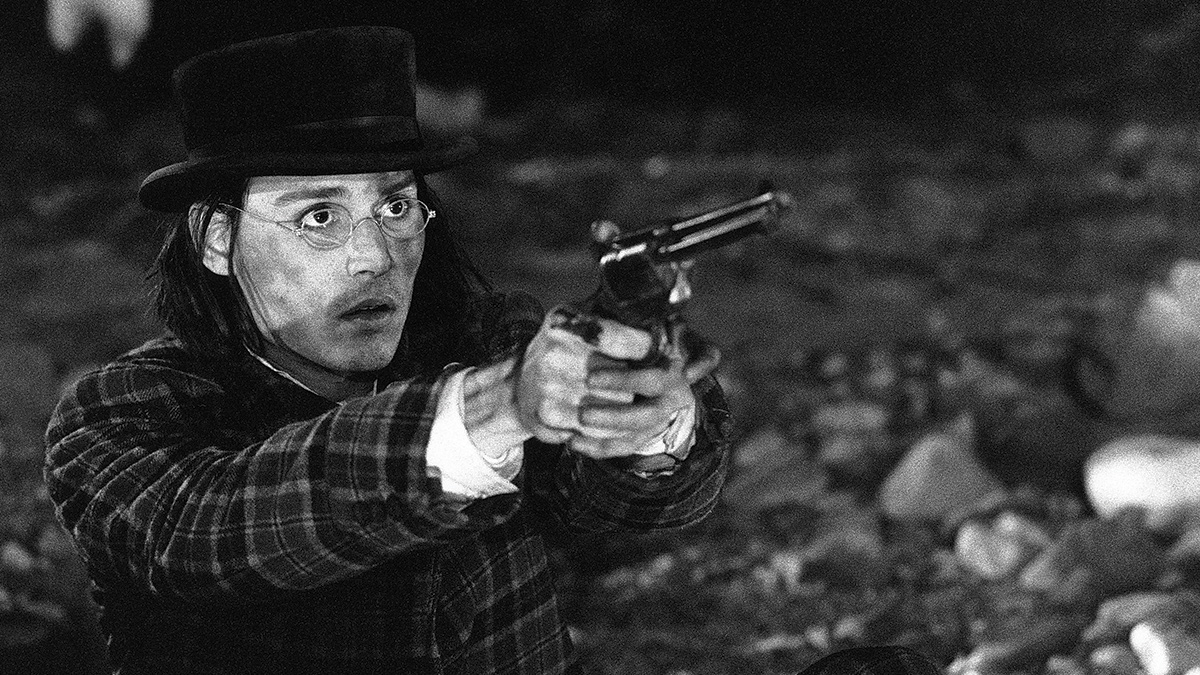
William Blake begins the film as a passive outsider traveling west for work, a plot point that sets up his character for the rest of the film as something metaphorical for both the Western genre and the concept of death itself. After becoming tangled with a woman who has a husband the young man enters the crime riddled towns vibe by shooting the husband in a frenzy after their affair is revealed. It’s a retaliation to seeing the women who had comforted him after his job denial be shot as well, and becomes the turning point of the narrative. The film now places Blake on the run as he escapes into the nature of the wilderness avoiding bounty hunters searching for him, with the help of a native man named Nobody. As his condition worsens from a wound obtained in the scuffle his journey becomes a transformation from ordinary man into hardened outlaw and the film begins to feel more and more dream-like as the chase continues. The wilderness strips Blake from all of his values and former identity as the man once shown at the beginning of the film slowly slips away until the final shot. Dead Man is a simple tale of a simple man turned outlaw on its surface, and many likely took it that way; however, a question has arisen from audiences as to whether this chase, is a fleeting memory as Blake dies or an actuality.
Perhaps the biggest story from the typical Western Jarmusch takes in Dead Man is how his film treats violence as more spiritual and existential rather than heroic. William Blake is not a hero of his own story, in fact he may not even be alive for it, he becomes increasingly hardened after he murders, moving through a natural world without a clear goal aside from staying alive. By the end of the journey he has killed multiple men and becomes the outlaw that the frontier creates in its stories, its an origin of the hardened frontier presented at the beginning of the film. Dead Man focuses on the isolation of the frontier, the harshness of the land and the psychological weight of survival in the time period; characteristics that make the film exceptional beyond its unique cinematographic style.
Perhaps one of the most unique elements aside from the film’s genre switch is its beautifully created guitar score from Neil Young that spans the entirety of the film. Young was asked by Jarmusch to make the soundtrack and decided to turn on the film without sound on multiple screens around him in a trailer parked outside, something that sounds as wild as it makes sense when you hear the guitar in the film. It’s a raw and improvised electric guitar score that feels so necessary when the alternatives could have been something unnatural to what Dead Man represented. The music Neil Young makes fills the gaps of the dialogue silence that is eerily present between Blake and Nobody for most of the film, in a way that doesn’t retract from the silence intended. It’s a sound that becomes a character of its own, that emphasizes the loneliness and tension of the film, Young’s music transforms quiet scenes into emotional landscapes, elevating the film and allowing minimal dialogue to carry enormous weight.
One of the most fascinating characters that appears in Dead Man is Nobody, the Native American man who becomes Blake’s unlikely companion throughout the second half of the film. Nobody acts almost as a spiritual guide for Blake as the journey continues deeper into the wilderness. He believes that Blake may actually be the reincarnation of the famous poet William Blake, adding a mystical and philosophical layer to a film that already exists in a dreamlike space. Through Nobody’s perspective the story becomes something far more existential than a simple outlaw chase. At one point he explains Blake’s visions after the killings and suggests that “Nobody is his friend,” a statement that works both literally and metaphorically. Blake is becoming completely isolated from society, drifting further away from the world he once belonged to and further into a spiritual journey that begins to feel more like a slow march toward death than a simple escape.
Because of this philosophical lens, Dead Man often feels less concerned with plot than atmosphere. The narrative moves slowly and quietly, something that may challenge viewers expecting a traditional western story. However, Jarmusch replaces conventional storytelling with mood and texture. The black and white cinematography, the haunting Neil Young guitar score, and the long stretches of silence create a hypnotic tone that makes the film feel almost dreamlike. Rather than pushing the story forward through action, the film allows these elements to shape the emotional experience of Blake’s journey.
In the end Dead Man stands as one of the most unconventional westerns of the modern era. Jarmusch strips the genre of its usual spectacle and instead crafts a quiet meditation on death, identity, and isolation. Through its striking imagery, hypnotic music, and philosophical storytelling, the film transforms the western landscape into something haunting and reflective. It may not follow the traditional rules of the genre, but that willingness to break away is exactly what makes Dead Man such a unique and memorable film.
Twilight Room Score: 86.2/100