For this week’s Criterion Tuesday, the TwilightRoom is reviewing John Huston’s magnum opus, the 1987 Irish family drama, The Dead.
The film is a classically structured and simple dialogue-driven film built around a family gathering in Ireland, which slowly moves into one of the most fantastic and philosophical commentaries on love, reflection, and insignificance in the history of film. It’s a film that solely operates through conversation, performance, and subtly emotional shifts portrayed by the pure and delicate performances of

its actors, presenting itself as more of a play-like experience, that emphasizes language and atmosphere over action itself. Huston’s The Dead is a beautifully constructed, dialogue-rich film that captures the quiet weight of reflection, love, and insignificance, culminating in one of the most powerful and understated cinematic endings in film history.
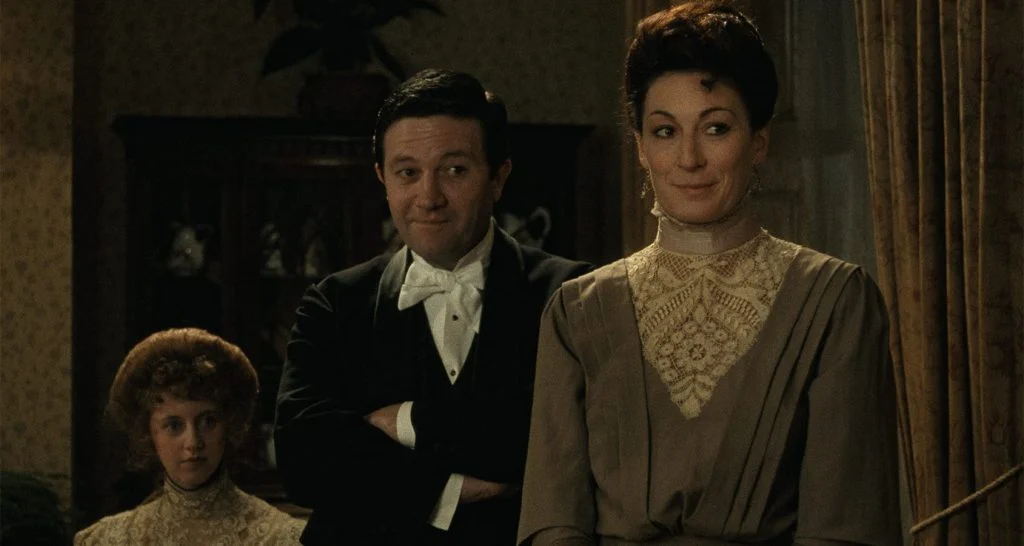
The story itself takes place in the snowy night backdrop of 1904 as an Irish family gathers for a family dinner that involves all the familial drama one would expect. Gabriel and Gretta Conroy serve as the central couple of the film, as they navigate the social dynamics of the evening surrounding them as the gathering progresses. The night is littered with artistic performances, strong speeches, and typical conversations that slowly but surely reveal the underlying tensions. The environment of the evening is shaped by polite interactions with proper etiquette at every turn yet filled with backhanded compliments and class-driven dialogue, that is so eloquently written by the director’s son Tony Huston, all the way through the film.
This Dialogue is the single driver for almost the entirety of the film, with its quick, sharp, and well composed language that is structured in an extremely classical style, resembling those of a staged play’s lines, both in pacing and design, yet seemingly fits perfectly into the cinematic format of the film. The full dinner and toast sequence act as the central backbone for the film alongside this dialogue, as the writing elevated the simplicity of the setting into something that is much more layered and meaningful than one would expect.
As the dinner comes to an end, Gretta becomes severely emotionally shaken after hearing a specific song performed at the end of the gathering as the couple sets to leave. The moment is revealed to have brought the memory of her past connection to a former lover Michael, back into the forefront of her mind. Michael’s death occurred as he waited for her in the snow, similar to the night the film is set, adding a tragic and real emotional weight to the story that takes the memory of the past and turned it into the present and current moment of the story. This revelation creates a clear emotional divide between Gretta and Gabriel that become the kicker for the last act of the film but also the real importance of Huston’s work. Gabriel begins to reflect on his own life and his place within his own wife’s emotional world. As the film moves to its end he reveals that his presence may be more insignificant compared to the depth of her past love, shifting the film from a social observation of the early 1900s Irish into a deeply interactive and philosophical conflict and reflection through Gabriel’s character. It’s the emotional core of the final act of the film that leads into its final sequence as the film concludes with Gabriel’s voice over reflection on life live and mortality. A snow background setting across Ireland visually ties together all of the film’s established themes allowing the snow to symbolize a connection between the living and the dead. It’s an ending that delivers a quiet but overwhelming emotional impact on its audience as it leaves you with more thoughts than you began with.
The film overall is strong in its use of classical music as a score that enhances the emotional tone of the film fitting perfectly with the narrative. It contains many great and simple performances that stand out in the final moments of the party and through Gabriel and Gretta’s emotional realizations. The film’s restraint in its storytelling allows its themes to feel as natural and impactful as they can be, making the subtle, atmospheric nature of the film give a lasting impression on the audience in the way it was fully intended.
The film does however struggle on its reliance of a full dialogue-based script that can make it feel quite slow at times, relying on the audiences’ full educated attention. Its lack of traditional narrative movement may disengage some viewers before the true nature of the film is revealed, making the conversation-heavy structure lose its audience before they are able to fully put the pieces together.
Overall the film fully functions as a meditation on life and mortality as one of the best in that aspect I have ever seen. It explores how the past continues to shape the present identity and relationships with the quiet nature of the film, leaving space for an audience to linger in the emotional weight and balance their own concepts with those presented to them. Its themes last long after the film ends, which is a testament to the film’s spectacular writing, play-like performances and emotional depth. The film moves towards a final realization that reframes everything to come before it, no matter how subtle. It’s a profound exploration of human connection and mortality that delivers one of the most understated yet powerful endings in cinema, cementing itself as one of the Criterion Collection’s best pure dramas and earning its an 89/100 from the Twilight Room.
Twilight Room Score: 89.3/100